

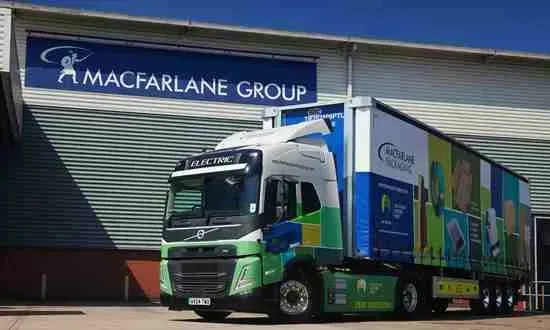
Macfarlane Group, a significant player in the packaging sector, has released its 2025 financial results, painting a complex picture of resilience in top-line growth juxtaposed with substantial profit erosion driven by a challenging macroeconomic environment and specific operational setbacks. Despite recording an 11% uplift in overall revenue, surging to £300.8 million from £270.4 million in 2024, the company’s profitability metrics experienced a sharp contraction. Operating profit plummeted to £12.5 million, a stark contrast to the £23.6 million achieved the previous year. Furthermore, adjusted operating profit saw a significant 28% decrease, settling at £19.7 million compared to £27.4 million in 2024, signaling intense margin pressure across key business segments.
The financial disclosure highlights the dual nature of the company’s performance across its primary divisions: Packaging Distribution and Manufacturing Operations. The Packaging Distribution segment, the larger revenue generator, demonstrated relative stability in sales, posting revenues of £229.2 million, a marginal increase from £228.8 million in 2024. However, this segment bore the brunt of the profitability decline. Its adjusted operating profit collapsed to £11.4 million, a substantial fall from £20.2 million in the preceding year. This steep drop in profitability within the core distribution arm underscores the pervasive headwinds impacting customer demand and pricing power.
Conversely, the Manufacturing Operations division showcased robust top-line expansion, with revenues jumping to £78.5 million from £47.5 million in 2024. This growth was partially fueled by the integration of recent acquisitions, although the statement notes the tragic incident at the newly acquired Pitreavie Group facility. Encouragingly, Manufacturing Operations managed to improve its profitability, achieving an adjusted operating profit of £8.3 million, up from £7.2 million the prior year, indicating successful cost management or favorable product mix shifts within that part of the business despite the difficult context.
The Shadow of Economic Uncertainty and Cost Inflation
The Chair’s statement provided a candid assessment of the year, acknowledging 2025 as "a difficult year for the Group." While revenue growth was celebrated, the fact that the resulting profit, though below 2024 levels, aligned with revised market expectations suggests that the extent of the downturn was largely anticipated by analysts following interim updates.
The primary culprits cited for the profit squeeze were multifaceted. The company contended with significant "economic headwinds and uncertainty," which translated directly into a "particularly competitive trading environment." In such conditions, customers, particularly those in retail supply chains, exhibited cautious purchasing behavior, leading to weaker-than-expected demand and prolonged decision-making cycles for new business opportunities. Crucially, this competitive intensity exerted downward pressure on gross margins as clients aggressively sought lower prices.
Simultaneously, Macfarlane faced an undeniable surge in operational expenditures. The statement pointed to "material increases in operating costs," which Chief Executive Peter Atkinson later specified included the impact of changes in National Insurance contributions and the implementation of Extended Producer Responsibility (EPR) fees levied by retail clients. These mandated cost increases eroded the bottom line directly, as the ability to fully pass them onto customers was constrained by the hyper-competitive market.
Impact of Operational Incidents and Strategic Investments
Beyond the broader economic narrative, Macfarlane Group had to contend with a profound internal tragedy. The Chair expressed deep sorrow over the loss of a colleague in a fatal incident at the corrugate manufacturing facility of The Pitreavie Group Limited, which had been acquired earlier in 2025. This event, which remains under official investigation, cast a shadow over the year’s operational performance and necessitated a focus on support and well-being for affected parties, an unavoidable drain on management time and resources.
Focusing on the specific challenges within Packaging Distribution, the management commentary elaborated on the factors driving the profit decline. Weak demand, delayed contract awards, margin pressure, and rising input costs—specifically labor and property-related expenses—created a toxic cocktail for this division. Despite these pressures, the company confirmed it continued strategic investment in its infrastructure, specifically mentioning efforts to "strengthen its management and sales teams," indicating a commitment to future competitiveness even during a period of retrenchment.
CEO’s Perspective on Margin Erosion
In an interview with Packaging News, Chief Executive Peter Atkinson provided further color on the financial outcomes, emphasizing the dual impact of external fiscal policy and client behavior. Atkinson highlighted the dual burden: mandatory cost inflation stemming from governmental policies (like NI changes) and EPR levies imposed by major retail partners, which immediately impacted the cost base.
"Uncertainty in the economy was driving clients to buy less, and drive lower prices, hitting profitability," Atkinson stated, confirming that the market dynamic favored buyers, forcing Macfarlane to absorb significant cost increases rather than passing them entirely down the supply chain. This dynamic is particularly damaging for distribution businesses where volume efficiencies are critical to maintaining healthy margins.
Manufacturing Strength Offsets Distribution Woes
The performance divergence between the two divisions is telling. The significant revenue surge in Manufacturing Operations, which saw its sales rise by over 65% year-on-year (£78.5m vs. £47.5m), suggests successful integration of acquired assets and strong demand in specific manufacturing niches, possibly benefiting from supply chain reconfiguration or specialized product offerings that allowed for better pricing control. The corresponding 15% growth in adjusted operating profit within this division provided a crucial buffer against the steep profit decline experienced in the distribution arm.
Outlook and Strategic Focus
Looking forward, Macfarlane Group faces the immediate challenge of navigating persistent inflation and subdued demand until broader economic sentiment improves. The Chair’s statement, while somber regarding the past year’s performance, implicitly frames the current results as a necessary navigation through an extraordinary confluence of negative factors—economic contraction, cost inflation, and an isolated operational tragedy.
The company’s strategy will likely pivot towards aggressively managing the cost base within Packaging Distribution, seeking efficiencies to counteract the intense margin compression, while simultaneously leveraging the growth momentum seen in its Manufacturing Operations. Success in 2026 will hinge on Macfarlane’s ability to demonstrate pricing resilience in the distribution sector and integrate its recent manufacturing acquisitions smoothly, ensuring the investment translates into sustainable, high-margin growth rather than simply volume expansion that underperforms against cost inflation. The market will be watching closely to see how quickly the company can stabilize profitability as it absorbs the full financial impact of its recent strategic expansion amidst a stubbornly difficult trading landscape.