
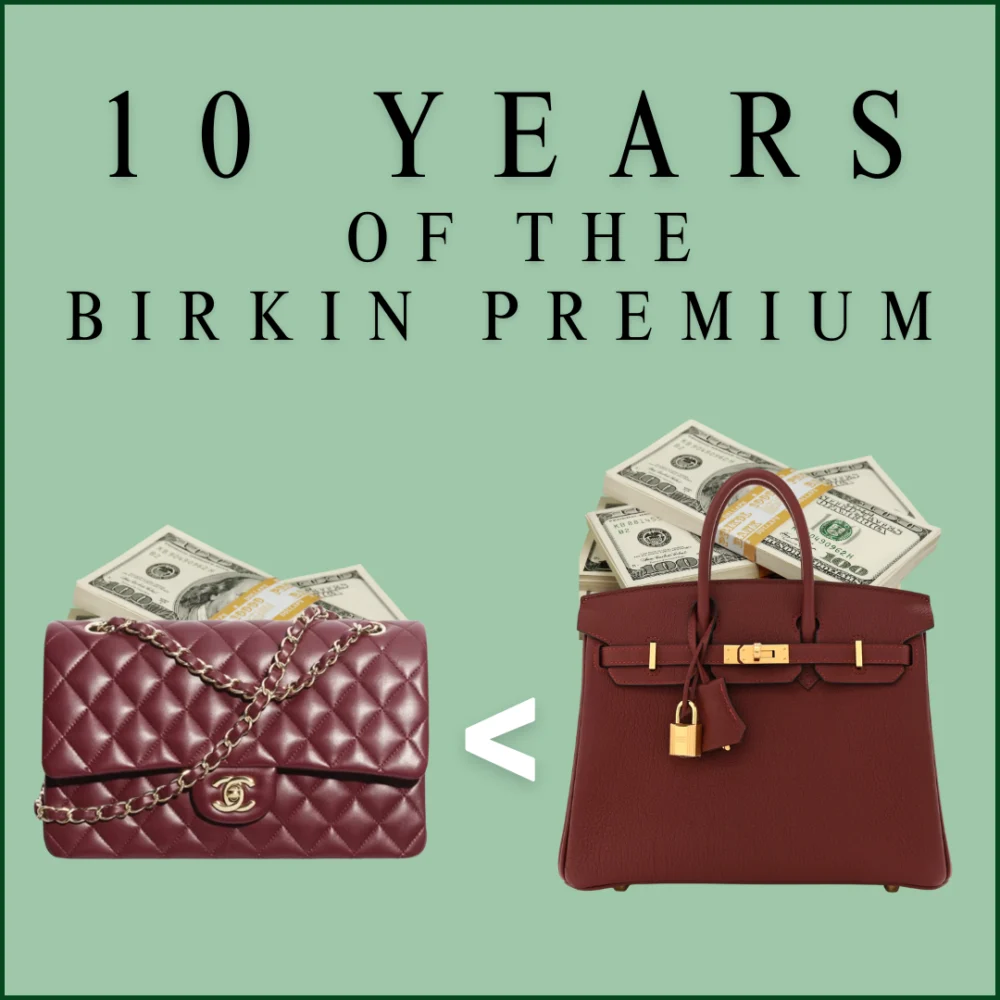
The long-standing rivalry in the luxury handbag market, often quantified by the price differential between the Hermès Birkin and the Chanel Classic Flap, has seen a significant recalibration. As of January 2026, the calculated "Birkin Premium"—the percentage by which the Birkin 25 surpasses the retail price of the Chanel 11.12 Medium Classic Flap—has climbed to 19.5%. This figure marks a decisive swing back in favor of the Parisian leather house, reversing a period of surprising price convergence seen just a few years prior.
To fully appreciate this metric, one must first establish a clear understanding of the Birkin Premium. In the context of luxury asset valuation, a premium or discount simply quantifies the relative cost between two comparable items. For this analysis, the focus remains strictly on the stated retail price of the Birkin 25 and the Chanel Medium Classic Flap, deliberately excluding the often-cited, yet unquantifiable, factors of brand mystique, secondary market desirability, and the notorious difficulty of acquisition associated with the Birkin. When the Birkin’s price increases at a faster rate than Chanel’s, the premium expands; conversely, if Chanel implements steeper price hikes, the premium contracts. Over the past decade, the dynamic tension between these two titans of luxury has resulted in a volatile yet fascinating spectrum of price relationships.
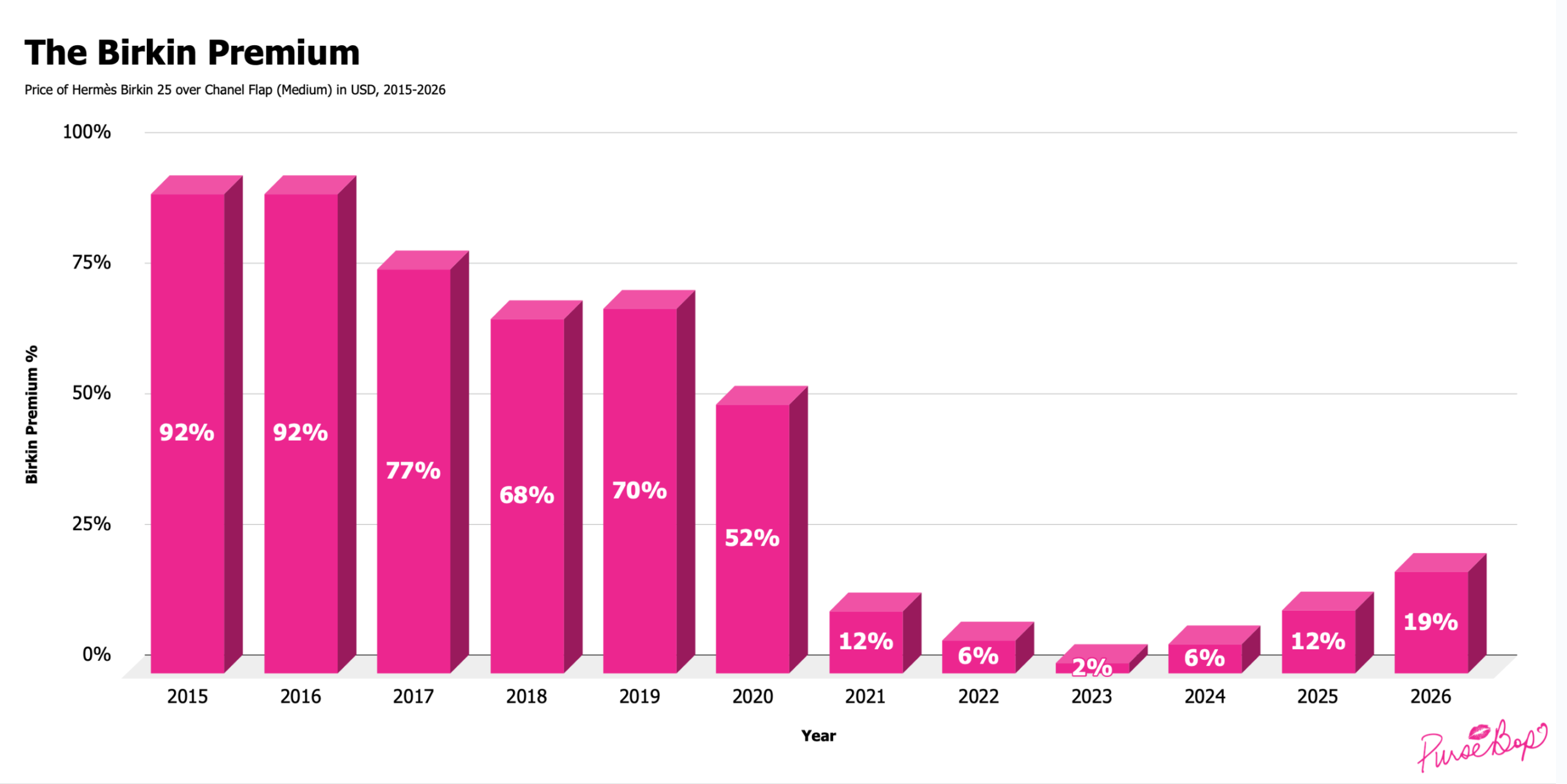
The current 19.5% premium represents a dramatic U-turn from the near parity experienced in January 2023. At that juncture, the Chanel Flap had closed the gap to a mere 2% less than the Birkin, an anomaly that sent ripples of concern through the Hermès faithful. This convergence was a stark contrast to the peak dominance observed in 2016, where the Birkin commanded a staggering 91.8% premium, effectively costing nearly double its Chanel counterpart. Tracking these shifts reveals a decade defined by fluctuating pricing strategies from both Maisons.

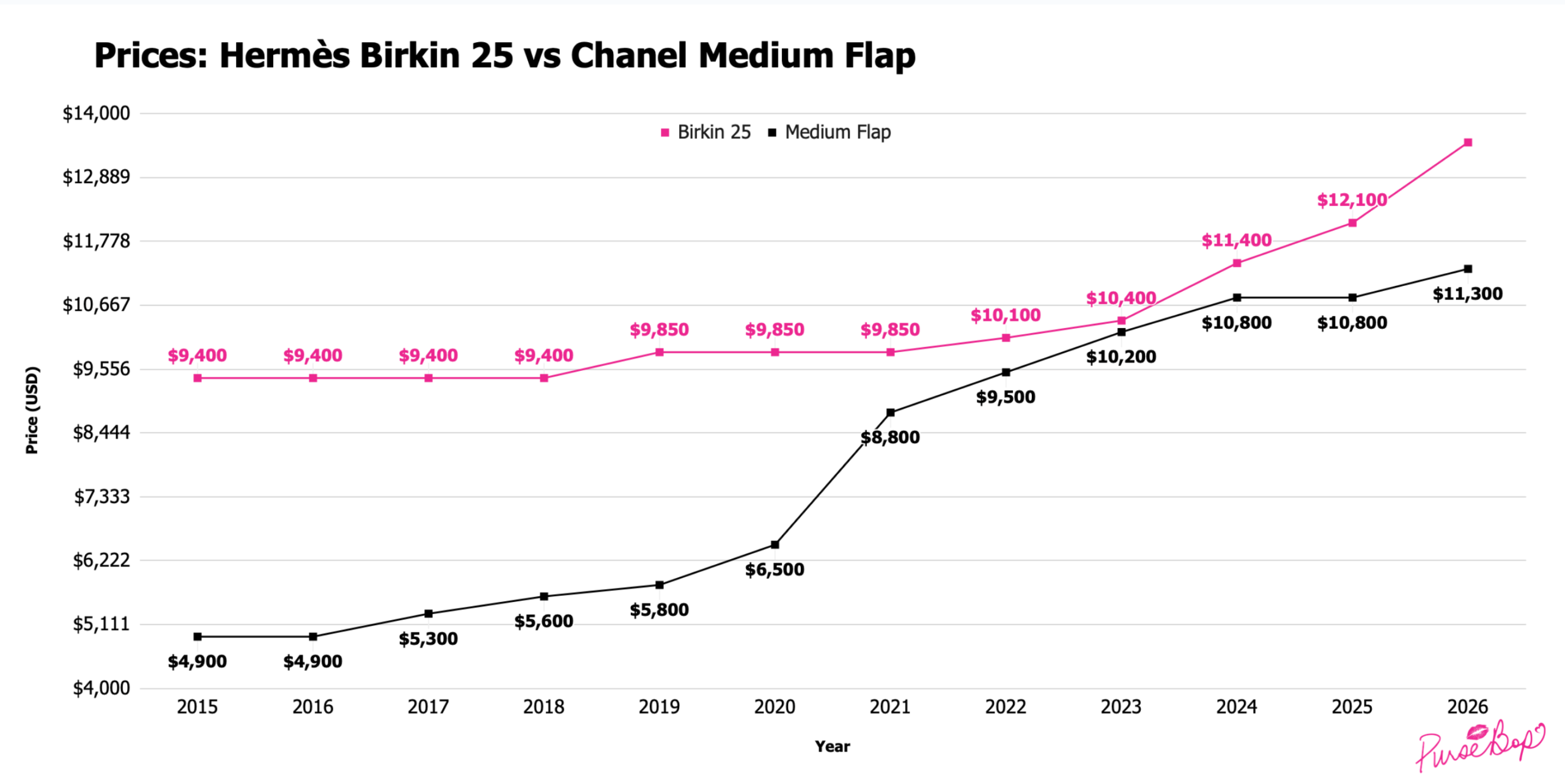
The period between 2020 and 2023 was dominated by aggressive pricing moves from Chanel. During these three years, the retail price of the Medium Classic Flap surged by an accumulated $3,700, moving from an entry point of $6,500 to crossing the five-figure threshold at $10,200. Meanwhile, during this same inflationary burst, the Birkin 25 saw comparatively restrained increases, totaling only $550. This strategic disparity allowed the Chanel bag to rapidly erode the Birkin’s historical price advantage, leading to the historic 2% premium observed in early 2023.

However, the script has demonstrably flipped since 2024. Hermès appears to have recalibrated its strategy, initiating a more pronounced upward trajectory for its core leather goods. From the beginning of 2024 through early 2026, the Birkin 25 experienced cumulative price increases amounting to $3,100. Coinciding with this aggressive move, Chanel moderated its own inflation, implementing price adjustments totaling $1,100 over the same two-year span. This divergence in pace—Hermès accelerating while Chanel decelerated—is the direct mechanism driving the current expansion of the Birkin Premium back toward the 20% mark.
A decade-long comparative view offers a compelling narrative: between 2016 and 2026, the Birkin 25 saw its price escalate by $4,100. In the same timeframe, the Chanel Classic Flap’s price increased by a greater absolute amount of $6,400. Despite Chanel’s larger cumulative dollar increase over the full ten years, the timing and sequencing of these hikes—particularly the recent acceleration by Hermès—have created the observed volatility, swinging the premium from a high of 92% down to 2%, and now settling at 19.5%.
What does this 19.5% valuation signify for the luxury landscape in 2026? It suggests a return to a more traditional—though not historically extreme—hierarchy based purely on listed price. The premium acts as a quantifiable metric confirming the Birkin’s superior cost structure relative to the Flap. While this figure is substantial, many seasoned Hermès clientele argue that the premium remains deceptively low when factoring in the true "cost of entry" for a Birkin. They contend that the listed retail price does not account for the necessary ‘client relationship’ expenditures—the mandatory purchases of ready-to-wear, shoes, or jewelry required to secure an allocation for a highly coveted piece like the Birkin 25. In stark contrast, acquiring a Chanel Classic Flap remains largely a transactional process, unhindered by such prerequisites, making the Chanel purchase inherently more straightforward for the general consumer.
The key question now facing the market is the sustainability of this renewed Hermès pricing momentum. Will the escalating retail prices continue their upward march, aiming to spike the Birkin Premium further, perhaps towards the historical 50% or 90% benchmarks? While the enduring, almost insatiable global demand for the Birkin suggests strong pricing power, there must inevitably be a ceiling. At what price point do even the most dedicated luxury consumers begin to exhibit price resistance or seek alternatives? The next few pricing cycles from both houses will be crucial in determining if 19.5% represents a new stable baseline or merely an intermediate step in a renewed pursuit of maximum price differentiation. The data clearly shows that in early 2026, the Birkin has firmly reclaimed its position as the significantly more expensive proposition between these two iconic investment bags.