
In the contemporary B2B landscape, the saturation of generic, disposable promotional merchandise has created a paradox: while more "swag" is being produced than ever before, its ability to actually influence brand perception is at an all-time low. For high-impact organizations, a standard off-the-shelf tote bag is no longer a viable vessel for their message. It was within this context of seeking excellence over expediency that Theirworld, a global children’s charity dedicated to ending the education crisis, approached The Bag Workshop. Theirworld did not just need a carrier; they required a sophisticated physical touchpoint that mirrored the prestige and urgency of their mission. As a premier UK-based OEM (Original Equipment Manufacturer) and a subsidiary of The Wurlin Group, our task was to move beyond the limitations of "logo slapping" and instead engineer a set of specification-heavy, custom-dyed A4 bags that would stand as a testament to luxury textile manufacturing.
The Strategic Necessity of Bespoke Manufacturing
Theirworld is an organization that operates on the world stage, advocating for the 260 million children currently out of school. When engaging with global leaders, donors, and stakeholders, every element of their presentation must convey professionalism and intentionality. A flimsy, translucent cotton shopper would undermine that gravity. The project required a highly technical approach to bag manufacture, focusing on structural integrity, color precision, and tactile quality.
The Bag Workshop does not operate as a traditional wholesaler. Instead, we position ourselves as technical partners. For Theirworld, the brief was complex: the bags needed to be custom-dyed to specific Pantone references, feature intricate contrast stitching, incorporate bespoke woven labels, and utilize heavy-duty cotton webbing handles. By leveraging our position as an OEM manufacturer, we managed the entire product lifecycle—from the chemical matching of raw fabric dyes to the final quality assurance of reinforced gussets—ensuring a result that no stock catalog could ever provide.
Phase 1: Structural Architecture and the A4 Mandate
The foundational requirement of the project was the "A4" designation. In the world of merchandise, "A4" often refers loosely to any bag that can hold a piece of paper. However, from an engineering perspective, a bag intended to house documents, journals, and tablets requires more than just two-dimensional surface area. A standard flat tote bag (two pieces of fabric sewn together) fails as soon as a bulky item is inserted; the fabric stretches awkwardly, the corners of the documents bend, and the bag loses its aesthetic profile.
To solve this, our design team moved away from 2D patterns to a three-dimensional construction. We engineered the bag with dedicated side panels and a full bottom gusset. This architectural choice allows the bag to maintain a rectangular footprint, providing internal volume that accommodates a stack of A4 folders or a laptop without distorting the exterior shape. By creating a custom template rather than using a stock mold, we ensured the Theirworld team didn’t have to compromise on the physical footprint of their brand asset. This is the hallmark of a true OEM bag manufacturer: the product is built around the utility, not the other way around.
Phase 2: Material Science and the Art of Custom Dyeing
The most critical visual challenge was color fidelity. Most promotional bag suppliers offer a "standard" range of colors—typically a primary red, a navy blue, and a forest green. For a brand like Theirworld, which relies on a specific, vibrant visual identity, "close enough" was not an option.
We implemented a custom-dyeing process using high-grade cotton. Unlike surface printing, where ink sits on top of the fibers, custom dyeing involves immersing the raw fabric in a Pantone-matched pigment bath. This process, known as reactive dyeing, ensures that the color is "locked" into the molecular structure of the cotton. The benefits are twofold: first, the color vibrancy is unmatched, achieving a depth and saturation that printing cannot replicate; second, the fabric retains its soft, natural handle. There is no "plasticky" feel, and the color will not crack or fade over time, ensuring the bag remains a premium item for years of use.
Phase 3: Executing Dual Personalities through Colorways
The project was split into two distinct colorways, each requiring its own set of technical specifications and strict inventory management during the manufacturing process.
The High-Contrast Pink Colorway:
This design was a study in bold, modern branding. The primary body was dyed to a specific, high-energy pink. To elevate the design, we utilized contrast stitching in a complementary hue, which required extreme precision from our sewing teams. In luxury manufacturing, contrast stitching acts as a spotlight; any deviation in the stitch line becomes immediately visible. To finish the look, we integrated heavy-duty cotton webbing handles in a contrasting tone, providing a structural counterpoint to the vibrant body.
The Tonal Green Colorway:
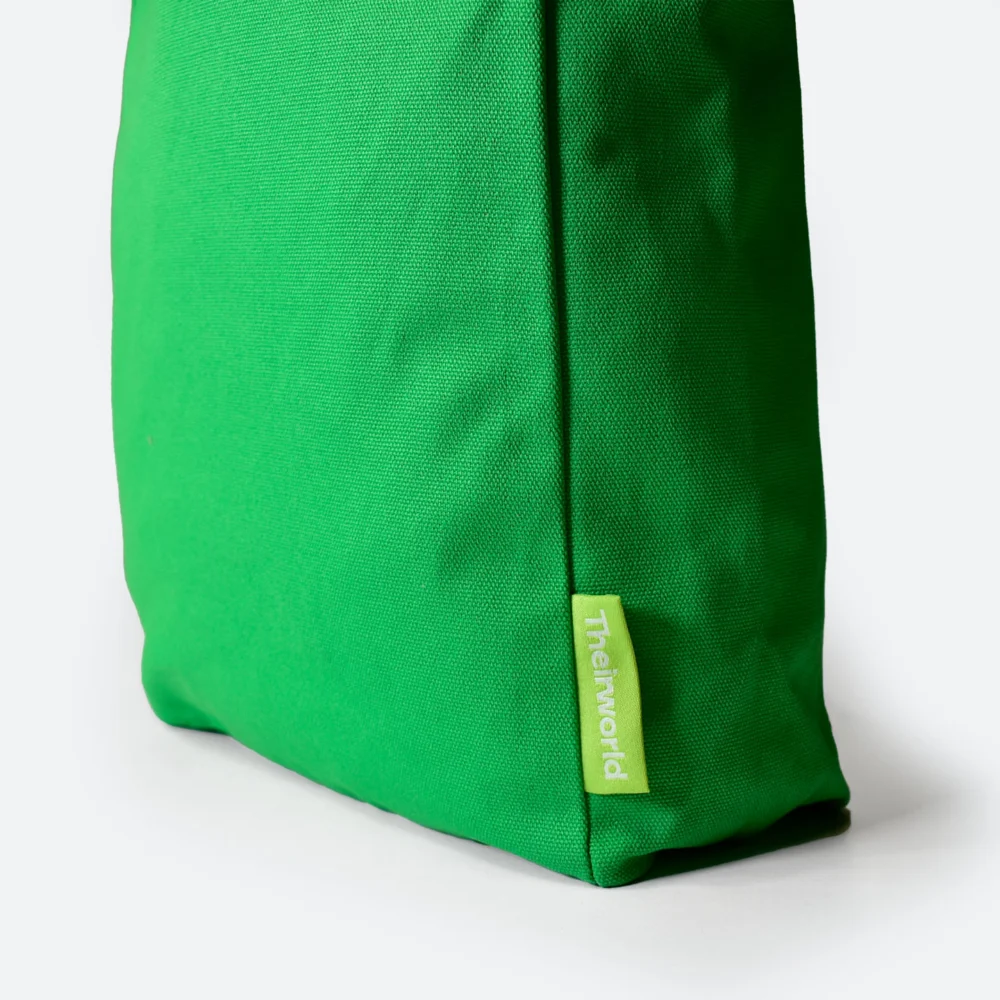
The second design focused on harmony and monochromatic depth. This version used a sophisticated green palette, where the handles, body, and stitching worked in a tonal gradient. This required multiple dye lots to be matched perfectly to ensure the "tonal" look felt intentional and premium rather than like a near-miss on a single color.
Both versions featured bespoke woven labels. Unlike printed labels, which can scratch off or look cheap, woven labels are created on a loom, using high-denier threads to recreate the logo with needle-point precision. These were "loop-folded" and sewn into the side seams, a small detail that significantly increases the "perceived value" of the item in the hands of the end-user.
Phase 4: The Mechanics of White Label Precision
As a leading white-label bag supplier in the UK, we understand that our role is to be the "invisible engine" behind a brand’s success. For Theirworld, this meant leveraging our global supply chain to select a partner factory capable of "incredible attention to detail," particularly regarding gusset construction.
In mass-produced wholesale bags, you will often see "bunched" stitching at the corners where the side panels meet the base. This is a result of high-speed, low-precision manufacturing. For this project, we implemented a specific quality control gate to ensure sharp, clean corners. We utilized reinforced cross-stitching (often called a "box-X" stitch) at the handle attachment points to ensure the heavy-duty webbing would never tear, even when the bag is filled with heavy educational materials.
The Result: A Case Study in Brand Longevity
The collaboration between Theirworld and The Bag Workshop resulted in a product that redefined the expectations for a promotional A4 bag. By avoiding stock inventory and committing to a fully bespoke manufacturing route, the client received an asset that was undeniably "theirs."
The success metrics for this project were clear:
- Brand Consistency: 100% Pantone accuracy across two distinct fabric types (canvas body and webbing handles).
- Durability: The use of high-GSM (grams per square meter) cotton and reinforced stitching created a bag with a multi-year lifespan.
- Stakeholder Resonance: The bags were not treated as "freebies" but as valued gifts, increasing the likelihood of the brand being seen in high-value environments like conferences and government offices.
Understanding the Technical Landscape: OEM vs. Wholesale
To truly appreciate the work done for Theirworld, one must understand the technical distinctions in the bag manufacturing industry.
What is the difference between a stock bag and a bespoke OEM bag?
A stock bag is a pre-made item sitting in a warehouse. Your only option is to print a logo on a pre-defined area. An OEM manufacturer, like The Bag Workshop, builds the bag from the ground up. You choose the fabric weight (e.g., a heavy 12oz canvas vs. a light 5oz cotton), the exact dimensions down to the millimeter, and the hardware. This allows for edge-to-edge design elements that are physically impossible to achieve on a pre-sewn bag.
Why choose cotton webbing over "self-fabric" handles?
"Self-fabric" handles are made from the same thin material as the bag. They are prone to rolling, wrinkling, and digging into the shoulder. Cotton webbing is a thick, woven tape. It distributes weight more evenly, stays flat on the shoulder, and provides a "pro-grade" aesthetic that signals high-end manufacturing.
The Role of the Gusset in Professional Utility
A gusset is the "hidden" hero of the Theirworld bag. By adding that extra strip of fabric around the sides and bottom, we transformed a flat envelope into a structural vessel. For B2B clients, this is essential. If your stakeholders are carrying laptops, journals, or presentation folders, a gusseted bag is the only professional choice.
Conclusion: Engineering the Future of Brand Identity
In a market flooded with disposable items, Theirworld chose to invest in quality. By selecting a luxury tote bag manufacturer capable of intricate custom-dyed work and technical structural design, they created an asset that reflects their commitment to excellence.
At The Wurlin Group, we believe that a bag is more than just a container; it is a mobile billboard and a tactile representation of your brand’s values. Whether you are a creative agency looking for a white-label partner or a global organization seeking an OEM manufacturer to bring a complex vision to life, our expertise ensures that your project is managed with surgical precision. We invite brands to move beyond the catalog and explore what is possible when you stop buying "stuff" and start engineering solutions. For those ready to develop a custom-branded solution that explores the full potential of textile design, The Bag Workshop is ready to lead the way.