

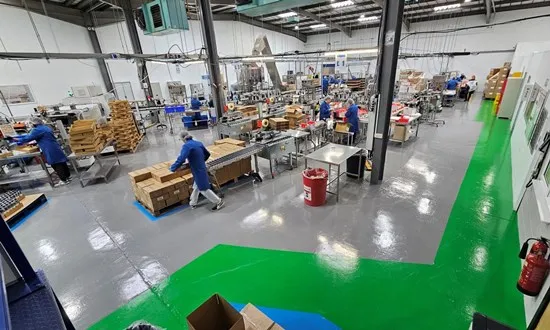
Since its acquisition in 2016 by Dr. Graham Royle, the visionary founder, chairman, and CEO of the GRI Group, co-packing specialist Expac has undergone a remarkable metamorphosis, transforming from a respected industry player into a dynamic, multi-award-winning powerhouse in personal care, household care, and pet care manufacturing. Established initially in 1980, Expac’s trajectory shifted dramatically following the 2016 integration into the GRI Group, a conglomerate specializing in the sophisticated development, production, and distribution of chemical intermediates across personal care, household, pharmaceutical, and industrial sectors. This strategic alignment provided Expac with immediate synergies, robust backing, and access to specialized chemical expertise that few contract manufacturers can match.
The subsequent decade has been defined by aggressive, strategic investment and focused talent acquisition. Under Royle’s leadership, Expac channeled £7.1 million into high-technology manufacturing infrastructure between 2016 and 2025. This capital injection directly fueled a fivefold multiplication of turnover, soaring from a modest £5 million to an impressive £30 million. Simultaneously, the dedicated workforce expanded significantly, growing from 47 employees to a highly skilled team of 161 professionals. Expac attributes its sustained success not merely to capacity expansion, but to an unwavering commitment to advanced formulatory science, state-of-the-art production techniques, and deeply embedded client relationships cultivated through the GRI Group’s extensive network and proactive market engagement.
The company’s portfolio is exceptionally diverse, encompassing everything from complex wet and dry hair care systems to advanced skincare, luxurious bath and body products, and specialized sun protection formulations. These are meticulously packaged across an extensive array of formats, including traditional bottles, innovative tottles, high-barrier tubes, broad tubs, and modern refillable solutions, catering to a client roster spanning major blue-chip international corporations down to niche, single-brand enterprises.
Looking ahead, the momentum shows no signs of abating. Dr. Royle confirms plans for the coming year include realizing further turnover increases, earmarking an additional £2.2 million for capital expenditure, and onboarding another 35 highly skilled staff members. Expac’s continued ability to win and retain blue-chip clientele rests squarely on its dual strengths: proprietary, cutting-edge manufacturing technology and profound expertise in chemical formulation, all underpinned by a culture obsessed with superior customer support and partnership. The operational footprint has expanded across two dedicated sites, augmented by robust third-party logistics (3PL) support, with active scouting underway for a third manufacturing facility to accommodate escalating demand. This excellence was recently recognized when Expac secured the prestigious Contract Manufacturer & Packer of the Year award, sponsored by the BCMPA, at the UK Packaging Awards—a title the firm has now secured three times, cementing its status as an industry benchmark.
Formulatory Mastery: The Scientific Edge
A crucial differentiator for Expac lies in its deep integration with the GRI Group’s chemical supply chain, particularly its sister company, Libra Speciality Chemicals, a key manufacturer of essential product ingredients. Dr. Royle emphasizes that clients approach Expac with varying levels of chemical knowledge. While large multinationals often provide detailed specifications or existing proprietary formulas requiring optimization, smaller brands typically possess a clear vision for product performance but lack the internal chemistry teams to translate that vision into viable formulas.
This is where Expac’s unique technical advantage—its ‘key technical USP’—comes into play. “The synergistic combination of blending and reaction technologies housed within the laboratories of both Expac and Libra is quite formidable,” Royle explains. Equipped with cutting-edge analytical machinery capable of dissecting formulations down to the molecular level, Expac possesses the unparalleled capability to reverse-engineer or radically improve any client-submitted product. “A client can present a formula they wish to replicate, or merely use as a conceptual starting point, and Expac can precisely determine its exact chemical composition on their behalf,” he notes.
Delivering the End-to-End Service Proposition
Expac strategically aims to offer a comprehensive, full-service partnership, mitigating complexity for its clients. This end-to-end offering begins at the technical drawing board: formulating initial samples, rigorous in-house testing and approval, navigating complex product registration processes, and compiling the essential Product Information File (PIF).
“We initiate the process with the technical foundation, manage all subsequent production stages, and typically handle the entire sourcing and procurement pipeline for chemicals, componentry, and packaging materials,” Royle details. To aid decision-making, Expac provides extensive physical samples showcasing different bottle designs, cap configurations, label aesthetics, alongside various fragrance and color options, accompanied by detailed guidance on the proposed product’s performance characteristics and efficacy claims.
Navigating Economic Headwinds: Costs and Taxation
Despite its phenomenal growth, Expac, like much of the UK manufacturing sector, faces significant headwinds from escalating operational costs driven by recent government fiscal policies. Dr. Royle is forthright about the detrimental impact of successive budget tax hikes.
“Increases in labor rates, National Insurance Contributions (NICs), energy expenses, environmental levies, and business rates have proven exceptionally punishing,” he states. He highlights the annual rise in the National Minimum Wage (NMW) exceeding 10% annually for the past four years. A critical challenge is the inability to fully pass these costs down the supply chain, as major retailers exert strong resistance to commensurate price adjustments. Royle points out the ripple effect: “The government seems oblivious to the fact that substantial NMW increases necessitate cascading adjustments throughout the entire payroll structure to maintain appropriate pay differentials. Suddenly, an entry-level operator might earn more than a line leader, or a line leader more than a supervisor or QC inspector. Before long, the entire payroll has inflated far beyond general inflation rates—a burden that is extremely difficult to absorb.”
Furthermore, he points to the employer’s NIC increase, which, though seemingly minor on the surface, was compounded by a simultaneous reduction in the threshold at which it applies, effectively doubling the employer’s NIC burden on a substantial portion of the payroll—costs Expac is forced to absorb internally. Coupled with the UK possessing some of the world’s highest energy costs, the necessity for continuous growth becomes existential. “We must continually outpace increasing operating costs by expanding turnover so that our gross margin always exceeds rising overheads. In essence, we must sell more every single year just to maintain our existing profit level. Businesses with flat turnover in this environment often face operating losses and potential collapse.”
Regulatory Compliance and Environmental Commitment
While recent legislative changes present financial strains, Expac remains a staunch proponent of the Extended Producer Responsibility (EPR) framework for packaging, viewing environmental stewardship as paramount. A significant operational burden involves ensuring that every supplier, whether providing raw chemicals or packaging materials, adheres strictly to all relevant regulations—a process that is both time-consuming and costly.
Royle expresses frustration with the regulatory landscape in the European sphere: “Unfortunately, the EU often operates as a bureaucratic machine, creating overlapping regulations that effectively duplicate compliance efforts. Consider the regulations surrounding palm-based ingredients: the EU has mandated RSPO, NDPE, REACH, and EUDR—regulations that could easily be consolidated into one streamlined framework instead of multiple, expensive versions.”
The Path Forward: Reshoring Through Technical Superiority
Dr. Royle observes that British and broader European manufacturing industries are currently struggling against the twin pressures of inflated domestic costs and intense competition from cheaper imports, primarily sourced from Asia. “Everyone is heavily taxed, and many European regulations intended for market protection have proven counterproductive, as evidenced by the palm product complexity.”
Expac’s resolute strategy is to navigate these difficulties by embracing the "many taxes" and focusing purely on growth. This growth is targeted both through capturing greater domestic market share and actively encouraging the "reshoring" of manufacturing back to the UK. This reshoring is achievable only by leveraging superior technical abilities and highly efficient manufacturing processes.
“The coming year and beyond will present no easier conditions for British manufacturers,” Royle concludes. “Therefore, our adaptation strategy must involve investing aggressively in ourselves—producing ever-better technologies and genuinely exciting products—to effectively neutralize the impact of higher costs, complex regulations, and low-cost imports. We remain committed to our long-term vision, maintaining a positive and proactive posture in all our operations.”