

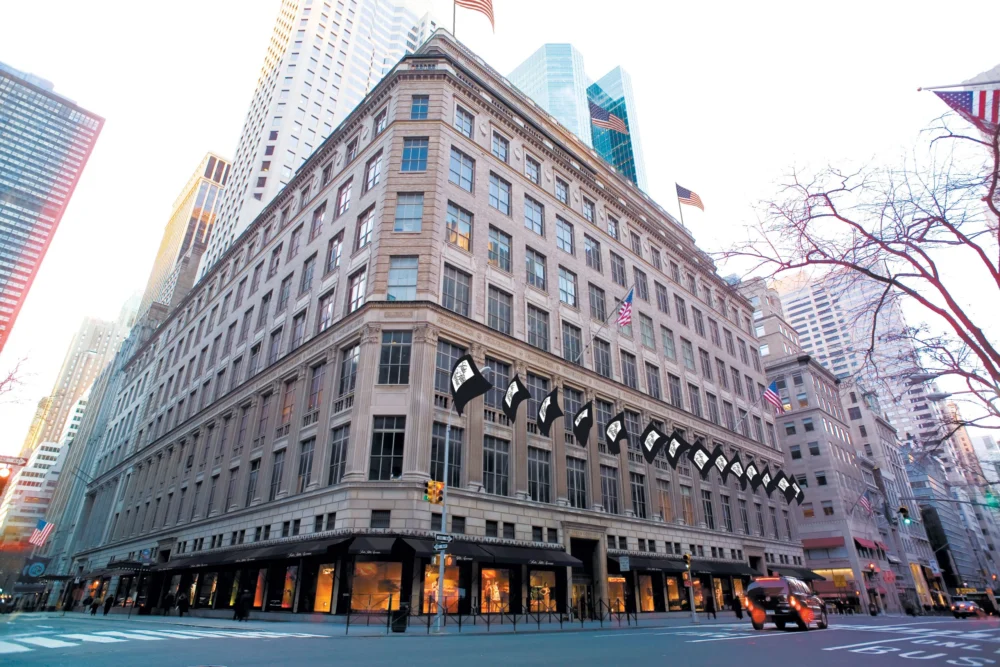
The precarious financial tightrope walk of Saks Global has finally ended in a catastrophic collapse. The luxury retail behemoth, parent company of Saks Fifth Avenue and the recent controversial acquirer of Neiman Marcus Group, filed for Chapter 11 bankruptcy protection late Tuesday in the Southern District of Texas. The move sends shockwaves across the high-end fashion ecosystem, leaving thousands of creditors, designers, and bondholders grappling with massive uncertainty and the fallout of a deeply flawed, debt-fueled consolidation strategy.
The filing represents the swift and brutal unraveling of an audacious $2.7 billion vision conceived by former executive chairman and CEO Richard Baker. Baker, who harbored a decade-long ambition to merge the two iconic, though financially vulnerable, U.S. luxury department store rivals, saw his empire succumb just over a year after the Neiman Marcus acquisition closed. The combined entity immediately groaned under a crushing debt load, exacerbated by rapidly deteriorating vendor relationships and an operating model that proved too expensive and too fragile to withstand market pressures.
A New Captain for a Sinking Ship
In a dramatic shift preceding the filing, Richard Baker stepped down, passing the reins to a familiar face in luxury retail: Geoffroy van Raemdonck. Van Raemdonck, who served as CEO of Neiman Marcus Group prior to the Saks Global takeover, is tasked with navigating the company through the intricate and contentious court proceedings. His appointment was secured following intense weekend negotiations, first reported by WWD, aimed at stabilizing management ahead of the bankruptcy declaration.
“This is a defining moment for Saks Global, and the path ahead presents a meaningful opportunity to strengthen the foundation of our business and position it for the future,” van Raemdonck stated, adopting a tone of cautious optimism. He emphasized a commitment to continuing service for customers and luxury brands while undertaking the fundamental transformation necessary for survival.
To ensure immediate operational continuity during the restructuring, Saks Global secured $1.75 billion in Debtor-in-Possession (DIP) financing from a consortium of its bondholders. This financing is critical, as it is earmarked to keep essential functions running, and crucially, provides a measure of certainty to vendors that new shipments—particularly vital spring merchandise that should already be hitting sales floors—will be paid for.
Van Raemdonck has quickly solidified his leadership team, installing key industry veterans. Darcy Penick was named president and chief commercial officer, overseeing buying, marketing, stores, and digital strategy. Lana Todorovich was appointed chief of global brand partnerships. These executives join Chief Financial Officer Brandy Richardson, who worked closely with van Raemdonck during his tenure at Neiman Marcus, signaling an attempt to leverage the operational expertise of the Dallas-based retailer, which historically outperformed Saks Fifth Avenue.
The Catastrophic Debt Load
The core malignancy that led to the bankruptcy was the staggering amount of leverage taken on to finance the merger. Saks Global entered Chapter 11 with both assets and debts estimated to fall between $1 billion and $10 billion, though these figures are subject to judicial refinement. The debt pile includes $2.2 billion in bonds issued to fund the Neiman acquisition, supplemented by an additional $600 million raised in a desperate refinancing effort just last August.
The sheer size of this debt strangled the combined entity’s ability to invest in the very "reset" strategy—focused on personalization, AI integration, and superior customer service—that was supposed to revitalize the luxury department store model.
The repercussions are immediate and severe for the fashion supply chain. The bankruptcy filing lists over 10,000 creditors, including a veritable who’s who of international high fashion. These unsecured creditors now face the devastating reality that they may recover little, if any, of what they are owed, as secured lenders stand first in line for repayment. The scale of the loss is staggering: Vince Holding Corp., for example, is listed as the 30th largest unsecured creditor, owed a staggering $9.1 million. For smaller, independent designers, these unpaid trade payables often represent a fatal blow, pushing them to the brink of their own insolvency.
The Vendor Revolt
The crisis accelerated dramatically last February when the company, then led by CEO Marc Metrick, attempted to stabilize liquidity by unilaterally imposing draconian payment terms on its partners. Metrick informed vendors that all new orders would shift from standard 30-day payment cycles to extended 90-day terms. Worse still, past due balances—which had already accumulated significantly—would only begin to be paid off in 12 monthly installments, commencing in July 2025.

Metrick framed this as providing “clarity and certainty,” but the industry saw it as a transparent admission of deep financial distress. The move decimated trust and led to a vendor revolt. While large brands often utilized a consignment or concession model, protecting their inventory, smaller and mid-tier designers, who rely on traditional wholesale terms, ceased shipping goods altogether. This lack of fresh, desirable merchandise created a vicious cycle, suppressing sales and further validating the financial fears of the vendors. The failure to secure the normal flow of luxury goods ultimately crippled the retailer’s ability to generate revenue and survive.
A History of Instability and Missteps
Saks Global’s downfall cannot be attributed solely to the Neiman merger; it is rooted in decades of strategic instability and operational failure at Saks Fifth Avenue.
Since its acquisition by Hudson’s Bay Co. (HBC) in 2013, Saks Fifth Avenue was already faltering. Baker’s long-term plan was always consolidation, believing the only path to viability was through shared infrastructure, combined buying power, and aggressive cost cutting enabled by merging with Neiman Marcus.
Historically, Saks struggled to maintain consistency against its rivals. While Saks and Neiman’s carried many overlapping luxury brands, Neiman Marcus consistently held the edge due to its superior customer service, enduring client relationships fostered by seasoned selling associates, and a consistent, high-end image across its store portfolio.
Saks, by contrast, suffered from chronic management volatility, which led to perpetual strategy reversals. The Nineties saw a misguided aggressive expansion into smaller “Main Street” and “resort” format stores across Florida, California, and Texas. This strategy failed, leading to the closure of 11 stores in 2004. Even recently, stores in San Francisco and Palm Beach shuttered, and the management shakeup continued up until the filing, including the departure of key executives like Emily Essner and the controversial legal battle with former Bergdorf Goodman Chief Merchandising Officer Yumi Shin over alleged non-compete violations.
In a recent, short-lived attempt to unlock value, HBC split Saks Fifth Avenue’s e-commerce operations from its physical stores in 2021, securing a $500 million investment from Insight Partners. The hope was an eventual public offering of the digital arm, but that effort was ultimately abandoned, and the two divisions were recombined, underscoring the lack of a cohesive long-term vision.
The Future: Store Closures and Asset Sales
The immediate focus shifts to drastic cost-cutting measures. Bankruptcy court allows retailers to break expensive store leases easily, meaning a significant wave of store closures is expected, particularly in markets where both Saks and Neiman Marcus currently operate—such as Chicago, Boston, Atlanta, and Beverly Hills.
The fate of the company’s crown jewels remains highly uncertain. Sources suggest that parts of the business may be sold off to appease creditors. Bergdorf Goodman, the highly profitable, prestigious jewel in the Neiman Marcus portfolio, could be separated and put on the market.
Strategic partners are watching closely. Amazon, which participated in the original Neiman Marcus deal and hosts a Saks shop on its platform, was once viewed as playing a "long game" to gain a foothold in luxury retail. The e-commerce giant’s next move is unclear, but its influence remains substantial. Authentic Brands Group, which holds a luxury joint venture with Saks Global, is also reportedly keen on acquiring specific components of the business.
In a worst-case scenario, the complexity of the proceedings—involving a myriad of bondholders, investors, landlords, and vendors all vying for recovery—could lead to total liquidation.
As Saks Global barrels into an uncertain future, the fashion industry watches, exhausted and wary. The failure of this ambitious merger serves as a harsh lesson that in luxury retail, debt cannot replace operational excellence, trust, or the simple act of paying bills on time. The collapse of the core of U.S. luxury department store world marks the end of an era and signals a fundamental reshaping of how high fashion reaches the consumer.