
Shinya Kozuka’s inaugural show as the guest designer at Pitti Uomo for Fall/Winter 2026 transcended a mere display of menswear; it was a curated, atmospheric performance, steeped in the quiet contemplation of urban solitude and the lingering chill of a Japanese winter. Staged within the cavernous, raw architecture of an industrial venue in Florence, the presentation immediately established a tone of profound, almost melancholic placidity. This mood was amplified by the precisely chosen soundscape, dominated by the neo-classical minimalism of Ólafur Arnalds, specifically his evocative track, "For Now I Am Winter." The combination of the snow-dusted setting, the austere venue, and the pensive rhythm of the models walking the runway forged an unforgettable, introspective experience.
For this highly anticipated European debut, the Japanese designer intentionally imported the sensory experience of his homeland’s coldest months, filtering it through the specific lens of his routine—the reflective night commute back home in Tokyo. This focus was not just geographical; it was deeply personal, serving as the conceptual bedrock for a collection that sought to capture the fleeting moments and abandoned objects that characterize the journey between work and rest.
Kozuka himself articulated his objective prior to the show, emphasizing a commitment to distillation rather than expansion. His ambition was clear: "to highlight the fundamentals of the brand, the stronger components and avoid diluting them with too many elements. It’s about showing my characteristics and my character." In an industry often prone to excessive novelty, Kozuka sought to reinforce his established vernacular, built on sophisticated layering and thoughtful reinterpretations of utility wear. The result was a collection that zeroed in on familiar tropes—heavy fabrications, architectural silhouettes, and novel approaches to the workwear suit—while introducing refreshing detours toward pure, unadulterated utility and moments of intricate craft.
The Sartorial Narrative of Abandonment: The Lone Glove
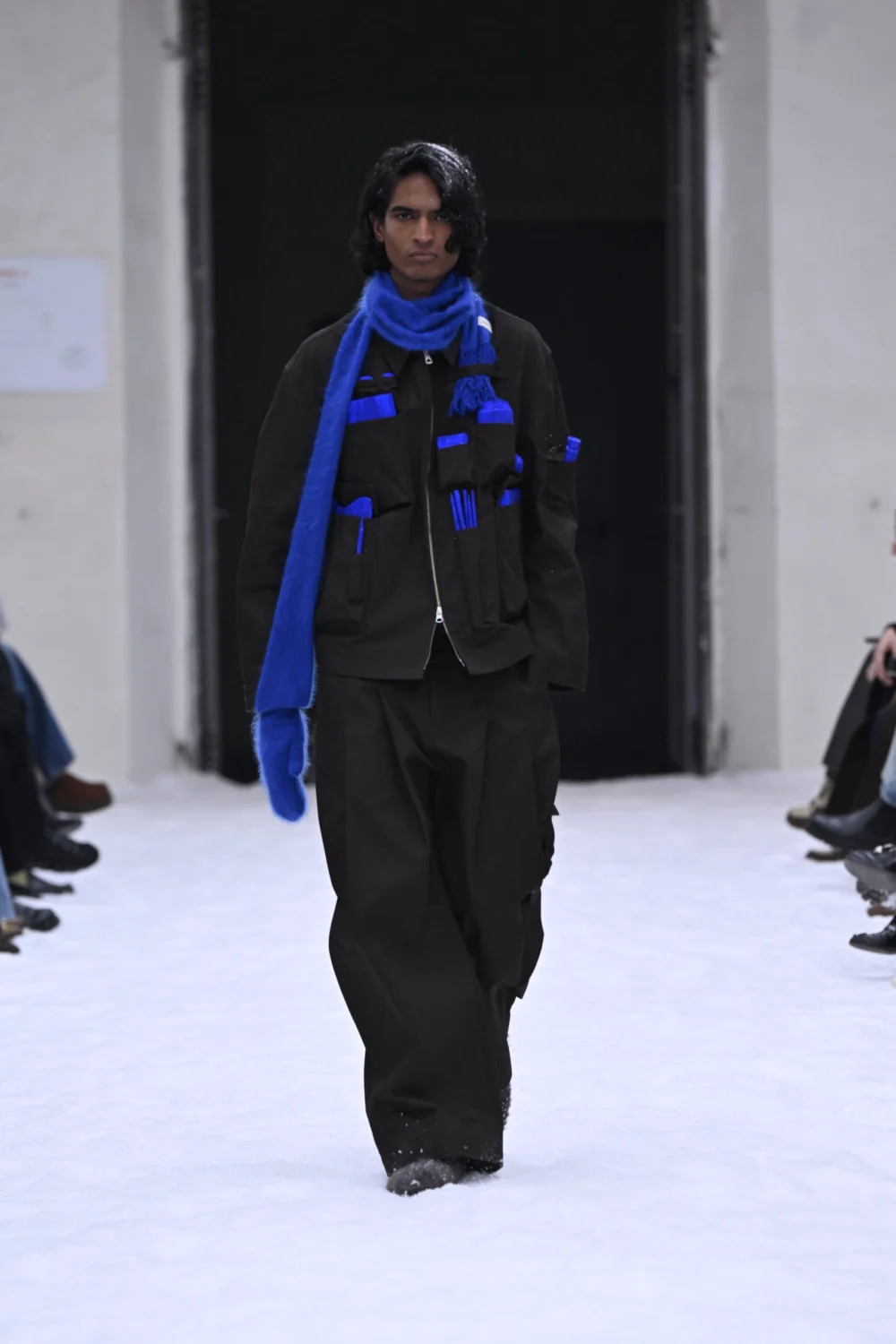
Perhaps the most potent and visually arresting conceptual element woven throughout the collection was the recurring motif of the lone glove. These varied iterations of the winter accessory were not merely functional additions; they served as non-linear narrative devices, prompting the audience to question their symbolic meaning.
The gloves appeared deliberately dislocated from their conventional pairing. Sometimes they hung loose, suspended from the oversized patch pocket of a heavy apron, suggesting a momentary pause or a forgotten necessity. In other instances, they were integrated into the ensembles in mitten-style versions, frequently accented with luxurious faux fur details, accessorizing ensembles defined by cropped, highly pocketed jackets and relaxed, ankle-length trousers.
Kozuka revealed that this idiosyncratic detail was a direct reference to the solitary gloves he frequently observes abandoned on the cold sidewalks of Tokyo. Far from being sad remnants, these discarded objects, he explained, are "familiar and comforting," serving as tangible reminders of people’s individual journeys back home, or, on a deeper symbolic level, a return to one’s fundamental roots and origins. This philosophy transforms the lost object into a profound meditation on human passage and urban solitude, elevating a common piece of street litter to a core element of high fashion storytelling.
Traces of the Urban Winter
The collection’s material language was devoted to translating the texture and imagery of a severe urban winter. The show’s opening sequence immediately established this palette of cold, memory, and grit. Melton topcoats and suits featuring elongated blazers were treated with speckled white paint, an artistic technique that visually rendered the residual traces of snowstorms—suggesting salt, ice, or residual debris clinging to the hemline.
The collection then moved through a series of fabrications designed to evoke the sensation of walking through a freshly frosted city. A flocked cotton duster coat, layered over a simple tracksuit, bore prints that mimicked footprints left upon a blanket of snow—a poetic capturing of movement and momentary impression. The less romantic, more chaotic side of city winter—the slush and wet grime covering the streets—was skillfully translated through jacquard patterns applied to chunky knits, and printed onto fluid pant and top combinations paired unexpectedly with short overskirts. This duality captured the beauty and the harsh reality of the urban cold.
The Architecture of Utility and Layering
Kozuka’s fundamental strength lies in his reinterpretation of workwear, and the Fall 2026 collection offered numerous examples of utility refined into high-concept layering. References to utility wear were scattered liberally: slightly elongated and multi-pocketed work jackets; military-nodding bomber jackets paired with matching, voluminous trousers; and the pervasive presence of the bib or half-apron.
These aprons, often layered over lean foundational outfits—such as simple shirts and culottes featuring voluminous, deep pleats—provided architectural structure and surprising volume. Some required several yards of heavy cotton to achieve their dramatic shape. The apron, typically a symbol of labor and domesticity, was here elevated and politicized.
Crucially, some aprons were emblazoned with a moody, almost existential quote that contrasted sharply with the utilitarian fabric: "youth is gone. Moon is there. Winter stands." This juxtaposition—the harshness of labor wear carrying a romantic, fatalistic sentiment—added a profound layer of depth, suggesting the endurance of the human spirit and the immutable presence of nature against the passing of time. Other aprons showcased innovative craft, rendered in inventive knitted versions, further demonstrating Kozuka’s commitment to texture and material novelty.
The emphasis on layering was not merely stylistic but integral to the collection’s narrative of protection and accumulation. The deliberate overlapping of heavy melton, structured cotton, and voluminous knits created silhouettes that felt both formidable against the elements and deeply contemplative, reflecting the interiority of the lone commuter.
Craftsmanship and Critical Reception
The show culminated on an intensely craft-focused note with the closing coat. This piece utilized trompe l’oeil prints of buttons, alongside delicate mother-of-pearl appliqués fixed to the bottom half. This final statement beautifully encapsulated the collection’s tension between illusion (the print, the memory) and reality (the tactile appliqué, the present moment), showcasing a dedication to artisanal detail that belied the rugged utility seen elsewhere.
As a runway performance, Shinya Kozuka’s Pitti Uomo debut stood out definitively for its immersive, moody, and deeply poetic undertone. The deliberate pacing, the atmospheric music, and the singular focus on the cold urban journey created a singular and emotionally resonant experience.
However, the ambition to distill the brand’s fundamentals while pursuing such abstract conceptual themes presented a minor challenge for international comprehension. While those familiar with Kozuka’s prior work could readily identify his core aesthetic—the architectural pleating, the novel workwear suits, the mastery of layering—the collection, by prioritizing emotional resonance and non-linear narrative (the lone glove, the existential quotes) over immediately recognizable commercial tropes, may have sacrificed some clarity. The critical assessment suggested that while the collection was a triumph of atmosphere and poetic expression, it potentially missed an opportunity to provide the broader international audience with a crystal-clear understanding of the essential, repeatable vocabulary that defines the Shinya Kozuka brand for commercial scalability.
Ultimately, the Fall/Winter 2026 collection was a sophisticated meditation on absence, memory, and the enduring human trace within the indifferent urban landscape. It confirmed Shinya Kozuka not just as a designer, but as a conceptual artist capable of turning the quiet melancholy of a Tokyo winter commute into a powerful and moving sartorial statement.