

The realm of Pre-Fall collections often serves as a practical bridge between the high drama of the runway and the commercial demands of the market, yet for Chloé’s Creative Director, Chemena Kamali, the 2026 season was treated less like a necessity and more like an exhilarating exercise in anti-formulaic freedom. Kamali, barely a year into her tenure, has successfully resurrected the quintessential Chloé spirit—a graceful, distinctly French femininity steeped in bohemian romance—but for Pre-Fall 2026, she injected a crucial new element: the unstudied, often contradictory, spontaneity of modern youth culture. The result is a wardrobe that champions the impulsive gesture, where seemingly disparate elements collide to create an unexpectedly harmonious vision of contemporary glamour.
Kamali’s philosophy for the collection was deeply rooted in observation, specifically drawing inspiration from the casual, expressive way the younger members of her design studio dress. This authentic, unselfconscious approach to layering and mixing textiles provided the spark for a collection defined by a "freewheeling" ethos. The designer articulated a clear mission to resist the urge to over-intellectualize or "formulate things," striving instead for garments that "feel familiar, but where there’s newness, inventiveness and surprise." This duality—the comfort of the recognizable coupled with the thrill of the unexpected—is the engine driving Pre-Fall 2026. It is a tacit acknowledgment that true personal style today is often derived not from strict adherence to trends, but from treating clothing as a fluid "extension of their own individuality."
To ground this modern spontaneity, Kamali mined the rich seam of the late 1970s and 1980s, eras that, much like today, celebrated expressive individuality and the blending of high glamour with personal eccentricity. Her mood board was a compelling visual dialogue between polished celebrity portraiture and raw, rebellious imagery. It featured the slick, stylized photographs of Francesco Scavullo, known for capturing the opulent side of ’70s and ’80s society, juxtaposed with the edgier, often provocative work of Bettina Rheims, particularly images sourced from her influential 1989 volume, Female Trouble. Rheims’ work offered a counterpoint to Scavullo’s gloss, depicting women with a defiant sensuality that resonated with the collection’s desire to merge delicacy with strength.
The ultimate muse uniting these two decades was the legendary style icon Paloma Picasso, specifically captured at her 1978 wedding after-party. Wearing a custom gown designed by Karl Lagerfeld for Chloé, Picasso’s look was a masterclass in controlled contradiction: frothy, ethereal fabric paired with powerful, sculpted shoulder lines. This image became a template for the collection’s core aesthetic—a blending of Chloé’s inherent grace with a backbone of structural confidence, demonstrating that femininity need not be synonymous with fragility.
This foundational tension manifests throughout the collection in a series of styling decisions that deliberately challenge conventional logic. Kamali revels in the "illogical" combination. Consider, for instance, the robust, chunky texture of a Donegal rib-knit sweater, typically associated with rustic warmth, which is abruptly cropped at the ribcage and finished with a delicate band of Guipure lace. This fusion of rugged material and intricate, fragile detailing epitomizes the collection’s rebellious spirit, merging utility with lingerie-inspired delicacy.
Footwear further underscores this playful defiance. The designer proposes the wearing of socks—a practical, everyday item—with towering platform clogs. These clogs themselves are composites of contrasting materials: rich wood, soft suede, and unexpected inserts of transparent polyurethane. The juxtaposition speaks volumes: an embrace of clunky, grounded comfort elevated by a surprising, almost futuristic material choice.
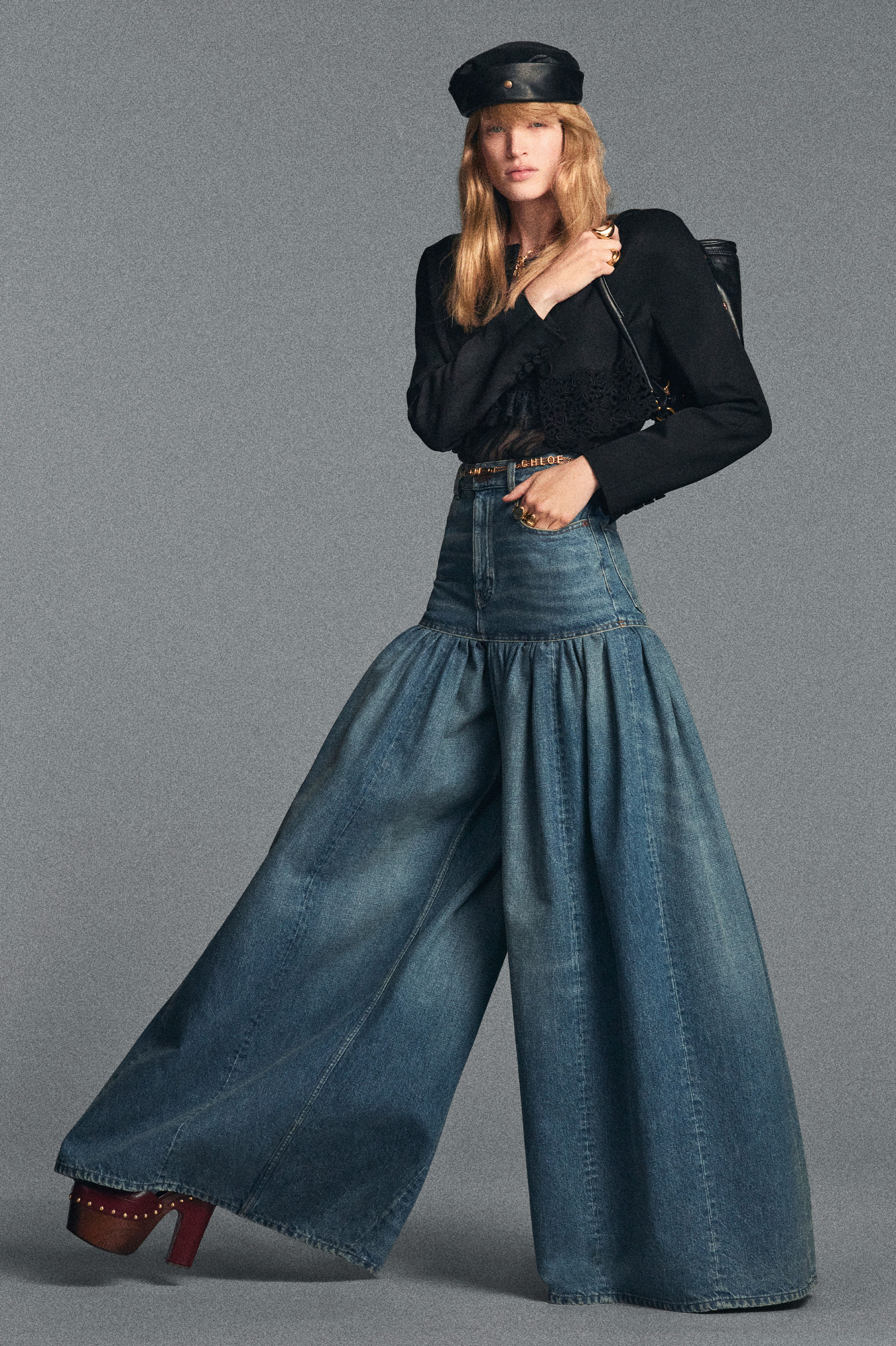
Perhaps the most inventive element, however, is the exploration of the peplum. Traditionally a structural detail used to define the waist, Kamali deploys it as a layering device. One delicate ruched peplum detail might finish the hem of a lace camisole top, embodying the soft Chloé heritage. Simultaneously, a second, perhaps sturdier peplum is attached to a leather belt, designed to be cinched over voluminous, ballooning pants. The layering of these two flounces—one inherent to the garment, the other an external, adjustable accessory—adds a dimension of spontaneous architectural complexity, giving the wearer agency in shaping the silhouette and transforming a relaxed outfit into a statement of high fashion.
Crucially, while embracing inventive newness, Kamali ensured that the Pre-Fall 2026 collection remained firmly linked to the established pillars of the Chloé house, particularly its long-standing reputation for impeccably cool and beautifully fitted pants. This season saw a significant expansion of the trouser repertoire, spanning a vast range of textures and cuts designed for immediate, instinctive wear. New styles included form-fitting velvet stirrup pants, sleek snug suede leggings, and garment-dyed workwear trousers cut with the straight, utilitarian precision reminiscent of traditional sailor uniforms. For the most dramatic statement, Kamali introduced high-waisted denim jeans that exploded into colossal pant-legs, achieving a voluminous, structured flow that gave the striking visual impression of a dynamic, oversized broomstick skirt.
Outerwear and lighter layers maintain this balance between familiarity and invention. Kamali riffed on the classic leather bomber jacket, reimagining it with the soft, fluid allure of a blouse, thereby elevating a traditionally rugged piece into something inherently feminine. This concept was mirrored in vaguely Victorian-inspired jackets—pieces imbued with an "heirloom quality"—which offered structure and romantic detail without sacrificing wearability. Delicate lingerie tops, a perennial Chloé favorite, and floaty chiffon dresses were also present, serving as the essential, graceful counterpoint to the collection’s heavier, layered elements. These are the "pieces that you instinctively and naturally reach for," as Kamali described them—garments that are relatable and "anchored in reality."
Yet, the collection is ultimately defined by the pure joy of the impulse buy, the small, fun details that elevate the everyday. This is where the spontaneity truly shines, moving beyond silhouette and into the realm of accessories. Kamali introduces a suite of whimsical, conversation-starting items: a pendant modeled with charming literalism after an apple core, and a delightful clam-shaped ring that opens to reveal a mirror inside. These objects are not merely embellishments; they are tiny narratives, injecting personality and humor into the wearer’s ensemble. Even the iconic Marcie bag, a staple of Chloé’s accessories lineup, is scaled down into a mini version, purely because, as the designer suggests, "why not?"
Chloé Pre-Fall 2026 is, therefore, a masterclass in elevated, unforced style. It is a collection that successfully argues that true elegance lies not in rigid perfection or adherence to predetermined rules, but in the confidence to mix a cropped, lace-trimmed sweater with wide-leg sailor pants and finish the look with a clam ring. Chemena Kamali has delivered a vision that celebrates the intuition of the wearer, offering a luxurious, sophisticated wardrobe that is simultaneously nostalgic, modern, and gloriously unscripted. It is an invitation to dress with freedom, making spontaneity the most compelling rule of all.