

In an era where digital saturation has made physical touchpoints increasingly rare, the significance of a high-quality tangible asset cannot be overstated. For global organizations, a promotional item is rarely just a "gift"; it is a silent ambassador of their values, quality standards, and attention to detail. This was the guiding principle when Theirworld, a prominent global children’s charity committed to ending the education crisis, approached The Bag Workshop. Seeking to move beyond the disposable nature of standard corporate merchandise, Theirworld required a sophisticated, technical, and durable A4 bag that could serve as a premium physical representation of their brand. As a leading UK-based OEM (Original Equipment Manufacturer) and a division of The Wurlin Group, we were tasked with engineering a product that married aesthetic vibrancy with structural integrity.
The challenge was not merely to print a logo on a pre-existing item but to construct a bespoke textile product from the ground up. In the B2B sector, "off-the-shelf" solutions often result in brand dilution. When a prestigious organization uses a flimsy, generic tote, the message sent to stakeholders is one of transience. Theirworld demanded the opposite: a product with longevity, precision-matched branding, and a functional design tailored to the modern professional’s needs. This project required a deep dive into material science, structural engineering, and meticulous production management to ensure that the final result was a "bespoke" masterpiece rather than a mere commodity.
Redefining the Architecture of the A4 Bag
The first phase of our collaboration focused on the fundamental geometry of the bag. Most promotional totes are designed as 2D "flat" bags—two pieces of fabric stitched together at the edges. While cost-effective, these designs fail the moment they are asked to carry anything of substance. A flat bag distorts when filled with documents or a laptop, causing the fabric to strain and the contents to bulge awkwardly. For Theirworld, whose stakeholders often carry journals, educational reports, and digital devices, this was unacceptable.
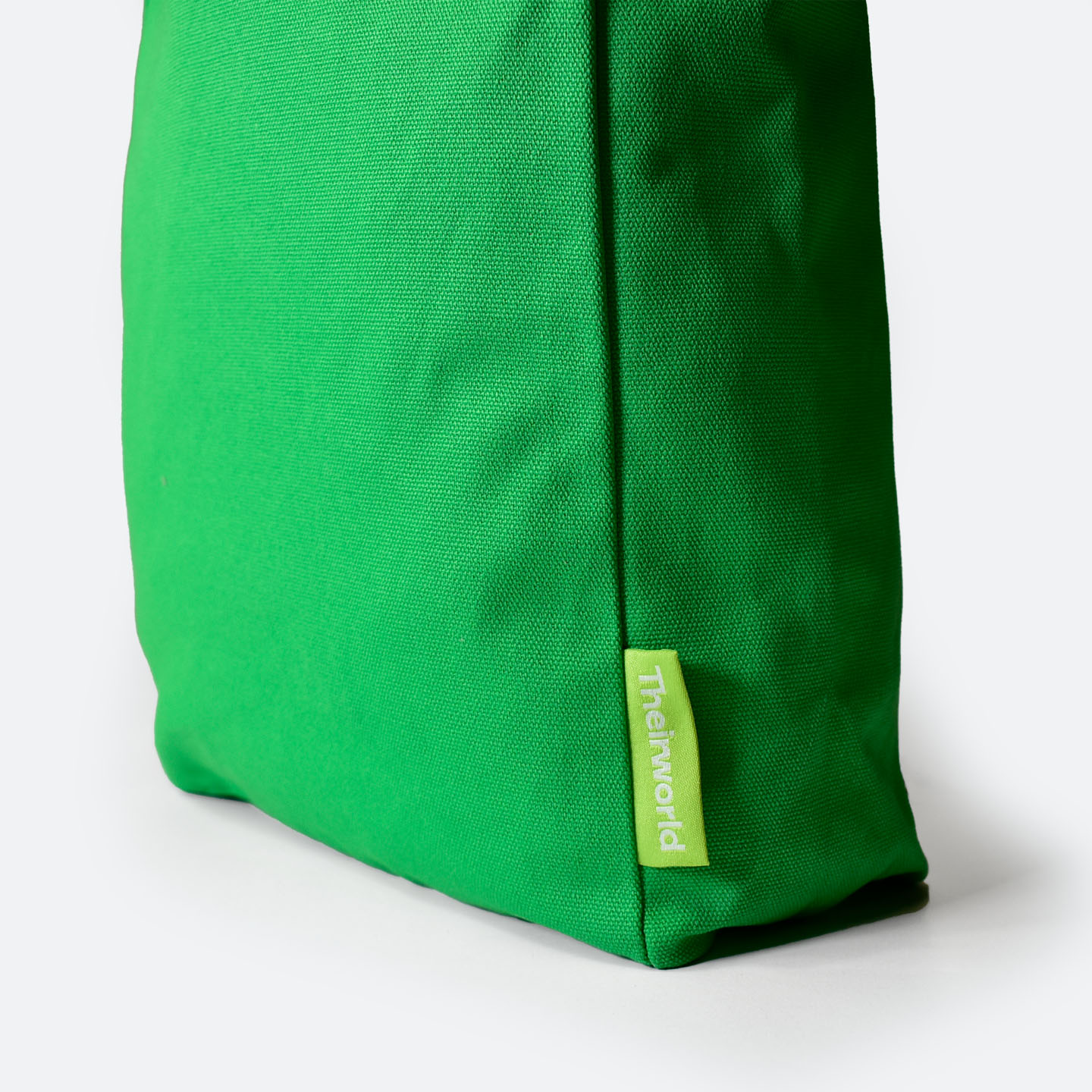
Our solution was to treat the bag as a three-dimensional architectural project. We moved away from stock templates to create a custom pattern featuring side panels and a full gusset. This construction provides a rectangular footprint, allowing the bag to maintain its structural "box" shape regardless of its contents. We meticulously calculated the internal dimensions to ensure that A4 documents would sit comfortably with enough clearance to prevent "dog-earing" or corner damage. By acting as a true OEM partner, we provided a custom-engineered template that prioritized the utility of the end-user, ensuring the bag would be used daily rather than relegated to the back of a cupboard.
Material Engineering: The Science of Pantone Perfection
Color is the most immediate communicator of brand identity. For an organization like Theirworld, their specific shades of pink and green are not merely aesthetic choices; they are recognizable symbols of their global advocacy work. Most wholesale suppliers offer a limited palette of "near-enough" colors—standard navy, basic red, or natural canvas. However, "near-enough" is the enemy of premium branding.
To achieve total brand alignment, we implemented a comprehensive custom-dyeing process. Unlike surface printing, where ink is layered onto a finished bag, custom dyeing involves treating the raw cotton fibers before the bag is even assembled. This process begins with laboratory "lab dips," where small fabric swatches are dyed and compared against Theirworld’s specific Pantone references under various lighting conditions. Once the match is perfected, the entire roll of heavy-duty cotton is submerged in the dye bath.
This method offers two distinct advantages. First, it ensures 100% color saturation throughout the fabric, providing a richness that cannot be achieved through printing. Second, it maintains the soft, tactile hand-feel of the cotton. Surface-printed colors often result in a stiff, plastic-like texture that cracks over time; custom-dyed cotton remains supple, durable, and vibrant through years of use.
A Study in Contrast: The Two Colourways
The project was split into two distinct design paths, each requiring a different approach to aesthetic detailing.
The High-Contrast Pink: This design was intended to be bold and unapologetic. To complement the vibrant pink body, we utilized high-contrast stitching in a secondary brand color. This requires an exceptional level of sewing precision, as any deviation in the stitch line is immediately visible against the bright fabric. We paired this with heavy-duty cotton webbing handles. Unlike "self-fabric" handles (made from the same thin material as the bag), cotton webbing is a thick, woven tape that provides superior comfort and weight distribution. The result was a bag that felt substantial and looked like a high-end retail product.
The Tonal Green: The second colorway focused on monochromatic sophistication. By using tonal stitching that matched the dyed green fabric, we created a sleek, professional aesthetic. To add a layer of premium branding, we integrated bespoke woven labels. These labels, featuring the Theirworld logo in high-definition thread, were sewn into the side seams, providing a subtle yet "designer" finishing touch that elevated the bag from a promotional item to a luxury accessory.
The White Label Advantage and Quality Assurance
As a trusted white-label supplier for UK agencies, we understand that the manufacturing process must be invisible to the end-user while the quality must be undeniable. Our role as project coordinators involved managing a complex global supply chain. We leveraged our partner factories that specialize in high-tension gusset sewing—a technical skill often overlooked in mass production.
Standard bags frequently suffer from "bunching" at the corners where the gusset meets the side panels. Our quality control protocol required sharp, clean 90-degree corners and reinforced "X-box" stitching at the handle attachment points. This ensures that even when the bag is loaded with heavy books or a 15-inch laptop, the structural integrity remains uncompromised. This level of detail is what defines "luxury" in the textile world—it is the absence of flaws and the presence of deliberate, reinforced engineering.
Why Quality is the Ultimate Sustainability Play
In recent years, the promotional industry has faced scrutiny regarding environmental impact. The Bag Workshop’s philosophy is that the most sustainable product is the one that never needs to be replaced. By choosing high-GSM (grams per square meter) cotton, custom dyeing, and reinforced construction, Theirworld invested in longevity. A "cheap" bag is discarded quickly, becoming waste. A bespoke, engineered A4 bag becomes a staple of the user’s daily life, providing years of brand exposure and reducing the need for disposable alternatives. This project demonstrated that when a brand invests in quality, they are also investing in a more sustainable and responsible form of marketing.
Technical Q&A: Navigating the World of Custom Manufacture
How does OEM manufacturing differ from traditional wholesale?
Traditional wholesale involves buying a finished product from a catalog and adding a logo. You are restricted by the manufacturer’s choices in size, color, and material. OEM (Original Equipment Manufacturer) manufacturing means the product is built to your specifications. You dictate the fabric weight, the exact Pantone color of the dye, the dimensions of the gusset, and the type of hardware or labels used. It is the difference between buying a suit off the rack and having one tailored to your exact measurements.
What is the benefit of a gusseted bag for B2B applications?
A gusset is an inset panel of fabric that adds depth to a bag. For B2B applications, where users are likely to carry laptops, folders, and notebooks, a gusset is essential. It transforms a flat pouch into a functional container with a flat bottom, allowing the bag to stand upright and protecting the contents from being crushed or bent.
Why is cotton webbing preferred for handles in luxury bags?
While self-fabric handles are cheaper, they lack the structural integrity required for a "luxury" feel. Cotton webbing is a dense, multi-weave material that does not stretch or fray. It feels more comfortable in the hand and stays on the shoulder more effectively than thin fabric. Furthermore, it allows for a more "structured" look, which is vital for professional branding.
What role do woven labels play in brand perception?
A woven label is a hallmark of high-end manufacturing. Unlike a heat-transferred logo, which can peel, a woven label is integrated into the construction of the bag. It suggests a level of permanence and craft, signaling to the recipient that the item was produced with care rather than mass-produced as an afterthought.
Conclusion: Engineering the Future of Brand Physicality
The collaboration between Theirworld and The Bag Workshop serves as a blueprint for how organizations should approach physical branding. By rejecting the "standard" and embracing the "bespoke," Theirworld has created a set of assets that truly reflect their mission’s importance. From the precision of the Pantone matching to the reinforced geometry of the A4 gussets, every element was designed with a purpose.
At The Wurlin Group, we continue to push the boundaries of what is possible in textile manufacturing. Whether you are an agency looking for a reliable white-label partner or a brand seeking an OEM specialist to bring a complex vision to life, our focus remains on engineering solutions that stand the test of time. We don’t just make bags; we build brand legacies through technical excellence.