

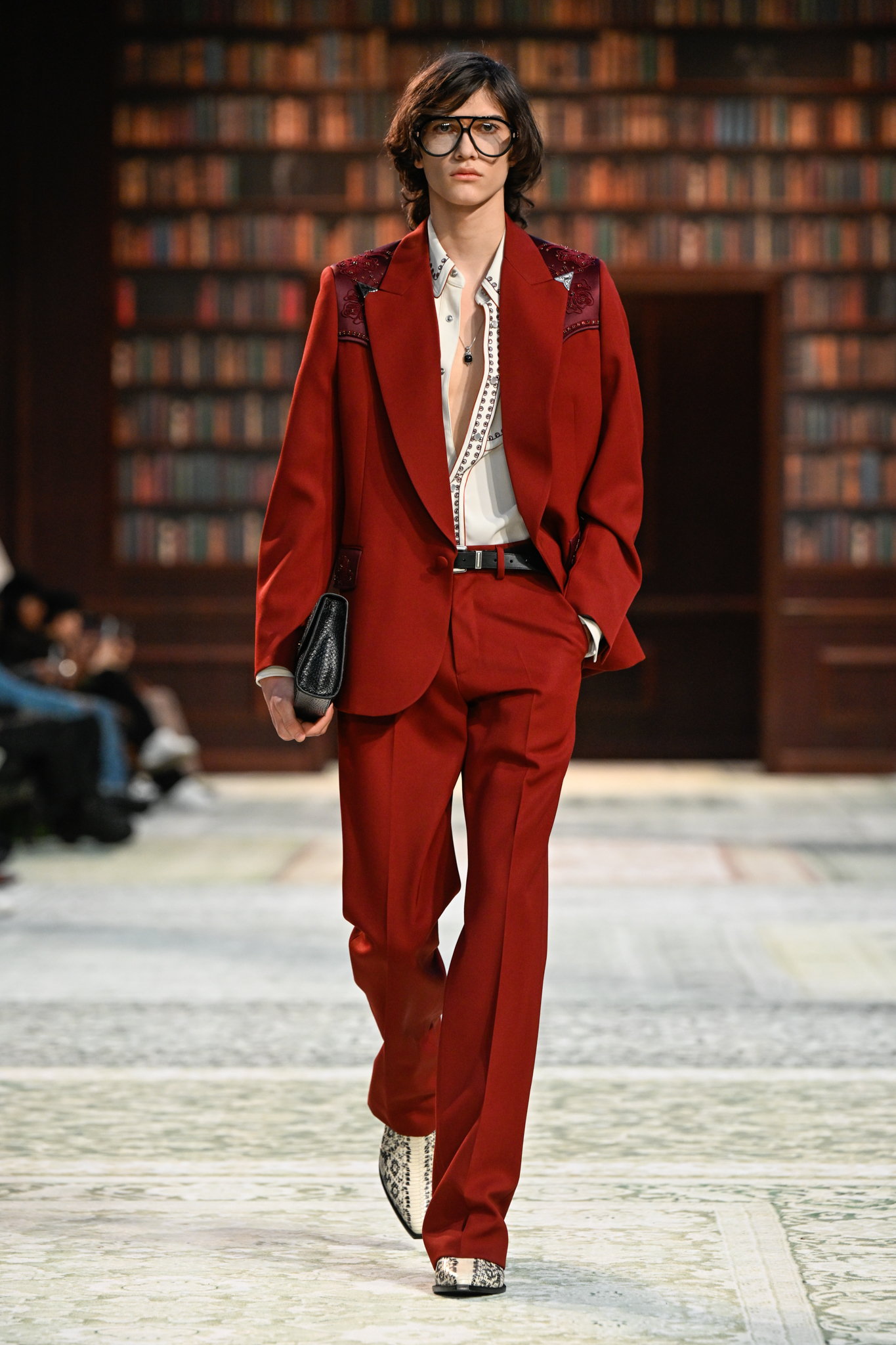
The presentation of Amiri’s Fall 2026 collection in Paris served as a deliberate and evocative cultural transplantation, lifting the sun-drenched, bohemian soul of 1970s Los Angeles and setting it down amidst the rigorous architecture of the French capital. Guests entering the show venue were immediately immersed in an environment that felt less like a runway spectacle and more like a highly curated, private gathering. The space was meticulously dressed to resemble a plush, slightly faded Laurel Canyon residence: thick-pile rugs, velvet armchairs invitingly arranged in cozy clusters, and a vast faux library serving as the atmospheric backdrop. The immediate, almost audible question among the fashion elite was whether Mike Amiri, the foremost purveyor of refined California cool, was signaling a shift toward the heritage luxury aesthetic often championed by titans like Ralph Lauren.
The answer, delivered backstage by Mike Amiri himself, was rooted firmly in the specific, nostalgic geography of L.A. history. The décor was intended to capture the intimate, creative energy of a house party thrown in Laurel Canyon during the decade of free love and groundbreaking music—the 1970s. This was the legendary enclave that served as home and crucible for an entire generation of rock troubadours, from The Eagles and Crosby, Stills, Nash & Young to Joni Mitchell and Jackson Browne. Amiri was not just referencing a vintage era; he was tapping into the specific mythos of artistic freedom and laid-back luxury that defines the West Coast aesthetic.
This commitment to L.A. authenticity was reinforced by the presence of a true Hollywood and music icon nestled comfortably in the set: the inimitable Jeff Goldblum. Alongside his wife, former Olympic gymnast Emilie Livingston, Goldblum epitomized the blend of creative flair and effortless style that Amiri celebrates. The couple had just flown in fresh from a performance at L.A.’s legendary Troubadour nightclub, a venue synonymous with the very musical history Amiri was channeling. Goldblum, a seasoned jazz pianist, had performed with his band, while Livingston had delivered an unexpected moment of artistic fusion by performing contortions atop the piano.
Goldblum, known for his distinctive sartorial choices and theatrical presence, spoke effusively about his connection to the brand, a relationship fostered by his stylist Andrew Vottero. “We love Mike and we love all his clothes,” he enthused, confirming the deep synergy between Amiri’s design philosophy and the personal narratives of Hollywood’s creative vanguard.
Amiri’s collections have always been characterized by a certain “main-character energy”—the ability to outfit the wearer for the spotlight, whether they are stepping onto a stage or simply walking down a street. The Fall 2026 collection deepened this commitment to individual expression, drawing inspiration from a kaleidoscopic range of vintage eras and iconic performance aesthetics, all filtered through the lens of meticulous Parisian craftsmanship.
The most striking elements of the collection were the suits, a nod to the highly customized, show-stopping Western tailoring that defined mid-century performance wear. Amiri resurrected the spirit of the custom "Nudie suits" favored by country and rock legends such as Johnny Cash and Elvis Presley in the 1950s. These were not mere costume reproductions, but highly refined garments featuring sharp, modern silhouettes rendered in unexpectedly rich materials. Details elevated the traditional Western jacket: metal-tipped lapels catching the light, intricate floral embroidery tracing sinuous lines across the chest and sleeves, and contrast piping that defined the architecture of the garment.
The color palette was intentionally bold, moving far beyond the muted tones typically associated with fall. Amiri employed eye-catching, saturated hues that spoke to the vibrancy of performance and the dramatic lighting of a nightclub stage. Deep vine green, dusty rose, and an electrifying seafoam green dominated the suiting, offering a visual jolt against the muted backdrop of the faux library. These tailored statements were invariably paired with highly polished, metallic cowboy boots—a final, decisive touch of rock-and-roll extravagance that grounded the collection in a narrative of amplified Americana.
Beyond the tailored pieces, the collection offered elevated interpretations of bohemian staples and vintage finds—the kind of irreplaceable treasures one might unearth at a high-end L.A. flea market, meticulously re-engineered for luxury. Knitwear, a category Amiri has mastered, included crystal-embroidered cardigans that shimmered with subtle opulence. Washed leather jackets possessed a lived-in patina, suggesting years of wear on the open road, yet were cut with the precision of haute couture. Embellished shirts, often layered beneath the suits or worn open over fine knit tanks, further blurred the line between casual comfort and stage-ready glamour.
The models themselves seemed to embody a diverse musical lineage. Some evoked the clean-cut yet rebellious spirit of early rock-and-roll pioneers like Buddy Holly, while others channeled the introspective, shaggy-haired ease of 70s singer-songwriters like Jackson Browne. This deliberate mixing of eras underscored Amiri’s message: style is not about adhering to a single trend, but about constructing a personal history.
Amiri articulated this philosophy succinctly: “People are looking for something real and something believable and honest. I don’t really believe it’s about loud fashion or quiet fashion. I believe it’s about something that touches people emotionally.”
This focus on emotional resonance is the brand’s enduring strength. Amiri has successfully created a luxury niche based on nostalgia for a specific, idealized version of West Coast creativity—a time when music and fashion were inextricably linked to personal freedom. His clothes offer a tangible connection to that mythology, allowing the wearer to inhabit a role that feels authentic and deeply resonant.
However, despite the rich narrative and the stunning collection, the presentation format itself left some observers wishing for a refresh. Given Amiri’s deep and authentic connections within the music industry—evidenced by the presence of Goldblum—the show seemed to miss a crucial opportunity to integrate a live sonic element. The reviewer pondered why Amiri hadn’t revisited the dynamic energy of previous shows, specifically recalling DJ Premier’s memorable performance during the Fall 2023 collection.
The juxtaposition of the collection’s rock-and-roll heritage and the static runway format felt slightly discordant. The very energy that defined Laurel Canyon—spontaneous, acoustic, and live—was confined to a silent walk. With Goldblum’s new album, Night Blooms, slated for release soon after the show, the potential for an organic, fully immersive performance seemed tantalizingly close, yet unrealized. While the clothing effortlessly evoked the music, the show’s structure could benefit from amplifying the volume, transforming the set from a static house party recreation into a genuinely electrifying cultural event, truly uniting the worlds of Parisian craft and L.A. rock royalty. Amiri has the emotional depth in his clothes; the next step is perhaps to give that emotion a live, unforgettable soundtrack.