

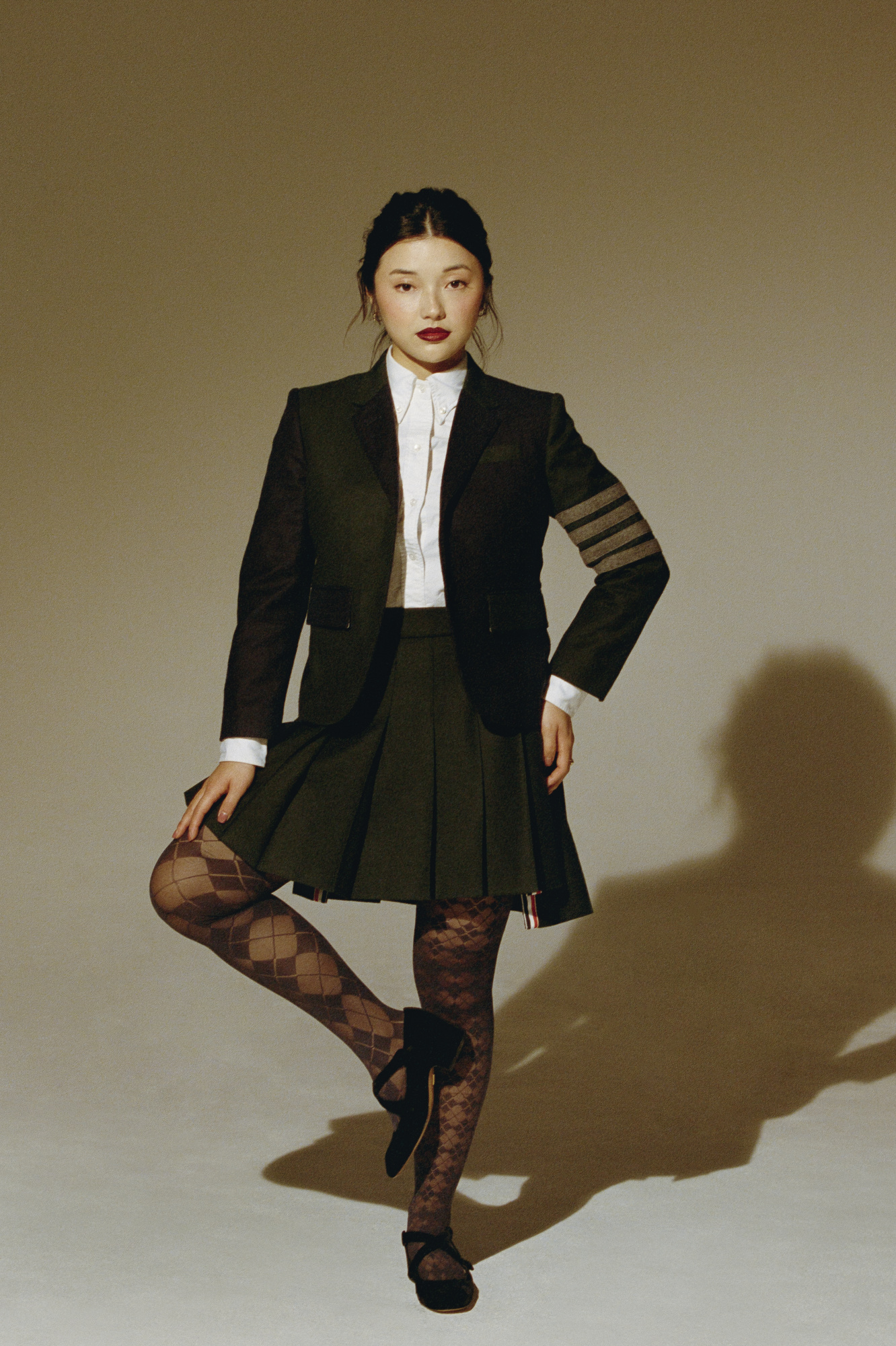
The world of Bridgerton is one defined by its glittering ballrooms, whispered scandals, and the relentless pursuit of "the incomparable." For millions of viewers, the Netflix juggernaut is a form of escapism, a Regency-era fever dream where modern sensibilities meet historical grandeur. But for Michelle Mao, the show was more than just a binge-worthy obsession—it was a blueprint for her future. Long before she stepped onto the set as a key player in the show’s fourth season, Mao was a self-described "diehard" fan, a "stan" who had memorized the cadences of the Ton and the intricate social hierarchies of Shondaland’s reimagined London. Little did she know that her encyclopedic knowledge of the series would become her greatest professional asset during one of the most secretive audition processes in Hollywood.
The journey began with a set of "dummy sides"—scripts designed to look like a generic project to prevent leaks. In the high-stakes world of major streaming franchises, secrecy is paramount, and actors often audition for roles without knowing the show’s title or the character’s true name. However, for a devotee like Mao, the veil was thin. As she read the lines for her self-tape, she felt an immediate sense of recognition. The rhythm of the dialogue, the specific tension between the characters, and the underlying themes felt unmistakably familiar. She realized she wasn’t just reading a new script; she was reading a scene from the Bridgerton spin-off, Queen Charlotte.
Speaking from Vancouver, where she is currently filming a new project, the 27-year-old actor recalls the moment the realization hit her. "Because I was such a fan of the show—and quite literally a stan, I think we can say that, I’m not embarrassed—I literally clocked it immediately," Mao says with a laugh. Her intuition was so sharp that she didn’t wait for confirmation. She immediately contacted her representatives with a bold declaration: "This is for Bridgerton."
That intuition launched a grueling six-month casting process. Mao was vying for the role of Rosamund Li, a character who would become a central antagonist in the fourth season’s narrative arc. Season 4, which focuses on the long-awaited romance of Benedict Bridgerton (played by Luke Thompson), draws heavily from Julia Quinn’s novel An Offer from a Gentleman. The story is a Regency-era reimagining of the Cinderella trope, introducing Sophie Baek (Yerin Ha) as the "Lady in Silver" who captures Benedict’s heart at a masquerade ball. In this retelling, Rosamund Li is the eldest stepsister—the ambitious, beautiful, and often cruel rival for Benedict’s affections.

Securing the role was no small feat. Mao submitted tape after tape, each time convinced it might be her last. "Every time I sent in a tape, in my head, it was like, ‘Well, that’s it. I’m not going to hear back,’ but I did my best and I feel happy about what I sent in," she reflects. One of the primary hurdles was the accent. Born in Nashville and raised in Hong Kong and Beijing, Mao had never professionally acted with a British accent. Looking back at her early audition tapes, she admits to a certain amount of "cringe" at hearing her voice fluctuate. "The accent is going in and out," she says. "I’m like, ‘Somebody saw the potential there, and I’m so thankful that they did.’"
By the time she arrived on set in the United Kingdom, the accent was no longer an obstacle. Mao had spent months refining her speech, ensuring that Rosamund would sound every bit the aristocratic social climber she was meant to be. But while she mastered the voice, she also had to prepare for the emotional weight of playing a villain. In a show as beloved as Bridgerton, fans are fiercely protective of their heroes. Playing the woman who stands in the way of Benedict and Sophie’s "happily ever after" comes with a unique set of risks.
The production team was well aware of the potential for social media backlash. Showrunners held individual meetings with Mao and her on-screen mother, the legendary Katie Leung (of Harry Potter fame), who plays Lady Araminta Gun. They were warned that the passion of the Bridgerton "fandom" could sometimes translate into vitriol directed at the actors playing the antagonists. "The showrunner Zoomed with all of us individually and was like, ‘You need to be prepared. We have resources, especially for you and Katie being the antagonists… they might vent their frustration,’" Mao recalls. At the time, she felt she could handle it, thinking she might be immune to the "internet hate." However, once the episodes premiered, the reality of the audience’s investment became clear. "People are really passionate about this," she notes.
Rather than being discouraged, Mao views the audience’s visceral reaction as a testament to her performance. To be hated as Rosamund is to have succeeded in her craft. She has developed a profound respect for actors who inhabit "unlikable" spaces, noting that the work requires a deep dive into the character’s psychology. "A villain is never a villain to themselves," Mao explains. She worked to find the "why" behind Rosamund’s actions—the pressures of the marriage mart, the influence of a demanding mother, and the desperation to secure a future in a society that offers women very little agency.
Mao’s own path to the screen was a "long and scenic" one, far removed from the choreographed balls of the Ton. Her childhood was spent navigating different cultures, moving from Tennessee to Hong Kong as an infant and later living in Beijing. Throughout her youth, theater was a constant presence, but it was always framed as a secondary pursuit. In her family and social circles, acting was a "hobby," never a viable career path.

The shift in perspective occurred when she moved to California to attend the University of California, Berkeley. At 18, she began taking classes at a local playhouse, where a teacher offered a piece of advice that would change the trajectory of her life: "What you are is what you spend the most time doing a week. So if you spend the most time acting, then you’re an actor." This simple logic dismantled the idea that she had to "wait" for permission to call herself an artist. From that day forward, she embraced the identity of an actor, trusting that the professional opportunities would eventually align with her dedication.
That dedication has led her far beyond the Regency era. In between the releases of Bridgerton Part 1 and Part 2, Mao traveled to the Sundance Film Festival for the premiere of Zi, an independent film directed by the visionary Kogonada (After Yang, Pachinko). Shot on location in Hong Kong on a shoestring budget, Zi represents the opposite end of the cinematic spectrum from the sprawling production of Bridgerton. The film allowed Mao to experiment with a more minimalist, avant-garde style of storytelling.
Currently, the team behind Zi is navigating the complex world of independent distribution. Mao is particularly excited about the possibility of bypassing traditional release models. "We’re trying to see if there are any alternative routes to distribution… because we made this film for basically nothing, and I don’t think we’ll ever get a chance again to be so free with how we experiment with a film’s release," she says. This spirit of experimentation defines Mao’s current career phase—a balance between high-profile streaming hits and soul-nourishing independent art.
As the world continues to buzz over the latest scandals in Bridgerton, Mao is already looking toward her next transformation. She is currently undergoing rigorous physical training for an undisclosed new role, one that she describes as being in the "best shape of her life." While she remains tight-lipped about the details of the project, she offers one tantalizing clue: "It’s very different to Bridgerton."
From the corsets and tea parties of 19th-century London to the cutting-edge landscapes of Kogonada and the physical demands of her upcoming work, Michelle Mao is proving to be a versatile force in the industry. Whether she is playing the villain we love to hate or an indie protagonist lost in thought, Mao’s journey from a "stan" in the audience to a star on the screen is a reminder that sometimes, the best way to enter a world is to know it by heart before you even arrive.