

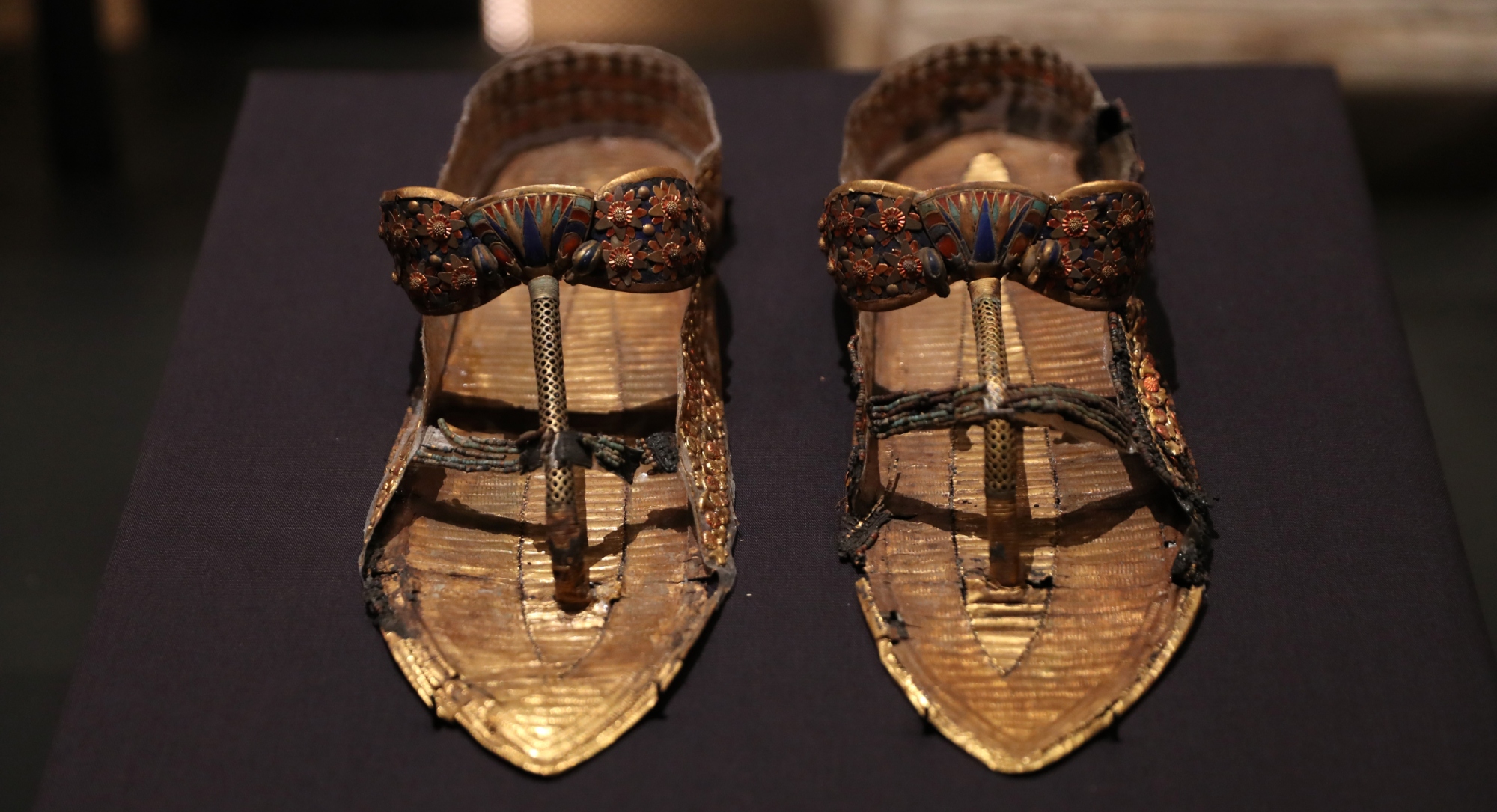
Long before modern icons like Jonathan Bailey, Pharrell Williams, or Gigi Hadid lent their celebrity status to elevate the humble flip-flop into a contemporary fashion phenomenon, the young Pharaoh Tutankhamun stood as history’s most celebrated champion of ancient sandal design. The incredible collection of footwear interred with the boy-king over three millennia ago offers far more than just a glimpse into ancient Egyptian fashion; it provides a detailed cultural roadmap of status, technology, trade, and even royal anatomy.
The story of these remarkable artifacts culminates today at the Grand Egyptian Museum (GEM) in Cairo, which has finally brought together the entirety of the funerary cache discovered by Howard Carter in 1922. Now, visitors can view all 5,500-plus items from Tutankhamun’s tomb—including the extraordinary collection of at least 82 pairs of shoes—in one comprehensive display. This unprecedented inventory ranges from simple daily wear to elaborately decorated ceremonial pieces and the critical gold burial shoes placed directly on the mummy’s feet.
The Paradox of the Sewn Sandal
The majority of Tutankhamun’s collection consists of a style known as the “sewn sandal.” These were not opulent creations of precious metal, but rather meticulously crafted pieces made from readily available, yet durable, organic materials: grass, tightly woven palm leaves, and papyrus.
Archaeologist and paleontologist Dr. André J. Veldmeijer, a leading expert in the field and author of seminal works like Tutankhamun’s Footwear: Studies of Ancient Egyptian Footwear, highlights the intriguing cultural significance of these seemingly simple items. Veldmeijer notes that despite their inexpensive composition, these sewn sandals were profound markers of elite status.

“Research has shown that specifically these sandals were important status markers: they were worn by the royal family and those officials that were rewarded by the king himself,” Veldmeijer explains. The paradox remains: why did such high regard attach itself to footwear made of common fibers? It suggests that the value lay not in the raw material, but in the sophisticated craftsmanship, the specific design, and the symbolic authority bestowed by the pharaoh upon the wearer.
This high status was immortalized in the afterlife preparations. The two pairs of gold open shoes and, most importantly, the pair of gold sandals placed directly on Tutankhamun’s mummy, were not new designs. They were detailed, solid-gold replicas of the simple sewn sandals. These funerary shoes were fashioned using advanced techniques like embossing, painstakingly replicating the texture and structure of the palm leaf stitching around the grass cores—a clear sign that the form of the simple sandal held deep, enduring significance, even when executed in eternal gold.
Masterpieces of Ancient Luxury: The "Open Shoes"
While the sewn sandals defined daily prestige, the most breathtaking examples of the collection are the highly complex "open shoes." These pieces, considered by Veldmeijer to be “the most special examples of footwear,” represent the pinnacle of New Kingdom artistry and material wealth.
These open shoes featured a low-cut upper that covered the back three-quarters of the foot while leaving the toes and front section exposed. The materials list alone is astounding: gold, leather, wood, linen, and thousands of meticulously placed beads.

Creating a single pair of these royal shoes required a convergence of specialized artisans. Goldsmiths used techniques like repoussé (embossing) to shape the gold components and delicate filigree to create fine wire elements. Expert tanners processed the leather, likely dyeing it the favored royal colors of red or green, using complex methods to ensure the material’s survival through millennia. Bead-makers created and strung thousands of tiny beads to form the outer layer of the upper, while precious inlays, such as imported lapis lazuli and vibrant colored glass, were set into the elaborate leather straps.
Another pair of highly specialized leather sandals stands out for its delicate openwork straps and ornamentation with gilded bronze bosses—a testament to the high-level metal and leather craftsmanship available exclusively to the royal court.
The Anatomical Mystery and Foreign Influence
Perhaps the most fascinating aspect of a few select pairs of the most special shoes—including one pair made purely of leather and another of the luxurious gold/beaded "open shoes"—is their unique structural configuration.
Traditional ancient Egyptian sandals featured a single thong strap passing between the first and second toes. However, these specific royal pairs display an unusual design where the front strap is either missing entirely or combined with a strap that runs across the top of the foot.

This deviation from the norm immediately sparked speculation among historians and researchers after the tomb’s discovery. Given that modern analyses of Tutankhamun’s body suggest he suffered from multiple health issues, including potentially a clubfoot or other bone deformities, some theorized that these custom shoes were designed to accommodate a physical disability or unique gait.
However, Dr. Veldmeijer cautions against drawing premature conclusions based solely on the strap configuration. He notes that comprehensive study of the surviving footwear has revealed no “extraordinary pressure points that he walked differently than the usual gait of a human being.”
Instead, the unique design points toward a significant aspect of New Kingdom geopolitics: cultural exchange. Veldmeijer suggests that comparable, non-traditional closure systems existed in footwear from regions outside of Egypt, such as the Near East or Nubia. This suggests that the distinctive sandals might have been gifts from foreign dignitaries, adapted slightly to Egyptian aesthetic standards, or perhaps inspired by international fashion trends embraced by the cosmopolitan 18th Dynasty court. This theory underscores how even personal items like shoes can reveal global connections and diplomatic relationships from the ancient world.
Footwear as a Jigsaw Puzzle Piece
The importance of Tutankhamun’s footwear transcends its intrinsic beauty or historical curiosity. For archaeologists, the collection is a vital source of information on multiple levels.

Studying the construction methods of the sandals illuminates the technological capabilities of the era—from leather tanning and dyeing to highly refined gold-working techniques. The evolution of styles over time allows researchers to more accurately date other archaeological finds. Furthermore, the availability and use of materials like imported lapis lazuli speaks directly to the wealth of the royal family and the extent of their trade networks.
The footwear also carried significant symbolism. As Veldmeijer notes, beyond acting as status markers, some ancient footwear may have served an apotropaic function—believed to ward off evil, a belief still observed in parts of the world today. The very act of placing numerous pairs of shoes in the tomb ensured the pharaoh’s successful transition and protection in the afterlife.
In conclusion, the 82 pairs of sandals and shoes recovered from Tutankhamun’s tomb provide a rich and tangible link to ancient Egyptian civilization. As Dr. Veldmeijer summarizes, “Footwear, like clothing and basically all variables of the material culture, contains information that, all combined, help to build a picture of the ancient world and people as complete as possible—everything provides for pieces of the huge jigsaw puzzle.” These ancient artifacts, now magnificently displayed at the GEM, prove that even the most mundane items of material culture can carry the weight of history, diplomacy, and enduring artistic excellence.