

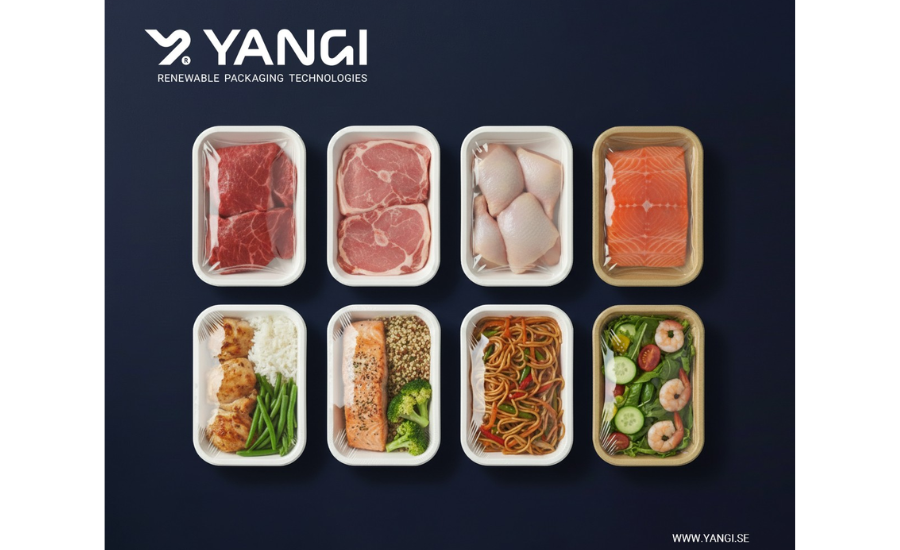
The global packaging industry is currently navigating a period of unprecedented transformation, driven by a dual mandate: the urgent need for environmental sustainability and the unyielding demand for functional, high-performance materials. For decades, the meat, poultry, seafood, and ready-meal sectors have been among the most challenging to transition away from traditional plastics due to the rigorous requirements of moisture resistance, gas barriers, and thermal stability. However, a significant technological breakthrough has emerged from Sweden. Yangi, a pioneer in sustainable packaging technology, has officially launched its first production-ready dry-formed fiber tray, specifically engineered for the demanding protein and deli markets. This innovation is powered by Cellera®, Yangi’s proprietary turnkey dry-forming platform, which promises to render traditional wet-molded fiber processes obsolete by offering a faster, more efficient, and more aesthetically versatile alternative.
The launch of this tray represents more than just a new product; it signifies the commercial maturation of dry-forming technology. While fiber-based packaging has existed for years—most notably in the form of egg cartons and molded pulp protective inserts—it has historically struggled to compete with plastic in the "wet" food category. Wet-molding processes are energy-intensive, requiring vast amounts of water and lengthy drying times, which often result in rough surfaces and inconsistent dimensional tolerances. Yangi’s Cellera® technology bypasses these limitations entirely. By utilizing a dry-forming process, the platform achieves a level of precision and surface smoothness that was previously unattainable with renewable fibers. This allows brands to maintain a premium shelf presence while meeting the stringent functional needs of fresh food logistics.
At the heart of this innovation is the Cellera® platform, a fully integrated industrial system designed for high-volume manufacturing. Unlike traditional methods that rely on water-slurry suspension, Cellera® employs a precision dual-drum airlaid formation system. This is complemented by in-line custom pad formation and advanced transfer technology, ensuring that every gram of fiber is utilized with maximum efficiency. One of the most striking features of this system is its speed. With cycle times ranging from just four to six seconds, the platform offers the operational stability and throughput necessary for large-scale packaging converters to scale their operations with confidence. This efficiency is a critical factor in making fiber-based trays cost-competitive with the fossil-fuel-based plastics they are intended to replace.
The functional versatility of the new tray is designed to handle the "real-world" rigors of the modern food supply chain. Food producers require packaging that can withstand extreme temperature fluctuations, from the sub-zero environments of industrial freezers to the high-heat conditions of conventional ovens and microwaves. Yangi’s dry-formed trays have undergone rigorous testing to ensure they maintain their structural integrity and shape throughout these transitions. Furthermore, the trays are compatible with Modified Atmosphere Packaging (MAP), a crucial requirement for extending the shelf life of fresh proteins like fish and meat. By enabling effective sealing and barrier properties, the tray ensures that food safety and waste reduction goals are met alongside sustainability targets.
From a design perspective, the Yangi tray breaks the "utilitarian" mold of traditional fiber packaging. One of the primary complaints brands have regarding wet-molded fiber is its aesthetic limitation. Yangi has addressed this by providing expanded design freedom. The trays feature a premium surface quality that supports high-resolution digital printing across the entire surface area, including the sidewalls. This allows for vibrant branding and essential nutritional information to be printed directly onto the tray, potentially eliminating the need for secondary sleeves or labels. Additionally, the trays support debossing, allowing for tactile branding elements that enhance the consumer’s sensory experience. Available in both bleached and unbleached options, the trays can be tailored to fit various formats, providing a "label-ready" finish that aligns with the visual identity of premium food brands.
Sustainability is, of course, the primary driver behind this technological leap. The trays are manufactured using responsibly sourced, renewable virgin fibers and are entirely PFAS-free. Per- and polyfluoroalkyl substances (PFAS), often referred to as "forever chemicals," have historically been used in fiber packaging to provide grease and water resistance. However, increasing regulatory pressure and health concerns have led to a global movement to eliminate them. Yangi’s commitment to a PFAS-free composition ensures that their packaging is ahead of the regulatory curve. Furthermore, when compared to traditional plastic alternatives, the dry-formed fiber tray boasts a carbon dioxide impact that is approximately 80% lower. This dramatic reduction in greenhouse gas emissions is achieved by eliminating the energy-intensive water evaporation phase of the production process and utilizing a more streamlined supply chain for raw materials.
Hanna Rudel, the Chief Commercial Officer at Yangi, emphasized the flexibility of the new offering, noting that the tray is not a one-size-fits-all solution but a customizable platform. Brands can work with Yangi to adjust the barrier requirements and design specifications to suit their specific products. This flexibility is essential in a market where a tray for fresh salmon might require different performance characteristics than a tray for a pre-cooked pasta meal. According to Rudel, this technology allows brands to move into fiber-based solutions without being forced to compromise on the functionality or cost-effectiveness they have come to expect from plastic.
The environmental impact of the tray is further enhanced by its end-of-life profile. Recyclability is a cornerstone of the circular economy, and Yangi has designed its trays to be compatible with existing paper recycling streams. While the specific recyclability can depend on the type of functional laminate applied for high-barrier applications, the goal remains the maximum recovery of fibers. By using integrated fiber chemistry, Yangi ensures that the outer properties of the tray are robust enough for handling while remaining "repulpable" in standard recycling facilities. This alignment with existing infrastructure is vital for achieving high recycling rates, as it does not require consumers or municipalities to invest in specialized sorting or processing equipment.
Anna Altner, the founder of Yangi, views this launch as a pivotal moment for the industry. She notes that for many years, packaging producers and brands have been searching for a viable alternative to both plastic and wet-molded fiber. The arrival of a scalable, industrially reliable dry-forming process provides that alternative. Altner believes that dry forming is poised to become the new benchmark for fiber-based packaging, offering a combination of environmental stewardship and manufacturing precision that was previously thought impossible.
The broader implications for the global market are significant. As governments around the world, particularly in the European Union under the Packaging and Packaging Waste Regulation (PPWR), move to restrict single-use plastics and mandate higher recycling content, technologies like Cellera® will become indispensable. The ability to produce high-performance packaging with minimal water use and a drastically lower carbon footprint positions Yangi at the forefront of the "green" industrial revolution. For converters, the transition to dry forming offers a way to future-proof their business models against fluctuating plastic prices and tightening environmental legislation.
In conclusion, Yangi’s introduction of the dry-formed fiber tray for the meat, fish, and ready-meal sectors is a landmark achievement in material science and industrial engineering. By solving the historical problems of speed, surface quality, and moisture resistance associated with fiber, Yangi has provided a clear pathway for the food industry to divest from plastic. With its 80% reduction in CO2 emissions, PFAS-free construction, and high-speed production capabilities, the Cellera® platform is set to redefine how we package the world’s most perishable foods. As this technology continues to scale, it will likely serve as the foundation for a new era of truly sustainable, high-performance packaging that meets the needs of the planet and the demands of the modern consumer.