

The global packaging landscape is undergoing a seismic shift, driven by a convergence of heightened consumer awareness, aggressive retail sustainability targets, and a tightening web of environmental legislation. At the center of this transformation is the dairy industry, a sector traditionally reliant on complex, multi-layered plastic structures designed to preserve freshness but often at the cost of recyclability. Addressing this challenge head-on, Amcor, a global leader in developing and producing responsible packaging solutions, has announced the commercialization of its AmPrima® Plus recycle-ready packaging. This innovation is specifically engineered to support cheese processors in North America as they navigate the transition toward a circular economy without sacrificing the rigorous performance standards required for high-value dairy products.
For decades, the "chunk cheese" segment—a multi-billion-dollar powerhouse in the North American food industry—has relied on packaging formats that prioritize barrier properties over end-of-life viability. Many premium cheeses have traditionally utilized a "double-pack" approach: a primary plastic flow wrap to maintain vacuum seals and moisture levels, encased within a secondary paperboard overpack intended to provide brand real estate and a premium "shelf-presence." While effective for marketing, this heavy-duty approach results in significant material waste. Amcor’s latest breakthrough aims to dismantle this paradigm by proving that sustainability and high-end branding are not mutually exclusive.
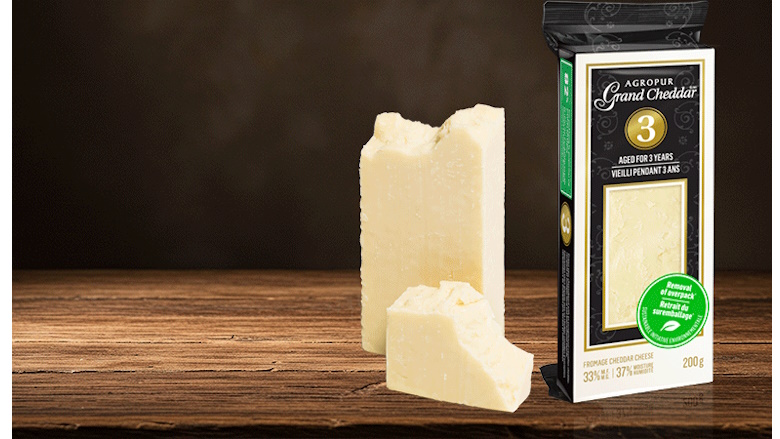
The real-world application of this technology is best exemplified by Agropur, a prominent North American dairy cooperative. Their signature premium product, Grand Cheddar™, recently underwent a significant packaging overhaul. Previously, the cheese was sold in a traditional paperboard overpack with a plain internal flow wrap. In a bold move toward sustainability, Agropur transitioned the product to an all-flexible, single-component package powered by Amcor’s AmPrima® Plus. This shift allowed Agropur to eliminate the bulky paperboard entirely, moving toward a streamlined, "recycle-ready" format that aligns with modern environmental mandates.
However, moving to a flexible format often raises concerns regarding brand perception. To ensure that Grand Cheddar™ maintained its "signature high-end look," Amcor utilized its proprietary Amplify® finishing technologies. By incorporating matte overlacquers and sophisticated metallic inks directly onto the flexible substrate, Amcor was able to replicate—and in some ways enhance—the premium tactile and visual experience of the original paperboard box. This demonstrates a critical milestone in packaging engineering: the ability to achieve "source reduction" (using less total material) while simultaneously elevating the product’s shelf appeal.
John Kearny, the Senior Commercial Director for Dairy at Amcor Flexibles North America, emphasized that this transition is about more than just aesthetics. According to Kearny, the new Agropur packaging serves as a masterclass in how flexible materials can deliver meaningful cost savings and environmental benefits. He noted that AmPrima® Plus represents a significant leap in material science, marking the industry’s first recycle-ready flow wrap for chunk cheese that fully complies with the Association of Plastic Recyclers (APR) guidelines. The APR guidelines are the gold standard for determining whether a plastic package can successfully pass through the existing recycling infrastructure without contaminating the stream, a feat that has historically been difficult for high-barrier cheese films.
The environmental data supporting this shift is compelling. According to an Amcor ASSET™ life cycle assessment, which has been independently certified by the Carbon Trust, the AmPrima® Plus flow wrap offers a staggering 45% reduction in carbon footprint compared to standard, non-recyclable flow wraps when the material is successfully recycled. This reduction is attributed to several factors, including the use of mono-material polyolefin structures that require less energy to produce and are significantly lighter to transport than rigid or multi-material alternatives. By reducing the weight and volume of the packaging, processors can fit more product into a single shipping container, further lowering the "carbon-per-unit" cost of logistics.
The technical prowess of AmPrima® Plus lies in its ability to balance two seemingly contradictory goals: recyclability and high-performance protection. Cheese is a living product; it requires specific oxygen and moisture barrier levels to prevent spoilage, mold growth, and oil migration. Traditional "recyclable" plastics often lack the density or chemical makeup to provide these barriers over a long shelf life. Amcor’s innovation bridges this gap, offering a "recycle-ready" solution that matches the hermetic seal integrity and puncture resistance of legacy non-recyclable films. This ensures that food waste—another massive contributor to environmental degradation—does not increase as a byproduct of switching to greener packaging.
Beyond the AmPrima® Plus line, Amcor is positioning itself as a comprehensive partner for the dairy industry’s green transition. The company has developed a broad portfolio of solutions tailored to the unique needs of different dairy formats. For example, their Eco-Tite® recycle-ready shrink bags offer a sustainable alternative for vacuum-packed meats and cheeses, while the Amcor Revolution™ Barrier APET films provide high-clarity, recyclable options for tray-based products. Furthermore, the AmFiniti™ platform is a groundbreaking initiative that enables the integration of both mechanically and chemically recycled content into flexible and rigid packaging formats. This is a crucial development for the industry, as it helps create a "closed-loop" system where old packaging becomes the raw material for new packaging, reducing the reliance on virgin plastics derived from fossil fuels.
The timing of these innovations is no coincidence. In North America, the legislative landscape is shifting rapidly. States like California, Oregon, and Maine have passed Extended Producer Responsibility (EPR) laws that hold manufacturers financially accountable for the end-of-life management of their packaging. Simultaneously, major retailers are setting "2025" or "2030" deadlines for their suppliers to switch to 100% recyclable, reusable, or compostable packaging. For cheese processors, the question is no longer if they should switch to sustainable packaging, but how fast they can do so without disrupting their supply chains or alienating consumers.
The transition to AmPrima® Plus also addresses the growing "green-seeking" consumer demographic. Modern shoppers are increasingly scrutinizing the back of the pack, looking for recycling symbols and "how-to-recycle" instructions. By adopting a format that is compatible with store drop-off programs or curbside recycling (depending on local infrastructure), brands like Agropur can build deeper trust with their customer base. This "eco-transparency" is becoming a powerful marketing tool in the competitive dairy aisle, where brand loyalty is often tied to shared values regarding the environment.
Furthermore, the operational benefits for the manufacturer are substantial. AmPrima® Plus is designed to run on existing high-speed packaging lines with minimal adjustments. This "drop-in" compatibility is vital for large-scale processors who cannot afford the downtime or capital expenditure required to overhaul their entire production floor. By providing a material that behaves like traditional plastic on the machine—maintaining heat-seal strength and line speed—Amcor has removed one of the biggest hurdles to sustainable adoption.
As the dairy industry moves forward, the success of the Agropur Grand Cheddar™ redesign will likely serve as a blueprint for other categories, from shredded cheese to sliced deli products. The ability to achieve a 45% carbon reduction while maintaining a premium brand image is a compelling value proposition that resonates with both the CFO and the Chief Sustainability Officer. Amcor’s commitment to the APR guidelines ensures that as recycling infrastructure improves across North America, these packages will be ready to be processed and repurposed, moving the industry one step closer to a truly circular economy.
In conclusion, the commercialization of AmPrima® Plus is more than just a product launch; it is a signal that the technical barriers to sustainable dairy packaging are falling. Through a combination of material science, aesthetic innovation via Amplify® technologies, and rigorous environmental validation through the Carbon Trust, Amcor is proving that the future of the dairy aisle is flexible, beautiful, and, most importantly, recyclable. For processors, the path to meeting legislative mandates and retail requirements is now clearly defined, paved with solutions that protect the product, the brand, and the planet simultaneously.