

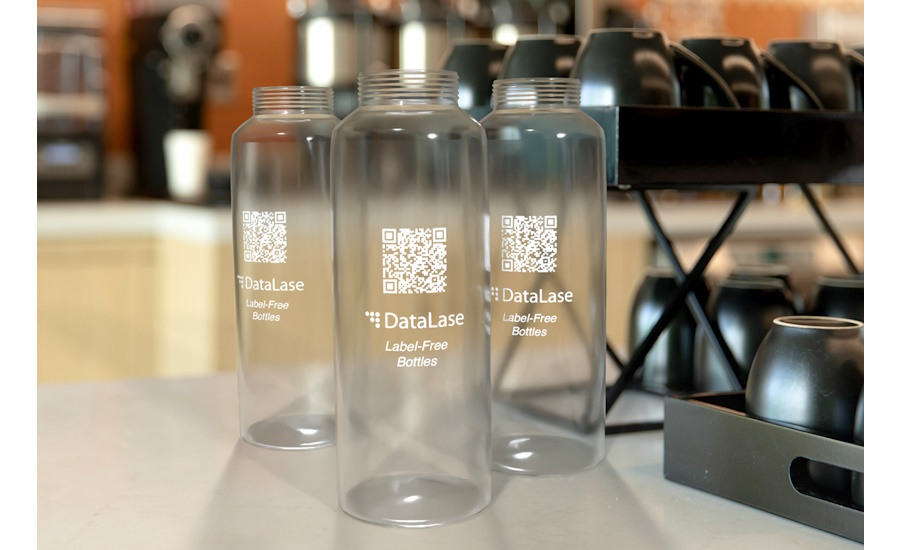
The global packaging industry is currently navigating a period of unprecedented transformation, driven by a dual mandate: the urgent need for environmental sustainability and the demand for smarter, more agile supply chains. For decades, the plastic bottle has relied on secondary materials—specifically paper or plastic film labels—to communicate brand identity, regulatory data, and consumer information. However, these traditional labeling methods are increasingly viewed as a bottleneck in the circular economy, complicating recycling streams and contributing significantly to the global waste crisis. In a decisive move to address these challenges, DataLase, a pioneer in laser-reactive pigment technology, has unveiled its latest innovation: a clear-to-white, label-free coating designed specifically for plastic bottles. This technology represents more than just a new product; it is a fundamental shift in how brands approach decoration, data integration, and material efficiency.
As brands across the beverage, pharmaceutical, and personal care sectors race to meet 2025 and 2030 sustainability targets, the pressure to "dematerialize" packaging has never been higher. Legislative frameworks, such as the European Union’s Packaging and Packaging Waste Regulation (PPWR), are setting stringent requirements for recyclability and the reduction of unnecessary packaging layers. Traditional labels, while functional, present several ecological hurdles. They often involve multi-material compositions, such as plastic films with acrylic adhesives or paper labels with metallic foils, which can contaminate recycling batches. Furthermore, the "matrix waste"—the backing paper or film that is discarded during the label application process—adds thousands of tons of non-recyclable material to landfills annually. DataLase’s new clear-to-white coating addresses these issues at the source by eliminating the label altogether.
The technical foundation of this solution lies in a sophisticated laser-reactive coating that is applied directly to the surface of the bottle. Optimized for use on Polyethylene Terephthalate (PET), Polypropylene (PP), and Polycarbonate (PC) substrates, the coating is designed for seamless integration into existing high-speed bottling lines. Manufacturers can apply the coating via standard spray-coating units, which are already common in many industrial filling environments. Once the coating is applied and dried, the bottle passes through a laser marking station. Unlike traditional inkjet printing, which adds liquid ink to a surface, or thermal transfer printing, which requires ribbons, DataLase’s technology utilizes the power of light to trigger a color-change reaction within the coating itself.
The imaging process is compatible with a wide array of laser sources, including CO₂, fiber, and UV lasers. When the laser strikes the coated area, it induces a photothermal reaction that turns the clear coating into a high-opacity, brilliant white image. The result is a sharp, high-contrast graphic that mimics the appearance of a high-quality printed label but without the physical substrate. This "clear-to-white" transition is particularly significant for the beverage industry, where white ink is often the most difficult to achieve with clarity and durability on transparent plastic. By providing a white-on-clear aesthetic, DataLase allows brands to maintain their visual identity and ensure that barcodes and QR codes are easily scannable against the contents of the bottle.
The operational advantages of moving to a label-free system are profound. In a traditional manufacturing setup, a brand might manage hundreds, or even thousands, of unique Stock Keeping Units (SKUs) based on the label design alone. Every time a production line switches from one product variant to another—for example, from a standard soda to a "limited edition" promotional bottle—the line must be stopped to change the label reels. This leads to significant downtime and potential for error. DataLase’s solution enables "late-stage customization," where the base bottle remains the same and the unique graphics are "printed" digitally via laser at the very end of the production process. This allows for instantaneous SKU changes without stopping the line, drastically improving equipment uptime and overall factory efficiency.
Furthermore, the elimination of physical labels streamlines the entire supply chain. Companies no longer need to source, transport, and store massive inventories of labels, which are often sensitive to temperature and humidity. By removing these consumables from the equation, manufacturers can reduce their warehousing footprint and lower the carbon emissions associated with the logistics of label materials. From a financial perspective, while the initial investment in laser hardware and specialized coatings is required, the long-term Total Cost of Ownership (TCO) is often lower due to the removal of ongoing consumable costs (labels, ribbons, inks) and the reduction in waste disposal fees.
Ally Grant, the Chief Technology Officer at DataLase, emphasized the transformative nature of this launch, noting that the industry is at a tipping point. Grant pointed out that brands are no longer just looking for incremental improvements; they are looking for ways to decouple production growth from environmental impact. The clear-to-white coating allows for this by providing full label-equivalent functionality—including the ability to print complex logos, detailed nutritional tables, and regulatory symbols—while using a fraction of the material. This flexibility extends to the era of "Big Data" and personalized marketing. Because the laser imaging is digital and variable, every single bottle can be unique. Brands can print individual serialized codes for anti-counterfeiting, unique QR codes for consumer engagement loyalty programs, or even personalized names and messages for marketing campaigns, all at production speeds that were previously unthinkable for customized packaging.
From a sustainability and recycling standpoint, the DataLase coating is a game-changer for the circular economy. One of the primary challenges for Plastic Recovery Facilities (PRFs) is the interference caused by labels during the Near-Infrared (NIR) sorting process. Large labels can sometimes "mask" the underlying plastic, leading to sorting errors where high-quality PET is misclassified. Additionally, adhesives used in traditional labeling can be difficult to remove in the wash cycle, leading to "yellowing" or contamination of the recycled plastic flakes (rPET). DataLase’s coating is formulated to be thin and compatible with standard recycling processes. By moving toward a mono-material-like construction where the decoration is an integral part of the bottle’s surface, the purity of the resulting recyclate is significantly improved, supporting the industry’s goal of "bottle-to-bottle" closed-loop recycling.
Durability is another critical factor where this new coating excels. Traditional labels are prone to peeling, flagging, or scuffing during the rigors of distribution and refrigeration. DataLase has engineered its clear-to-white coating to be exceptionally resilient. It is resistant to water, heat, and mechanical abrasion, ensuring that essential regulatory information remains legible from the factory floor to the consumer’s home. This is particularly vital for pharmaceutical applications, where the integrity of dosage instructions and expiration dates is a matter of consumer safety. The coating is also formulated to comply with stringent global regulations regarding non-direct food contact, ensuring that it meets the safety standards required for the global food and beverage market.
In conclusion, the launch of DataLase’s label-free, clear-to-white coating marks a significant milestone in the evolution of sustainable packaging. By merging the worlds of material science and digital laser technology, DataLase has provided a solution that satisfies the competing demands of modern commerce: the need for high-speed production, the desire for brand customization, and the absolute necessity of environmental stewardship. As the world moves away from a "take-make-waste" model toward a truly circular economy, innovations like this will be the catalysts that allow brands to remain competitive while significantly reducing their ecological footprint. The "bottle of the future" will likely not carry a label at all; instead, it will carry a digital identity etched in light, proving that in the world of packaging, sometimes less truly is more.