

The Fall/Winter 2026 collection from Pronounce, helmed by the formidable creative partnership of Yushan Li and Jun Zhou, marks a definitive and powerful maturation for the label. Presented within the refined, art-filled confines of Fondazione Sozzani—a venue itself synonymous with cultural curation and polished modernity—the collection was not merely a presentation of seasonal garments, but a profound architectural synthesis. After two years embedding themselves within the rigorous ecosystem of Milan, the Chinese duo demonstrated that they have fully metabolized the city’s inherent strengths, translating them into a lexicon that is simultaneously commercially astute and deeply conceptual. This season, Pronounce stepped away from the emerging experimentalism that characterized their early work and embraced the gravitas of intentional, sophisticated luxury, proving that the East-West dialogue they champion has reached a new, compelling fluency.
The Milanese Crucible: Refining the Pronounce Language
Yushan Li and Jun Zhou arrived in the Italian fashion capital with a clear vision: to forge a bridge between Eastern heritage and contemporary global design. While their initial collections were lauded for their innovative textiles and conceptual depth, the move to Milan has acted as a crucible, refining their output with an essential dose of sartorial discipline and commercial clarity. Milan, the global epicenter of precise tailoring and leather craftsmanship, has instilled a palpable sense of structure and meticulous finishing into the Pronounce identity.
This geographical shift has not diluted their core identity but rather sharpened it. The designers have successfully integrated the pragmatic expertise of Italian production—the flawless cut, the weight of the fabric, the subtle nuance of construction—into their existing framework of conceptual narrative. The result is an enhanced cohesiveness that transcends mere stylistic juxtaposition. The Fall 2026 collection radiates a polished confidence, suggesting the designers are now operating with a maturity that understands the demands of the luxury market without sacrificing artistic integrity. The influence is evident in the transition towards more covetable tailoring, the elevation of essential leather pieces, and a distinctly European sensibility regarding color and texture layering.
Where earlier seasons might have prioritized narrative complexity, F/W 2026 prioritizes wearability and enduring elegance. This newfound focus on the technical mastery of garment construction—a hallmark of Italian fashion—ensures that the conceptual dialogue between their Chinese roots and their European home is grounded in impeccable craft. It is the language of sprezzatura, where complexity appears effortless, adopted and adapted for a new global consumer.
The Rooted Inspiration: Architectural Verticality
Despite the pronounced Milanese influence on technique, the heart of the Fall 2026 collection remains firmly anchored in Chinese heritage. Backstage, Li and Zhou cited the Yingxian Wooden Pagoda in Shanxi Province as the central muse—a structure that represents an extraordinary confluence of history, engineering, and enduring aesthetic beauty. Billed as the tallest surviving wooden pagoda in the world, the structure is renowned for its ingenious, nail-free construction, relying instead on a sophisticated system of interlocking brackets (Dougong) that allow the structure to flex and withstand seismic activity.
This ancient architectural principle—structural integrity achieved through flexible joinery rather than rigid fastening—served as a powerful metaphor for the collection’s ethos. The designers translated the Pagoda’s engineering philosophy into garments that possess both imposing structure and surprising fluidity. The concept of nail-free elegance manifests in the seamless layering and the relaxed formality of the silhouettes. The architectural verticality of the nine-story structure directly informed the collection’s emphasis on elongated lines and slender, layered forms, creating an illusion of height and graceful ascent.
Furthermore, the aged colors of the Pagoda—the deep, oxidized tones of wood, the muted mineral pigments of ancient paint, and the atmospheric blues of the Shanxi sky—provided the bedrock for the collection’s polished color sensibility. The palette favored deep charcoals, rich oxbloods, mossy greens, and softened taupes, offering an autumnal depth that felt luxurious and subdued.
The Collection Breakdown: Structure Meets Fluidity
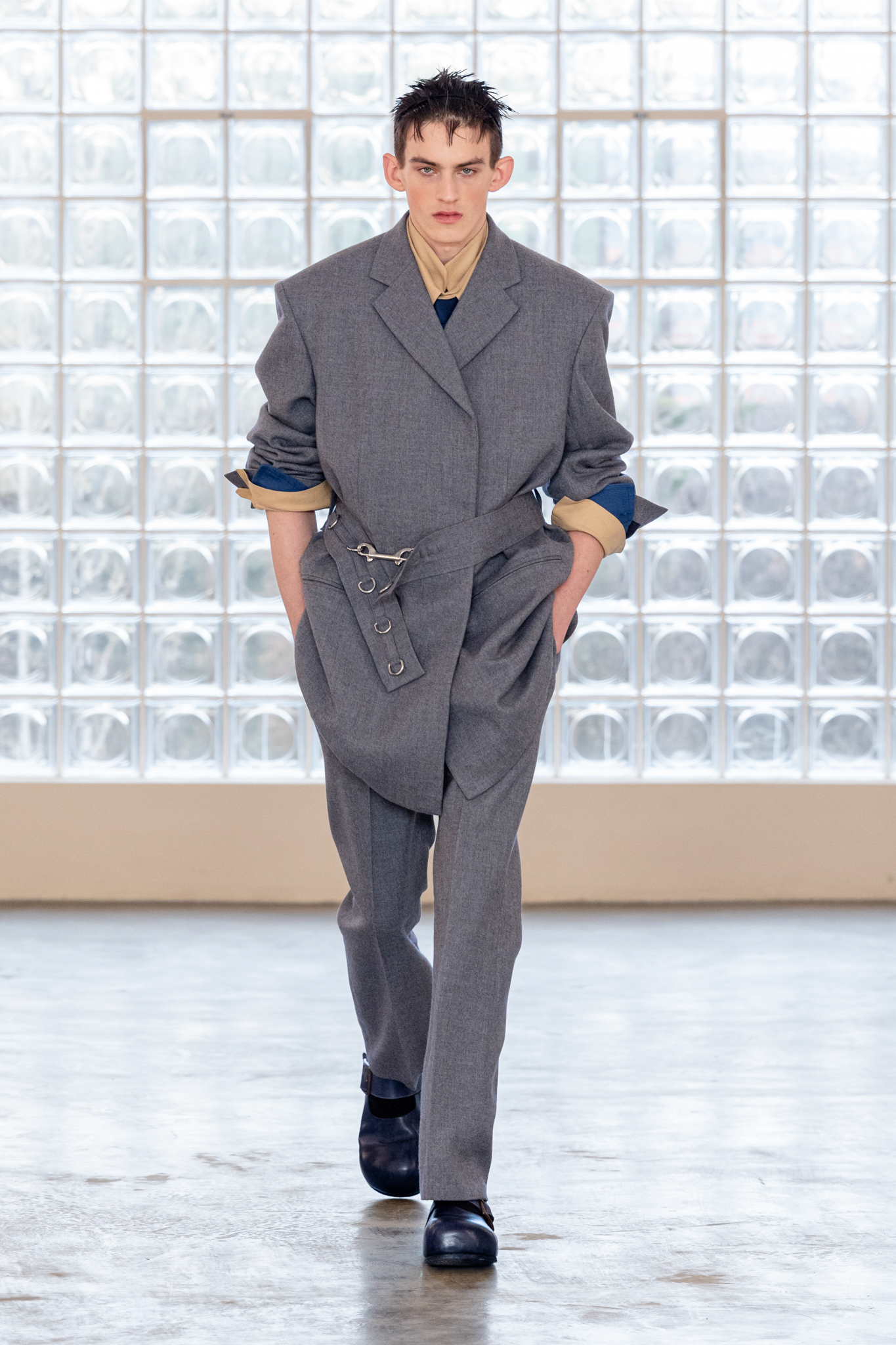
The resulting co-ed collection is a masterclass in controlled tension, juxtaposing the power of 1980s tailoring with the soft, almost floating quality of technical textiles. The ’80s whiff was unmistakable, particularly in the dramatically oversized shoulder proportions. This power silhouette—achieved through meticulous padding and cutting—was deployed across elongated blazer jackets and majestic long coats. Crucially, these pieces avoided feeling retro. They retained a modern relaxation, often tailored in soft wools or fluid blends that prevented the structure from becoming stiff or dated.
This powerful formality was often counterbalanced by accessories and inner layers that introduced an element of utility and industrial design. Many of the coats and blazers were cinched at the waist with carabiner-embellished belts. This small detail—the rugged, functional hardware against the luxurious drape of the fabric—perfectly encapsulates the brand’s East-West, high-low synthesis: the pragmatic, industrial touch of the West meeting the sophisticated drape of Eastern textiles.
The layering was instrumental in achieving the Pagoda’s verticality. Beneath the imposing outerwear, the designers showcased separates in liquid silk and fine knits that provided necessary movement and sheen. These silk pieces—trousers, blouses, and elongated tunics—offered a visual counterpoint, their fluidity amplifying the tailored rigidity of the external layers. The introduction of denim was perhaps the most surprising element, yet it was executed with the same elevated intent. These were not casual pieces, but incursions of workwear that grounded the collection. The denim was often dark, rigid, and structured, cut into utilitarian jackets and trousers that spoke to an urban functionality, elevating the fabric into a high-fashion utility statement.
Leather, a key Milanese category, was handled with impressive dexterity. Handsome leather pieces—from tailored jackets to high-waisted trousers—were treated to achieve a refined matte finish, emphasizing texture over gloss. These leather elements further solidified the collection’s mature approach, projecting confidence and enduring quality.
The Apex of Sartorial Intent
The Pronounce Fall 2026 collection serves as definitive proof that Yushan Li and Jun Zhou have successfully transitioned from promising conceptualists to serious contenders in the global luxury arena. The brand has achieved a profound synthesis: the architectural depth and philosophical elegance of ancient Chinese heritage are now seamlessly interwoven with the technical precision and commercial instincts of Milanese craft.
This collection represents the apex of their sartorial intent. Every garment feels considered, every silhouette intentional. The dialogue is no longer an experiment but a fully realized language—a mature vocabulary of polished colors, balanced proportions, and meaningful references. By channeling the enduring strength and elegant flexibility of the Yingxian Pagoda, Pronounce has not just presented a seasonal lineup, but has laid down a new foundation for its future—one built on resilience, sophistication, and a truly global perspective on luxury design. The step up is complete; Pronounce is now operating on a level of refined maturity that promises a long and influential tenure on the international schedule.