

For decades, the cannabis industry operated in the shadows, defined by fragmented supply chains and a reliance on artisanal, manual labor. However, as legalization sweeps across the globe and the market matures into a multi-billion-dollar juggernaut, the "Wild West" era of hand-weighed flower and manually rolled joints is rapidly coming to an end. Taking its place is a sophisticated industrial infrastructure that mirrors the high-speed efficiency of the pharmaceutical and consumer packaged goods (CPG) sectors. At the heart of this transformation is a shift toward high-tech packaging solutions—a movement led by innovators like LeafyPack, who are integrating artificial intelligence (AI), machine vision, and collaborative robotics to solve the unique challenges of the cannabis plant.
The transition from manual to automated processes is not merely a matter of convenience; it is a necessity driven by the harsh realities of modern commerce. Cannabis producers today face a "perfect storm" of economic pressures: rising labor costs, a shortage of skilled workers, and an increasingly complex regulatory environment that demands absolute precision in dosing, labeling, and contamination control. In the early days of the "Green Rush," a company could survive with a large team of workers hand-packing jars. Today, that model is often a recipe for bankruptcy. To compete in a market where margins are tightening and quality expectations are soaring, operators are turning to automation to ensure consistency, scalability, and compliance.

LeafyPack has emerged as a pivotal player in this technological migration. While many equipment manufacturers focus on a single aspect of the production line, LeafyPack has developed a holistic ecosystem of machinery that utilizes the same advanced technologies found in Fortune 500 food processing plants. By leveraging AI-driven vision systems and robotic precision, they are helping cannabis brands bridge the gap between niche production and mass-market readiness.
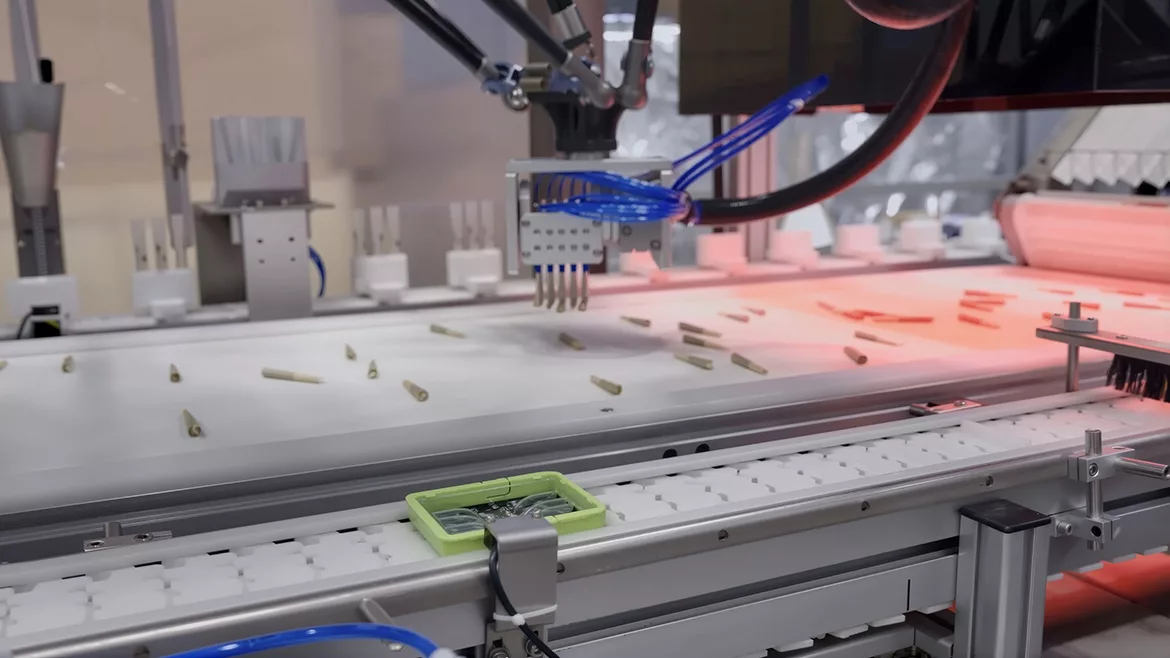
The centerpiece of this new era is the Spyder Pick and Place Joint Robot. Historically, the "pre-roll" segment of the industry has been notoriously difficult to automate. Pre-rolls are fragile, vary slightly in shape and density, and are prone to damage if handled too roughly. The Spyder solves these issues by utilizing high-speed AI vision. Instead of a "dumb" machine that simply moves objects from point A to point B, the Spyder "sees" the product. It can detect and classify pre-rolls based on quality, identifying defects that a human eye might miss during a long shift. Once a pre-roll is cleared for quality, the robot autonomously picks and places it into its final housing—be it a tin, a jar, or a tube—with a level of speed and delicacy that manual labor cannot match. This eliminates the bottleneck at the end of the line, allowing producers to move thousands of units per hour with minimal waste.
However, the innovation does not stop at the primary packaging level. As cannabis brands scale, they must move beyond individual units and focus on case packing and palletizing—the "secondary" and "tertiary" levels of packaging. This is where the Robopacker enters the fray. This system is a marvel of engineering efficiency, combining several traditionally separate machines into one compact footprint. The Robopacker integrates a case erector, a vision system, and pick-and-place robotics. By consolidating these functions, the machine allows operators to take loose products and prepare them for bulk shipment in a single, seamless motion. In an industry where floor space is often at a premium—particularly in high-cost urban cultivation centers—the compact nature of the Robopacker is a significant competitive advantage.
Further down the line, the industry is seeing the introduction of "Cobots," or collaborative robots. The LeafyPack Cobot Palletizer represents a major leap forward in workplace safety and ergonomics. Palletizing—the act of stacking heavy cases onto a pallet for shipping—is one of the most repetitive and physically taxing jobs in any warehouse. It is a primary source of musculoskeletal injuries and high employee turnover. Unlike traditional industrial robots that must be kept behind safety cages, Cobots are designed to work alongside humans. They use sensors to detect the presence of people, slowing down or stopping if a worker gets too close. By taking over the heavy lifting, these machines allow human employees to focus on higher-level tasks like quality oversight and data management, while simultaneously reducing the risk of workplace injuries.
The evolution of cannabis packaging also extends to the increasingly popular vape and cartridge market. The Ecovape Premade Poucher and the Rotobagger Gen 2 are designed to handle the specific geometry of vape pens, cartridges, and batteries. These systems utilize adaptive servo controls and AI-driven product counters. Servo motors allow for incredibly precise movements, meaning the machine can adjust on the fly to different pouch sizes or product weights. This adaptability is crucial in a market where product trends change almost monthly. If a brand decides to switch from a standard vape pen to a new, shorter disposable model, the machine can be recalibrated via software rather than requiring a complete mechanical overhaul.
Jonathan Ballard, Vice President of LeafyPack, notes that this technological shift is a natural progression of any maturing industry. He compares the current state of cannabis to the historical trajectories of the food and pharmaceutical sectors. Decades ago, those industries also relied on manual labor until the need for global scale and ironclad safety standards forced a move toward automation. For cannabis, the stakes are perhaps even higher. Because the plant remains a controlled substance in many jurisdictions, the "traceability" of every gram is paramount. Automated systems integrated with AI provide a digital paper trail that manual processes simply cannot offer. Every unit that passes through a vision system can be logged, photographed, and time-stamped, providing producers with the data they need to satisfy rigorous state audits and product recall requirements.

Beyond the immediate benefits of speed and compliance, the integration of AI and robotics is setting the stage for "Industry 4.0" in the cannabis space. This refers to the fourth industrial revolution, characterized by the use of data-driven production and interconnectivity. The next generation of LeafyPack systems is being built with "predictive maintenance" in mind. Sensors within the machines can monitor their own performance, alerting operators when a belt is wearing thin or a motor is running too hot—well before the machine actually breaks down. This prevents costly "downtime," which can be disastrous during a harvest cycle when thousands of pounds of perishable flower need to be processed immediately.
Furthermore, the data collected by these AI systems allows for "predictive optimization." By analyzing throughput data over weeks or months, cannabis operators can identify hidden inefficiencies in their workflow. They might discover that certain strains of flower take longer to pouch due to their resin content, or that a specific packaging material causes more jams than another. This level of granular insight allows for a "lean manufacturing" approach that was previously impossible in the cannabis world.
The ultimate goal of this high-tech surge is "parity." For years, cannabis products were viewed as "other"—a category of goods that didn’t quite fit into the standard retail or pharmaceutical box. By adopting the same robotics, vision systems, and AI that power the world’s most successful brands, the cannabis industry is signaling that it is ready for the global stage. Whether it is ensuring that a child-resistant cap is perfectly torqued every time or that a pouch is hermetically sealed to preserve terpene profiles, automation provides the quality assurance that builds consumer trust.

As the industry looks toward the future, the message from leaders like LeafyPack is clear: automation is no longer a luxury for the elite few; it is the baseline for survival. In a market defined by rapid change and intense competition, the companies that thrive will be those that embrace the "high-tech" side of the plant. By future-proofing their operations with scalable, data-driven robotic systems, cannabis producers are not just solving today’s bottlenecks—they are building the foundation for a professional, globalized industry that can stand shoulder-to-shoulder with any other CPG sector in the world. The era of the robot has arrived in the cannabis warehouse, and the results are faster, safer, and more consistent than ever before.