

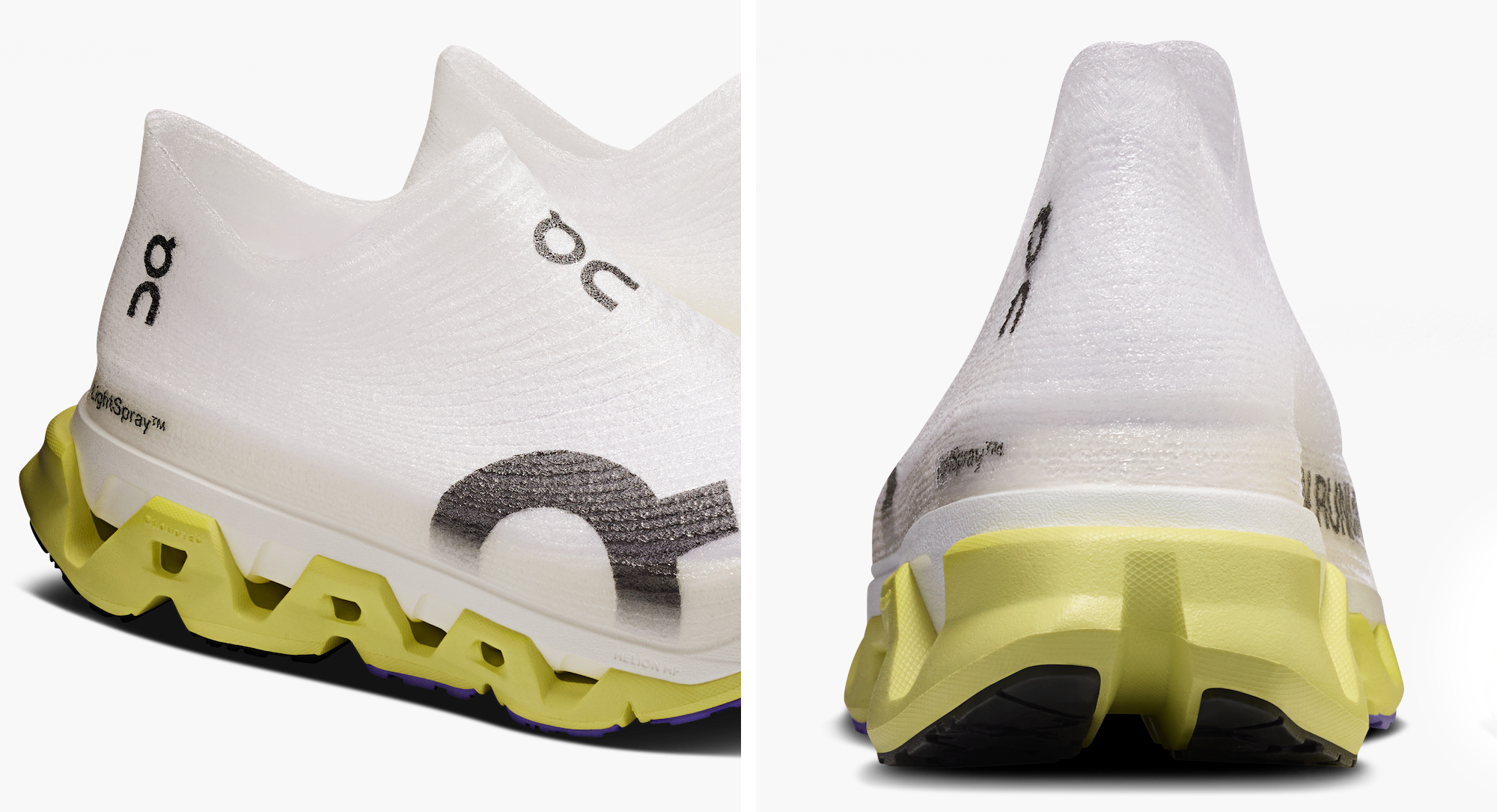
For years, the upper echelons of the marathon world have whispered about a radical shift in how footwear is constructed—a shift that moves away from the needle and thread and toward the precision of the robotic arm. Until recently, these advancements were reserved for the elite, the world-record chasers, and the Olympic podium contenders. However, the landscape of the running industry is about to undergo a seismic transformation. On, the Swiss-born sportswear powerhouse, has officially announced the transition of its "LightSpray" technology from a niche experimental prototype to a mass-market reality. The vehicle for this technological debut is the On LightSpray Cloudmonster 3 Hyper, a shoe that promises to redefine the "super trainer" category when it hits shelves in early 2026.
The LightSpray Cloudmonster 3 Hyper is not merely an incremental update to a popular line; it represents a fundamental rethinking of what a running shoe can be. By utilizing a fully 3D-printed upper created through a proprietary robotic spraying process, On has managed to strip away the complexities of traditional manufacturing. While a standard running shoe might consist of dozens of individual pieces—overlays, eyelets, heel counters, and various fabrics—the Cloudmonster 3 Hyper is built from just eight primary components. This minimalism is not just an aesthetic choice; it is a performance-driven engineering feat that results in the lightest Cloudmonster ever produced. To put the weight savings into perspective, a men’s size 8.5 weighs in at a staggering 190 grams. This is more than 100 grams lighter than the baseline Cloudmonster 3, which is scheduled for a simultaneous release. In the world of distance running, where every gram of weight requires metabolic energy to move over 26.2 miles, a reduction of this magnitude is nothing short of revolutionary.

At the heart of this innovation is the LightSpray process itself. Unlike traditional 3D printing, which often involves building layers of resin or plastic in a slow, additive process, LightSpray involves a robotic arm that sprays a continuous thermoplastic filament onto a rotating mold of a foot. This process happens in a single, high-speed step, creating a seamless, one-piece upper that is bonded directly to the midsole without the need for glue. The result is a structure that fits like a second skin. Because there are no seams, stitches, or overlapping materials, the upper eliminates the common friction points and pressure zones that lead to blisters and discomfort during long-effort runs. Furthermore, the material is naturally porous, providing a level of breathability and temperature regulation that traditional engineered meshes struggle to match. To ensure the experience is optimized, On includes a specialized sock with every pair, designed to work in tandem with the LightSpray upper to provide targeted cushioning and moisture management.
The journey of LightSpray from the laboratory to the local running shop began in earnest on the feet of Hellen Obiri. The legendary Kenyan runner and On athlete gave the world a glimpse of the future when she won the 2024 Boston Marathon wearing a prototype of the Cloudboom Strike LS, the first shoe to feature this technology. Originally, On had planned to unveil the technology on the world stage at the Paris Olympics. However, Obiri, prioritizing her performance and comfort, opted to race in the shoe early to ensure she was fully acclimated to the new sensation. Her victory served as the ultimate proof of concept, demonstrating that a sprayed-on upper could withstand the grueling demands of a world-class marathon at record-breaking speeds.
Despite the success of the Cloudboom Strike LS, the technology remained frustratingly out of reach for the general public. Production was limited to a handful of robots, and the labor-intensive nature of the early prototypes meant that supply could not meet the surging demand. On co-founder and executive co-chairman Caspar Coppetti acknowledged this challenge during a reveal at The Running Event in late 2025. He noted that while the initial project was ambitious, the true hurdle was mastering the scale of production. "We’ve managed to master technology so that we can do many more things than just one shoe, but we’ve also mastered the scale so that we can do hundreds of thousands of pairs," Coppetti stated. This scaling has been made possible by a massive investment in automated infrastructure. While the project started with a single robot dedicated to elite athletes, On now operates 32 robots at a state-of-the-art facility in South Korea, supplemented by four additional units at their Zurich headquarters. This expansion has increased their production capacity 30-fold, finally making the technology viable for a global commercial release.

The Cloudmonster 3 Hyper also introduces a sophisticated underfoot experience to complement its futuristic upper. The shoe features a two-piece Helion HF supercritical foam midsole. Helion HF is On’s premier energy-return compound, a Pebax-based foam that offers a "hyper" level of bounce and impact protection. By utilizing a supercritical foaming process—where the material is infused with gas under high pressure—the foam becomes lighter and more resilient than traditional EVA or standard TPU blends. In the Cloudmonster 3 Hyper, this foam is configured to provide the "maximalist" cushioning that the Cloudmonster line is famous for, while maintaining a level of responsiveness typically reserved for race-day "super shoes." The integration of the LightSpray upper directly onto this supercritical foam creates a unified platform that maximizes energy transfer from the foot to the road.
The design philosophy behind the shoe has already garnered significant attention outside of the running community. During a preview at Paris Fashion Week, industry insiders drew comparisons between On’s new direction and the sleek, user-centric design language of Apple. Coppetti embraced this comparison, noting that the simplicity and efficiency of the LightSpray process lead to an aesthetic that is as functional as it is beautiful. The "Apple of footwear" moniker reflects a shift toward products that feel less like a collection of parts and more like a singular, integrated piece of technology. This is further emphasized by the sustainability aspect of the LightSpray process. By eliminating glue and reducing the number of components, On has significantly lowered the carbon footprint of the manufacturing process. The robotic assembly also occurs closer to key markets, reducing the environmental impact of long-distance shipping and logistics.
For the running community, the release of the Cloudmonster 3 Hyper represents the arrival of a new sub-category: the "Super Trainer." These are shoes designed to provide the benefits of a race-day shoe—extreme light weight, high energy return, and advanced geometry—with the durability required for daily mileage. At a price point of $280, the Cloudmonster 3 Hyper is an investment, but it is one that reflects the cutting edge of material science. It caters to the runner who wants the same technological advantages as a Boston Marathon champion but in a package designed for the rigors of high-volume training.

The rollout for this highly anticipated model will be handled in two distinct phases. On March 5, 2026, the On LightSpray Cloudmonster 3 Hyper will see a limited initial release. This launch will be accessible through On’s official website and select flagship retail locations across North America. This "early access" phase is expected to sell out rapidly, given the pent-up demand for LightSpray technology. Following this, a comprehensive global launch is scheduled for April 16, 2026, making the shoe available to runners worldwide.
As the footwear industry looks toward the future, the success of the Cloudmonster 3 Hyper will likely serve as a bellwether for the role of automation and 3D printing in mass production. On has moved beyond the gimmick of 3D printing as a marketing tool and has instead used it to solve real-world problems related to weight, comfort, and manufacturing efficiency. By bringing the technology to the masses, they are not just selling a shoe; they are offering a glimpse into a future where footwear is "sprayed" to perfection, customized for the individual, and produced with a fraction of the waste of traditional methods. For the runners who manage to secure a pair in March, the road ahead looks lighter, faster, and significantly more advanced.