
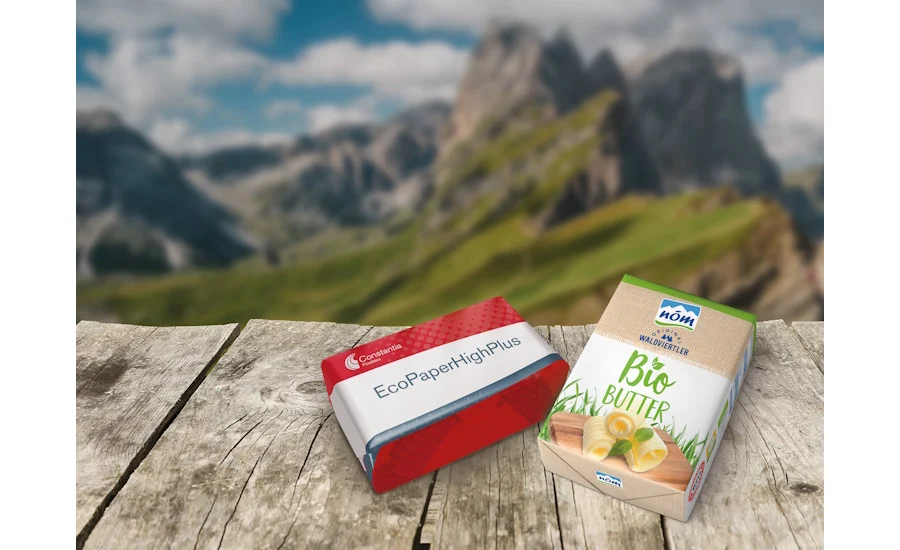
The European dairy sector is currently witnessing a significant shift in its approach to environmental stewardship, driven by both consumer demand for plastic-free alternatives and increasingly stringent regional regulations. At the forefront of this movement is a landmark collaboration between Constantia Flexibles, a global leader in flexible packaging headquartered in Vienna, and NÖM AG, one of Austria’s premier dairy producers. Together, these two industry titans have announced the commercial launch of a groundbreaking paper-based butter wrap, a development that marks a pivotal moment in the transition away from traditional multi-material laminates toward mono-material, circular solutions.
The new packaging solution utilizes Constantia Flexibles’ proprietary EcoPaperHighPlus technology. As the world’s third-largest manufacturer of flexible packaging, Constantia Flexibles has leveraged its extensive technical expertise to solve one of the most difficult challenges in the food industry: replacing the high-barrier performance of aluminum-based foils in the dairy aisle. For decades, butter has been wrapped in a composite of paper and aluminum foil because the product is exceptionally sensitive to external factors. However, these traditional laminates are notoriously difficult to recycle because the bonded layers of metal and fiber cannot be easily separated in standard municipal recycling streams. The introduction of EcoPaperHighPlus effectively bridges the gap between high-performance protection and end-of-life circularity.
The development of this material was not a localized effort but rather the result of a coordinated industrial strategy. The project was primarily spearheaded and industrialized at Constantia Jeanne d’Arc, the company’s specialized facility in France, with critical technical support provided by Constantia Flexibles’ R&D Paper Excellence Center. This center serves as a hub for innovation, where material scientists work to enhance the functional properties of paper—such as moisture resistance and gas barriers—without compromising the material’s ability to be repulped in existing paper mills.
To understand the significance of this launch, one must consider the unique chemical and physical demands of butter. Butter is a high-fat product that is susceptible to oxidation, which can lead to rancidity and off-flavors if exposed to oxygen or light. Furthermore, it is highly absorbent of surrounding aromas, meaning any packaging must provide a robust olfactory barrier to prevent the butter from taking on the scent of other items in a consumer’s refrigerator. Additionally, butter packaging must withstand temperature fluctuations during the cold chain journey and provide "deadfold" performance. Deadfold refers to the material’s ability to hold a crease or fold without springing back, a mechanical property essential for the high-speed wrapping machines used in dairy production lines.
EcoPaperHighPlus was engineered to meet all these criteria. According to technical data released by Constantia Flexibles, the paper-based wrap provides grease resistance and freezing resistance while maintaining an aroma barrier that rivals traditional foil. Extensive shelf-life testing conducted on both salted and unsalted butter varieties demonstrated that the paper-based solution maintains product freshness and quality on par with conventional aluminum-based reference packaging. This ensures that the transition to a more sustainable format does not result in increased food waste—a critical consideration in the broader sustainability conversation.
A major selling point of the EcoPaperHighPlus solution is its commitment to "green chemistry." The material is entirely PFAS-free. Per- and polyfluoroalkyl substances (PFAS), often referred to as "forever chemicals," have historically been used in paper packaging to provide grease resistance. However, due to their persistence in the environment and potential health risks, there is a global push to eliminate them from food-contact materials. By achieving high grease resistance without these chemicals, Constantia Flexibles is future-proofing its packaging against upcoming legislative bans in the European Union and North America.
Furthermore, the recyclability of the new wrap has been rigorously validated. It was developed in strict accordance with the 4evergreen design guidelines, a cross-industry alliance aimed at boosting the contribution of fiber-based packaging in a circular economy. To verify its compatibility with existing waste infrastructure, the material underwent testing via the CEPI (Confederation of European Paper Industries) laboratory method version 3. This standardized testing protocol simulates the conditions of an industrial paper mill to ensure that the fibers can be recovered and reused in the production of new paper products. By fitting into the established paper recycling stream, the wrap bypasses the complexities of chemical recycling or specialized sorting required for multi-layer plastics.
The partnership with NÖM AG is the catalyst that brings this technology from the laboratory to the supermarket shelf. NÖM, based in Baden, Lower Austria, has a long-standing reputation for innovation and environmental responsibility. As one of the largest dairy processors in the region, NÖM’s adoption of EcoPaperHighPlus represents a significant volume of packaging shifting to a more sustainable format. Helene Chretien, Market Product Manager Dairy at Constantia Flexibles, emphasized that while the technical development was a feat in itself, the collaboration with NÖM is what truly validates the solution. It proves that paper-based wraps can perform in real-world retail environments and meet the high expectations of modern consumers who are increasingly scrutinizing the environmental footprint of their grocery choices.
Beyond sustainability, the EcoPaperHighPlus solution offers operational advantages for dairy manufacturers. One of the primary barriers to adopting new packaging materials is the cost of upgrading machinery. Constantia Flexibles designed this paper-based wrap to be "drop-in" compatible with existing butter-wrapping equipment. This means that dairy producers can switch from aluminum-based foils to EcoPaperHighPlus without making capital-intensive investments in new production lines. This ease of integration is expected to accelerate the adoption of the material across the wider European market.
The launch comes at a time when the European Union is finalizing the Packaging and Packaging Waste Regulation (PPWR), which sets ambitious targets for recyclability and the reduction of unnecessary packaging. Under these new rules, packaging that cannot be recycled at scale will face higher fees and potential market bans. By proactively transitioning to a mono-material paper solution, Constantia Flexibles and NÖM are positioning themselves ahead of the regulatory curve, ensuring long-term market access and brand resilience.
As Constantia Flexibles continues to expand its "Eco" product range, the success of the butter wrap project serves as a blueprint for other categories. The company’s R&D efforts are increasingly focused on replacing non-recyclable multi-layer structures with fiber-based alternatives in sectors ranging from confectionery to pharmaceutical packaging. The "Paper Excellence Center" is central to this strategy, focusing on coating technologies that provide the necessary barriers for food safety while maintaining the ecological integrity of the paper substrate.
In conclusion, the commercial debut of EcoPaperHighPlus in the European butter market is more than just a product launch; it is a demonstration of how material science and cross-industry partnership can solve complex environmental hurdles. By combining the heritage and scale of Constantia Flexibles with the market presence of NÖM, the two companies have set a new benchmark for the dairy industry. Consumers can now enjoy high-quality dairy products with the confidence that the packaging can be easily recycled in their household paper bin, contributing to a truly circular economy. As this technology scales, it is likely that the traditional glint of aluminum foil in the butter aisle will increasingly be replaced by the matte, natural finish of high-performance, sustainable paper.