
In a definitive move toward global industrial sustainability, Nefab Group, a leading provider of integrated packaging and logistics solutions, has announced the successful completion of its transition to 100% recycled high-density polyethylene (rHDPE) for its entire Reflex Cushioning product line. This milestone represents a total shift in manufacturing standards across the company’s eight specialized thermoforming facilities, effectively unifying Nefab’s global production volume under a single, high-performance recycled material specification. By standardizing this material across its production hubs in the Americas, EMEA (Europe, Middle East, and Africa), and APAC (Asia-Pacific), Nefab has positioned itself at the vanguard of the circular economy, ensuring that its high-value protective solutions meet the increasingly stringent environmental demands of the modern supply chain.
The transition, which concluded with the final facility’s conversion in August, marks a significant departure from the fragmented material sourcing that often plagues global manufacturing. While recycled content had been integrated into Nefab’s Reflex Cushioning network in various capacities previously, the move to a 100% rHDPE standard ensures that every customer, regardless of their geographic location, receives packaging that is optimized for both protection and planetary health. This global alignment is particularly critical for multinational corporations that require consistency in their logistics chains to ensure predictable performance and regulatory compliance across borders.
The Strategic Shift Toward rHDPE
The decision to adopt rHDPE as the standard material for Reflex Cushioning is rooted in both environmental necessity and material science. High-density polyethylene is prized in the packaging industry for its exceptional strength-to-density ratio, chemical resistance, and durability. By utilizing 100% recycled content, Nefab significantly reduces the demand for virgin plastics, which are derived from fossil fuels and carry a much higher carbon footprint.
Olivier de Guitaut, Nefab’s Executive Vice President of Sustainability, Innovation, and Portfolio, emphasized that this transition is a direct response to the evolving landscape of global trade. He noted that today’s packaging requirements are undergoing intense scrutiny, with a specific focus on material composition, the percentage of recycled content, and the ultimate recyclability of the product. By documenting and standardizing the use of the same recycled material across the global Reflex Cushioning network, Nefab provides its clients with much-needed transparency. This clarity allows businesses to better understand the makeup of their packaging and proactively prepare for shifting legal frameworks, such as the European Union’s Packaging and Packaging Waste Regulation (PPWR).
Engineering Excellence: Reflex Cushioning vs. Traditional Foam
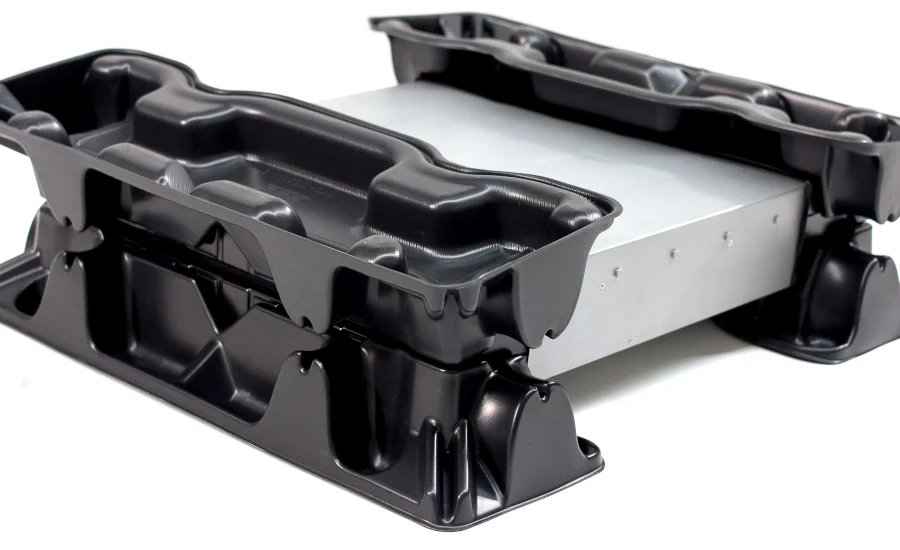
Reflex Cushioning is a specialized thermoformed alternative to conventional fabricated foam, such as expanded polyethylene (EPE) or expanded polystyrene (EPS). While traditional foam is effective at absorbing shock, it often lacks the precision and reusability required by high-tech industries. Nefab’s Reflex solution is engineered to protect shock-sensitive and high-value equipment by utilizing the inherent flexibility and strength of thermoformed plastic.
One of the primary advantages of this technology is the ability to engineer "restricted contact zones." Unlike foam, which often wraps around the entire product, Reflex Cushioning can be designed to support equipment only at specific, approved structural points. This creates a protective "clearance" around fragile surfaces, delicate screens, and protruding components. This precision engineering is vital for industries such as datacom and cloud infrastructure, where server racks and sensitive electronics require exact positioning to prevent internal damage during transit. Similarly, the semiconductor and medical technology (MedTech) sectors rely on this level of accuracy to transport multi-million dollar instruments that are susceptible to even minor vibrations or static discharge.
Validation Through Rigorous Testing
Transitioning to recycled materials in heavy-duty industrial packaging is not without its challenges. The primary concern for logistics managers is whether a recycled material can match the performance of its virgin counterpart. To address these concerns, Nefab utilizes its six ISTA-certified (International Safe Transit Association) testing facilities located strategically around the world.
Blair Vance, Nefab’s Global Product Sales Director, pointed out that the adoption of recycled material is only viable if the packaging continues to provide uncompromising protection. To guarantee this, Nefab subjects its rHDPE designs to a battery of tests that simulate the harshest conditions of the global shipping environment. This includes repeated drop tests at various orientations, vibration analysis, and G-force measurements. By combining 100% recycled HDPE with application-specific engineering, Nefab can validate that the packaging meets the customer’s precise protection requirements while simultaneously supporting a more circular flow of materials. This empirical approach ensures that sustainability does not come at the cost of product integrity.
Advancing the Circular Economy and Regulatory Compliance
A cornerstone of Nefab’s strategy is the promotion of circularity. To facilitate this, each Reflex Cushioning component is embossed with resin identification codes and the specific recycled-content percentage. This transparent labeling assists customers in identifying the material for internal sustainability reporting and ensures that the components can be easily sorted at the end of their lifecycle.
Furthermore, Reflex Cushioning is designed for more than just one-way shipping. Its durable rHDPE construction supports circularity programs where packaging can be reused multiple times within a closed-loop system, significantly reducing the cost per part and the overall environmental impact. When the cushioning eventually reaches the end of its functional life, it can be integrated into existing HDPE recycling streams. Depending on the specific regional market, Nefab offers take-back programs or connects customers with local recycling partners to ensure that the plastic is reprocessed into new products rather than ending up in a landfill.
This initiative is a critical step in helping Nefab’s clients navigate the complex regulatory environment. The EU’s PPWR, for instance, sets ambitious targets for recycled content in plastic packaging and mandates high levels of recyclability by 2030. By transitioning to 100% rHDPE now, Nefab is "future-proofing" its clients’ operations, ensuring they are compliant with upcoming laws well before they take effect.
The Roadmap Ahead: PCR and Responsible Sourcing
The transition to 100% rHDPE is described by Nefab as the first major milestone in a broader material roadmap. The company is already looking toward the next phase of its sustainability journey, which will focus on increasing the integration of post-consumer recycled (PCR) content. While rHDPE can be sourced from industrial waste, PCR material is derived from household or commercial waste that has been used by a consumer and then recycled. Incorporating PCR is more challenging due to potential variations in material purity, but it represents the "gold standard" of plastic circularity.
Nefab is also intensifying its focus on responsible material sourcing and further improving the overall recyclability of its entire portfolio. This holistic approach considers the entire lifecycle of the packaging—from the carbon emissions generated during the extraction of raw materials to the energy consumed during manufacturing and the final disposal or reuse of the product.
Industry Impact and the Global Context
The industrial packaging sector is at a crossroads. As global supply chains face increasing pressure to decarbonize, the materials used to transport goods are being viewed as a significant opportunity for carbon reduction. Nefab’s move to standardize 100% rHDPE across eight global facilities sends a clear signal to the market: high-performance industrial protection and environmental responsibility are no longer mutually exclusive.
For sectors like the semiconductor industry, where precision and cleanliness are paramount, or the MedTech industry, where the stakes of equipment failure are incredibly high, Nefab’s rHDPE Reflex Cushioning offers a path forward. It provides a scalable, repeatable, and sustainable solution that meets the technical rigors of high-tech logistics while aligning with corporate ESG (Environmental, Social, and Governance) goals.
By successfully unifying its global production under this new recycled standard, Nefab has not only streamlined its own internal operations but has also empowered its customers to take a significant step toward a circular economy. As the company continues to innovate through its material roadmap, the transition to 100% rHDPE stands as a benchmark for the industry, proving that with the right engineering and a commitment to testing, the transition to sustainable materials can be both seamless and highly effective.