

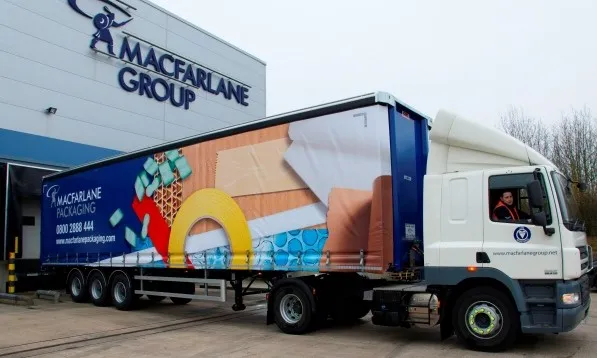
Packaging giant Macfarlane Group has demonstrated resilience in its latest financial reporting, navigating a challenging operational landscape to deliver a revenue increase for the first half of the year, even as legacy headwinds from its Pitreavie subsidiary weighed on overall margins. According to the company’s newly released financial statements, group revenue grew by 2% to reach £148.9m, up from £146.6m during the corresponding period in 2025. Standard operating profit also experienced a marginal uptick, rising to £7.1m compared to £7.0m previously.
However, a deeper dive into the numbers reveals a more nuanced narrative. Group adjusted operating profit experienced a 3% contraction, slipping from £9.8m in the first half of 2025 down to £9.5m. Consequently, the group’s adjusted operating profit as a percentage of revenue contracted slightly from 6.7% to 6.4%. Industry analysts note that while top-line growth is a positive indicator of market demand, profitability has been temporarily stifled by specific operational hurdles within the manufacturing division—most notably, the recovery phase of the Pitreavie business following a profoundly difficult prior year.
Macfarlane operates primarily through two core segments: Packaging Distribution and Manufacturing Operations. Performance across these divisions varied, highlighting the multi-faceted nature of the group’s business model. The Packaging Distribution arm proved to be a reliable engine of growth, lifting its revenues to £111.7m, an improvement from £110.4m in the previous year. More importantly, this division successfully expanded its adjusted operating profit to £5.1m, up from £4.8m. This demonstrates solid margin stability and strong commercial execution within the distribution network, driven by robust new business wins and effective pricing strategies.
Conversely, the Manufacturing Operations division presented a mixed picture. While the segment successfully grew its top-line revenue from £39.2m to £40.6m, its adjusted operating profit declined from £5.0m down to £4.4m. This contraction in manufacturing profitability is directly tied to the aforementioned struggles at Pitreavie, a subsidiary that has been the focal point of intensive restructuring and recovery efforts throughout late 2025 and the first half of 2026.
Chief Executive Peter Atkinson, speaking candidly to Packaging News, elaborated on the forces shaping these financial outcomes. He confirmed that the downward pressure on group adjusted operating profit—and the corresponding dip in profit margins relative to revenue—was heavily driven by the operational losses accumulated by the Pitreavie business.
The roots of Pitreavie’s financial strain trace back to a tragic workplace incident that occurred in 2025. The fatality not only deeply impacted the workforce and the corporate conscience of Macfarlane but also caused severe operational disruptions, halting productivity and resulting in significant financial losses throughout that year. The shockwave of this tragedy severely impaired the manufacturing segment’s bottom line, casting a long shadow into the early months of the current fiscal year.
Nevertheless, the latest Q2 data signals a turning point. Atkinson highlighted that decisive managerial interventions, most notably the successful installation and commissioning of a new production machine, have successfully stabilized the facility. This capital investment and operational overhaul have effectively reversed the subsidiary’s trajectory, steering Pitreavie back into profitable territory during the second quarter.
“We set out in 2026 to start the journey of profit recovery,” Atkinson stated, reflecting on the strategic priorities established at the turn of the year. “I think the H1 results are showing that those profit recovery actions are coming through. We have got sales growth in distribution, we’ve got margin stability and distribution, and we’ve got profit growth in distribution, along with strong new business momentum.”
Atkinson’s remarks underscore a broader confidence in the underlying health of Macfarlane’s core operations. While the manufacturing division absorbed the shock of the Pitreavie downtime, the distribution business continued to fire on all cylinders, capturing market share and retaining key accounts. The leadership team’s ability to isolate the operational failure, address its root causes through targeted investments, and restore the subsidiary to a profit-generating status within a matter of months has been hailed as a masterclass in corporate crisis management.
Looking ahead, Macfarlane’s executive team remains fiercely optimistic about the remainder of 2026. With the distribution network maintaining its upward trajectory and the manufacturing arm finally shedding the dead weight of the Pitreavie losses, the company is poised for a stronger second half.
“Having made significant losses in 2025, we’ve now got Pitreavie back into profit, and that will only strengthen in the remainder of this year,” Atkinson affirmed.
For investors and industry observers, the H1 financial report serves as a testament to Macfarlane’s structural robustness. By absorbing a major operational shock without sacrificing top-line growth, and by demonstrating a clear, actionable path to margin recovery, the packaging specialist has reaffirmed its market leadership. As the newly installed machinery at Pitreavie reaches full operational capacity and the distribution division capitalizes on its current momentum, Macfarlane appears well-positioned to convert its revenue gains into sustained, long-term profitability.