

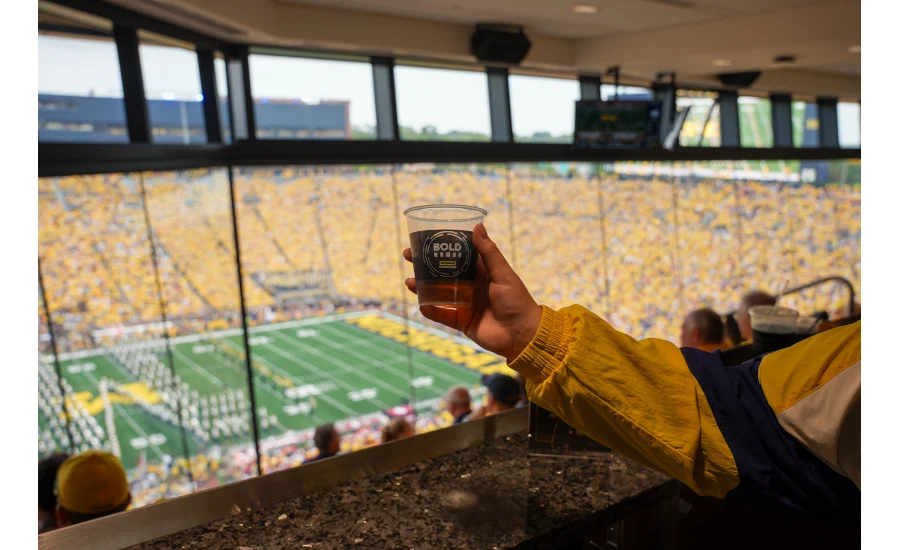
As the 2024 college football season marches toward the future, Michigan Stadium—the hallowed ground affectionately known as "The Big House"—is proving that its massive scale is not an obstacle to environmental progress, but rather its greatest asset. In a landmark move for the state’s sports culture, the University of Michigan has officially introduced a comprehensive reusable cup program, making Michigan Stadium the first venue in the state to implement such a circular packaging system. This initiative, which debuted during the 2024 season and is slated for full-scale operation through the 2026 season, represents a seismic shift in how large-scale athletic events manage waste. By replacing thousands of single-use plastic containers with durable, washable alternatives, the University of Michigan is not merely participating in a trend; it is architecting a new operational blueprint for collegiate athletics across the United States.
The program’s rollout focuses initially on the stadium’s most high-traffic hospitality areas, including the luxury suites and private clubs. In these spaces, where fan engagement and hospitality are at their peak, the traditional "use and toss" model has been discarded in favor of a sophisticated "use and return" loop. The mechanics of the program are as seamless as they are impactful: fans enjoy their beverages in specially designed reusable cups provided by SOLO, a brand under the Michigan-based Dart Container Corporation. Once the game concludes, or the drink is finished, these cups are deposited into designated collection bins rather than trash or standard recycling cans. From there, the infrastructure of the circular economy takes over. The cups are gathered, transported to a specialized facility, sanitized to professional health standards, and returned to the stadium’s inventory to be used again at the next home game.
This ambitious undertaking is the result of a multifaceted partnership that brings together leaders in sports marketing, sustainable manufacturing, and logistics. The coalition includes Michigan Athletics and Learfield Sports and Entertainment, the university’s multimedia rights holder, alongside SOLO, the iconic cup brand. Crucial to the day-to-day execution of the program are Levy Restaurants, the stadium’s long-standing food and beverage provider, and Bold Reuse, a company specializing in the logistics and sanitation infrastructure required to make reusable packaging viable at a massive scale. By aligning these various stakeholders, the University of Michigan has bridged the gap between environmental theory and gameday reality, demonstrating that sustainability does not have to come at the expense of the fan experience.
To understand the significance of this program, one must consider the sheer magnitude of Michigan Stadium. With an official capacity of 107,601, it stands as the largest stadium in the Western Hemisphere and the third-largest in the world. On any given Saturday, the "Big House" becomes a small city, and with that density comes a staggering amount of waste. Historically, the sports industry has struggled with the environmental footprint of single-use plastics, which often end up in landfills due to contamination issues in traditional recycling streams. By pivoting to a reuse model, Michigan Athletics is tackling the waste problem at its source. The initiative is a cornerstone of the University of Michigan’s broader commitment to achieving carbon neutrality and its aggressive goal of diverting 90% of campus waste from landfills.
Libby Rice, the sustainability program manager for SOLO Reusables, emphasized the symbolic and practical power of the venue. In a public statement regarding the partnership, Rice noted that Michigan Stadium provides the ultimate "proof of concept" for circular systems. When more than 100,000 fans gather, the opportunity to showcase innovation is unparalleled. The program is designed to prove that if a venue of this size can successfully navigate the logistical hurdles of collection, washing, and redistribution, then reusable packaging can work in virtually any setting—from smaller collegiate venues to professional arenas and convention centers.
The partnership with Bold Reuse is particularly noteworthy, as it addresses the "missing link" in many sustainability efforts: infrastructure. While many organizations want to reduce plastic waste, few have the specialized washing facilities and tracking systems necessary to ensure that "reusable" actually means "reused." The collaboration between SOLO and Bold Reuse first took root in Michigan in May, and its expansion into the Big House signifies a scaling up of these operations. By integrating this infrastructure into the gameday operations of one of the most visible brands in college sports, the university is helping to build the regional capacity for a circular economy that could eventually benefit the entire state of Michigan.
The introduction of reusable cups also serves an educational purpose. For many fans, the experience of returning a cup to a specific bin rather than throwing it away is their first hands-on interaction with a circular economy model. This behavioral shift is a critical component of the university’s sustainability mission. By normalizing reuse in a setting as culturally significant as a Michigan football game, the athletic department is fostering a culture of environmental stewardship that fans can take home with them. The visibility of the program in the suites and clubs is a strategic first step, allowing the university to refine the logistics of the "reuse loop" before potentially expanding the program to the entire bowl of the stadium in future seasons.
Furthermore, the environmental benefits of this transition are quantifiable. While single-use plastic cups are often marketed as recyclable, the reality of recycling rates in the United States is sobering, particularly in high-volume environments where food contamination is common. Reusable cups, by contrast, are designed for durability and a long lifecycle. Over the course of the 2024 through 2026 seasons, the reduction in raw material consumption and the prevention of plastic litter will be substantial. This move aligns perfectly with the University of Michigan’s "Vision 2034," a decadal plan that places sustainability and climate action at the heart of the institution’s identity.
The sports industry at large is watching Ann Arbor closely. As collegiate athletic departments across the country face increasing pressure from student bodies, alumni, and corporate sponsors to adopt greener practices, the Michigan Stadium model provides a repeatable framework. The partnership with Learfield and Levy Restaurants is especially important here, as these companies operate in hundreds of venues across the country. The lessons learned at the Big House—how to optimize bin placement, how to communicate the process to fans, and how to manage the "shrinkage" or loss of cups—will likely inform the next generation of sustainability contracts in the sports world.
As the program continues through the 2026 season, the University of Michigan plans to use the data collected to further refine its waste-reduction strategies. This data-driven approach ensures that the initiative is not just a one-time publicity stunt, but a permanent evolution of the stadium’s operational DNA. The "Big House" has long been a place where legends are made on the field; now, it is becoming a place where environmental history is made in the stands.
In conclusion, the transition to reusable cups at Michigan Stadium is more than just a change in beverage containers. It is a bold statement about the responsibility of major institutions to lead in the face of global environmental challenges. Through the combined efforts of Michigan Athletics, SOLO, Bold Reuse, and their partners, the university is proving that the future of sports is not disposable—it is circular. As the 2026 season approaches, the eyes of the nation will remain on Ann Arbor, watching as the largest stadium in the country transforms into a laboratory for a cleaner, more sustainable world. This initiative ensures that while the cheers of the crowd may fade at the end of the fourth quarter, the impact of their choices will resonate for generations to come.