
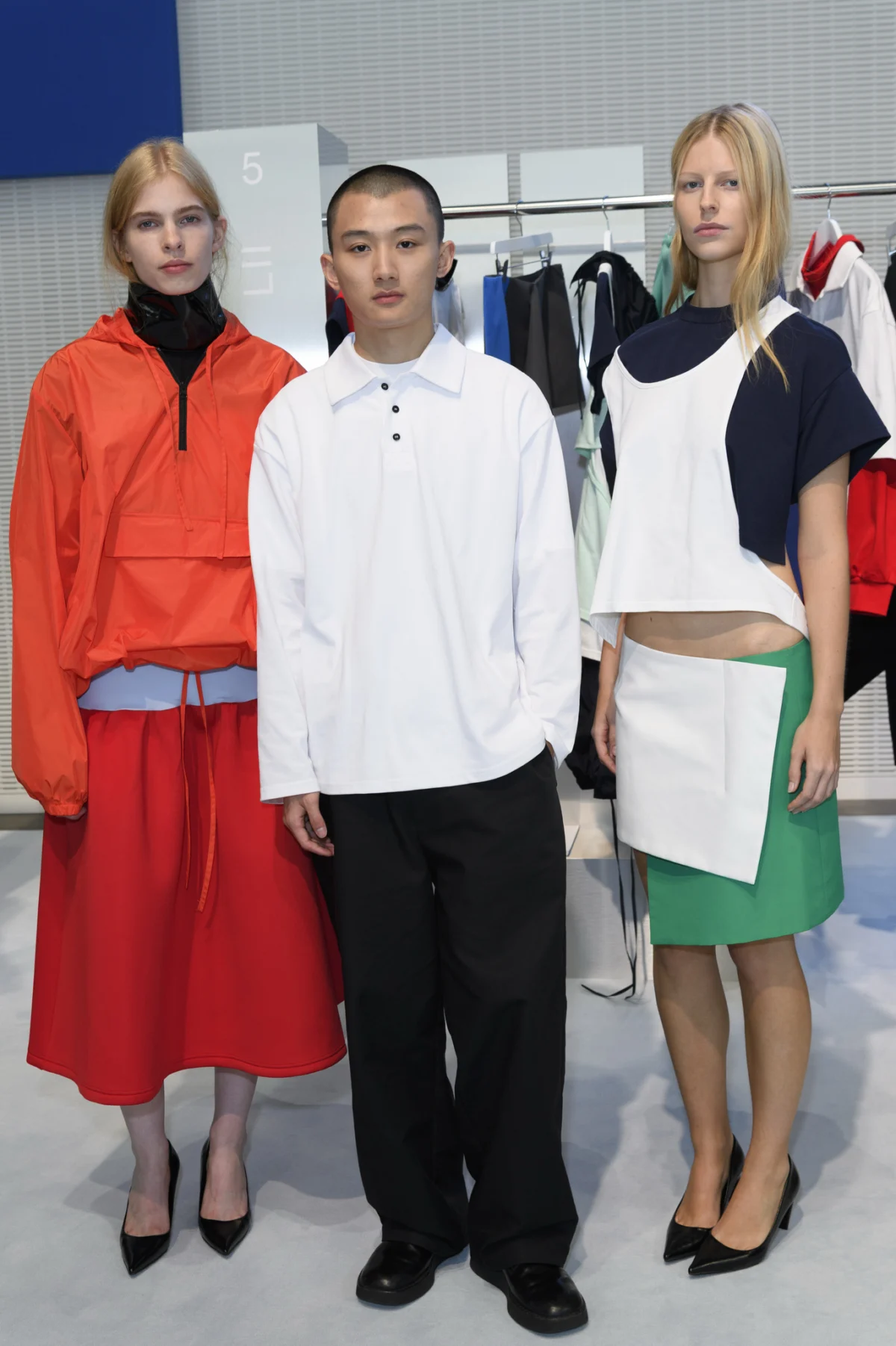
On a crisp Tuesday evening in Manhattan, the upper echelons of the international fashion community converged at The Crane Club to celebrate the crowning of fashion’s next vanguard. Amidst an electric atmosphere charged with anticipation and artistic camaraderie, designer Zane Li, the visionary founder and creative force behind the emergent label Lii, was proclaimed the winner of the 2026 CFDA/Vogue Fashion Fund (CVFF). The high-profile ceremony also paid homage to knitwear savant Aisling Camps and eclectic textile innovator Emily Dawn Long, who were both honored as the year’s exceptional runners-up.
Presided over by an eminent coterie of hosts—CFDA Chairman Thom Browne, American fashion titan Tory Burch, Vogue’s Head of Editorial Content Chloe Malle, and global editorial director Anna Wintour—the evening underscored the enduring vitality and reinvention of New York’s creative ecosystem. By capturing the coveted top prize, Li secures an invaluable $300,000 cash grant, while both Long and Camps will each receive $100,000. Beyond the transformational monetary infusion, the triumvirate of winners and the broader class of finalists gain access to a dedicated network of corporate mentors and industry leaders, offering essential scaffolding to translate runway radicalism into commercially viable, long-term luxury enterprises.
For Li, this crowning moment marks the continuation of an extraordinary, rapid ascension on the global fashion stage. Born in Chongqing, China, and based in New York City, Li sharpened his craft at the Fashion Institute of Technology (FIT) before establishing Lii as an atelier where technical athleticism meets sculptural elegance. His work unapologetically dismantles traditional boundaries, forging a design language anchored at the intersection of performance sportswear and dramatic demi-couture. By marrying technical fabrics, dynamic ergonomic lines, and rigorous structural corsetry, Li has captivated critics on both sides of the Atlantic.
Indeed, the 2026 Fashion Fund accolade is the crowning jewel in a string of high-profile triumphs for Li. Just last month in Paris, he was awarded the prestigious Karl Lagerfeld Prize at the LVMH Prize ceremony, followed closely by his win of the Fashion Trust U.S. Ready-to-Wear award. Capturing three of contemporary fashion’s most grueling and respected emerging designer prizes within a single calendar year cements Li’s standing as a formidable new voice shaping the future trajectory of American and global fashion.
The annual CFDA/Vogue Fashion Fund competition has long served as an intensive rite of passage for American talent, demanding not only unvarnished creative ingenuity but also financial transparency, strategic business acumen, and a cohesive worldview. The selection committee—an authoritative cross-section of retail executives, designers, and cultural arbiters—conducted an exhaustive evaluation throughout the year. Alongside Thom Browne and Chloe Malle, the 2026 judging panel featured Aurora James (creative director of Brother Vellies and founder of the Fifteen Percent Pledge), designer Christopher John Rogers, model and activist Paloma Elsesser, Instagram’s vice president of fashion partnerships Eva Chen, Nicole Phelps of Vogue, Denise Magid of Bloomingdale’s, and Yumi Shin of Nordstrom.
This year’s deliberations took place against the backdrop of a remarkably competitive cohort. The ten finalists demonstrated an expansive breadth of American aesthetics, ranging from minimalist knitwear to conceptual avant-garde sculpture. Joining Li, Long, and Camps were Amir Taghi, known for his refined modern eveningwear; Terrence Zhou, whose audacious label Bad Binch TongTong has captivated pop-cultural tastemakers; Jamie Haller, revered for understated, heritage-infused footwear and apparel; Julia Ferentinos of the dreamscape-inflected Juju Vera; George Inaki of fine jewelry and lifestyle atelier Milamore; Claire Sullivan, the creative behind the irreverently tactile Miss Claire Sullivan; and Zoe Gustavia Anna Whalen, whose ethereal, historically resonant draping has garnered a passionate cult following.
Throughout the selection process, finalists were called upon to prove their readiness for an unpredictable retail environment while engaging with urgent social and ecological imperatives. A defining pillar of this year’s competition was the introduction of the Material Innovation Challenge, hosted in partnership with Humane World for Animals—the influential animal protection collective formerly recognized as the Humane Society of the United States and Humane Society International. Operating as this cycle’s designated Design Challenge partner, the organization challenged the designers to discard exploitative textiles in favor of next-generation bio-based solutions, animal-free alternatives, and radically circular fabrications.
The participants met the challenge with remarkable creative vigor, translating progressive material sciences into sublime garments. During her remarks at the dinner, Chloe Malle lauded this boundless ingenuity, remarking that the young designers had offered an antidote to creative complacency. From vibrant silk textiles synthesized from discarded citrus peelings to otherworldly, bio-fabricated textiles inspired by the scales of prehistoric fauna, the class delivered an inspiring masterclass in modern alchemy. At a cultural moment when economic caution often tempts emerging businesses to conform to bland algorithms, Malle highlighted that these designers chose the opposite path: uncompromising courage, eccentric individualism, and pioneering ecological stewardship.
Echoing this sentiment, Thom Browne underscored the broader cultural responsibility of the CFDA and its corporate patrons, which this year included stalwart underwriters Bloomingdale’s, Instagram, Nordstrom, Vogue, and Humane World for Animals. Browne observed that the fund remains an indispensable guardian of authentic, idiosyncratic talent. He maintained that the idiosyncratic individuality exhibited by this year’s class is precisely the lifeblood that makes American design compelling on the world stage, reminding the assembled room of executives that it is the industry’s collective duty to fund, protect, and mentor these vulnerable stages of artistic growth.
The transformative impact of the Fashion Fund is well documented across its storied twenty-plus-year legacy. Established in the wake of the September 11, 2001 terrorist attacks, the fund was conceived as an emergency response to support young, struggling designers navigating an emotionally and economically paralyzed New York City. In the decades since, it has grown from an ad-hoc recovery effort into the most formidable creative incubator in North America. To date, the program has distributed over $8.2 million in capital support and provided countless hours of one-on-one mentorship to more than 200 emerging design houses.
The roster of Fashion Fund alumni reads as a definitive ledger of twenty-first-century American luxury. Industry giants such as Proenza Schouler, Altuzarra, and Billy Reid trace their foundational ascents to the fund, as do modern trailblazers including Bode, Christopher John Rogers, Pyer Moss, The Elder Statesman, Melitta Baumeister, L’Enchanteur, Simkhai, and Sami Miro. The fund’s most recent cohort follows in the footsteps of the 2025 prize winners, which saw Ashlynn Park of Ashlyn take the top honor, flanked by runners-up Julian Louie of menswear label Aubero and Stephanie Suberville of artisanal ready-to-wear brand Heirlome.
Significantly, the program has also evolved into a barometer for progressive representation in an industry historically faulted for insularity. More than 41 percent of the labels nurtured through the fund’s history are fully or partially women-owned, and over 40 percent are fully or partially minority-owned. The 2026 class, led by an immigrant designer from Chongqing working side-by-side with American artisans, exemplifies this ongoing institutional commitment to pluralism, borderless creative exchange, and technical excellence.
As dinner service concluded and the applause faded at The Crane Club, Zane Li stood surrounded by mentors and contemporaries alike, holding not just a crystal trophy and a life-changing grant, but the keys to the future of American ready-to-wear. With the CFDA, Vogue, and the global luxury establishment firmly in his corner, Li’s vision of marrying high-performance athleticism with the rarefied discipline of couture is no longer just an ambitious concept—it is poised to become the definitive silhouette of modern fashion.