

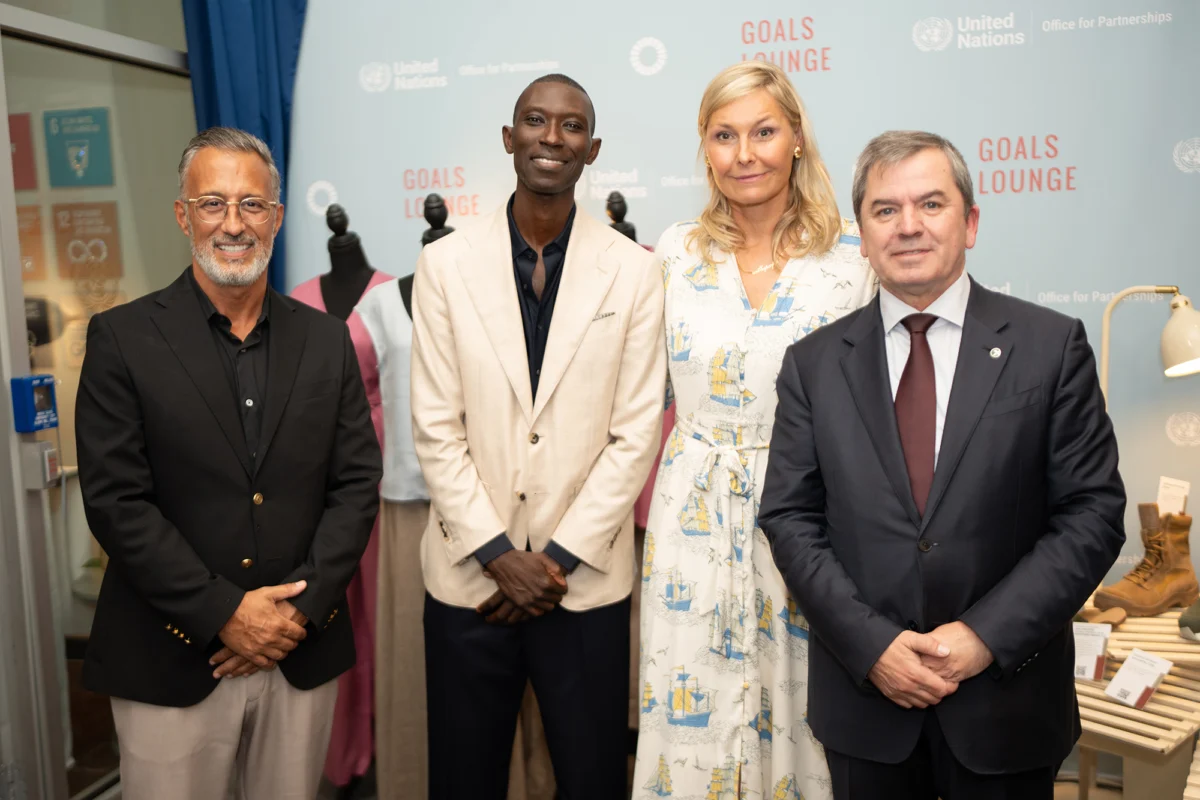
Amid the high-octane spectacle of New York Fashion Week, an influential delegation representing the vanguard of Portugal’s footwear, textile, and apparel sectors assembled at the United Nations headquarters in Manhattan to address one of the most pressing questions facing modern global trade: how manufacturing nations can decouple industrial competitiveness from environmental degradation. Convening under the banner of the nationwide initiative “Made to Matter: Portugal,” industry heads, international diplomats, and trade strategists engaged in a high-level dialogue hosted as part of the annual meeting of the United Nations Fashion and Lifestyle Network. The gathering served not merely as an exhibition of premium Iberian craftsmanship, but as a formal presentation of an economic and operational case study demonstrating how a medium-sized European nation transformed its industrial heartland into an international benchmark for sustainable, high-tech, and ethically anchored production.
The delegation was spearheaded by Luís Onofre, the internationally acclaimed luxury designer and current president of the Portuguese Footwear, Components and Leather Goods Manufacturers’ Association (APICCAPS), alongside César Araújo, president of the National Association of Clothing and Apparel Industries (ANIVEC). Together, they brought the collective voice of more than 6,000 domestic enterprises—an interconnected supply chain that produces over €7 billion in exports annually—directly into the diplomatic forum where global standards for responsible consumption and industrial innovation are forged. Joined by Annemarie Hou, Executive Director of the United Nations Office for Partnerships, and Carlos Moura, Trade and Investment Commissioner for the United States at AICEP (the Portuguese Trade and Investment Agency), the panel highlighted the imperative for the global fashion system to abandon its race to the bottom on price and instead embrace a value proposition centered on longevity, ecological stewardship, and transparent supply networks.
Addressing the assembly, Onofre emphasized that the modern inflection point of the apparel and footwear markets represents an unprecedented opportunity for Portugal to articulate its transformed identity. While the country has historically commanded respect for multi-generational leather-working traditions and tailored garment assembly, it has systematically converted those legacy capabilities into a forward-looking industrial engine driven by advanced research, materials science, and digital fabrication. In Onofre’s assessment, presenting this narrative inside the United Nations during New York Fashion Week carried profound symbolic and commercial resonance, sending a clear message to American fashion executives, retailers, and international tastemakers that Portugal operates not as a generic subcontracting depot, but as an indispensable, high-level innovation partner for brands seeking to meet stringent environmental metrics without compromising on design excellence or execution.

The thesis advanced by Portugal’s industrial leadership directly counters the prevailing low-cost outsourcing paradigm that has dominated global apparel production for four decades. Onofre argued that the coming decade will witness a structural realignment in international manufacturing. Rising carbon tariffs, heightened consumer awareness, and strict legislative frameworks—such as the European Union’s Ecodesign for Sustainable Products Regulation and emerging corporate due diligence directives—are rapidly rendering supply chains based exclusively on rock-bottom labor costs obsolete. In their place, brands are prioritizing agility, supply chain security, verifiable traceability, and reduced transport emissions. Portugal’s geographic positioning along the Atlantic seaboard, coupled with its mature industrial infrastructure, places it within rapid shipping transit of major European and North American metropolitan centers, offering a powerful antidote to the vulnerabilities exposed by long-haul transpacific shipping corridors during recent geopolitical and macroeconomic shocks.
Central to the discussions at the UN was the Portuguese industrial model’s collaborative architecture, a cohesive network uniting private enterprise, state investment, universities, and specialized technology hubs. Rather than operating in isolated silos, Portuguese factories maintain deep ties with scientific institutions such as the Footwear Technological Center of Portugal (CTCP) and the Center for Nanotechnology and Smart Materials. This dynamic public-private synergy has received monumental support in recent years, with the Portuguese fashion and footwear cluster mobilizing more than €200 million in strategic capital investments supported by the European Union-backed Recovery and Resilience Plan (PRR).
A substantial portion of this capital has been channeled directly into flagship green transition projects, most notably the BioShoes4All initiative. Operating under the leadership of APICCAPS, BioShoes4All is an ambitious, nationwide consortium designed to re-engineer the entire footwear lifecycle. The program focuses on five interconnected pillars: the commercial development of biomaterials derived from agricultural waste and organic side-streams, the implementation of eco-design principles that allow shoes to be easily disassembled and recycled at end-of-life, the radical decarbonization of tannery and manufacturing operations, the establishment of closed-loop circular economy models, and the accelerated rollout of Digital Product Passports (DPP). By integrating advanced data collection and automated life-cycle assessment tools into factory floors, the initiative is actively shaping the operational blueprints that global regulators and footwear conglomerates will require in the years ahead.
Parallel transformations were detailed on the textile and apparel front by ANIVEC President César Araújo, who articulated how Portuguese garment makers have positioned themselves as the agile production engine for global luxury and high-end streetwear labels. By combining robotic cutting tables, zero-discharge water recycling systems, and localized dyeing technologies with artisanal hand-finishing, Portugal’s textile manufacturers have managed to consistently outpace competitors in turnaround speed and quality retention. Araújo pointed out that sustainable manufacturing is inextricably bound to social responsibility and human capital; Portugal’s adherence to rigorous European labor conventions guarantees fair wages, safe factory conditions, and continuous technical training, ensuring that the human element of craftsmanship is preserved and elevated alongside automated workflows.

The strategic relevance of New York City as the venue for this intervention was underscored by AICEP’s Carlos Moura. North America represents one of the fastest-growing and highest-potential export destinations for high-value Portuguese goods, particularly as American retailers and independent designers seek alternatives to Asian manufacturing monopolies. By presenting their credentials within the United Nations framework, the Portuguese trade bodies aimed to connect directly with American procurement decision-makers who must align their commercial sourcing with Environmental, Social, and Governance (ESG) targets and the UN Sustainable Development Goals—most specifically Goal 9 (Industry, Innovation, and Infrastructure), Goal 12 (Responsible Consumption and Production), and Goal 13 (Climate Action).
Annemarie Hou of the UN Office for Partnerships reinforced the timeliness of the dialogue, acknowledging that the fashion industry, historically criticized as one of the most resource-intensive and polluting sectors on earth, has a moral and systemic imperative to evolve. Hou emphasized that high-level policy frameworks mean very little without the industrial capacity to execute them on factory floors. In this regard, Portugal’s multi-layered approach was commended as a tangible demonstration of public policy, private sector resilience, and environmental stewardship coalescing to modernize traditional manufacturing.
Ultimately, the New York summit marked a defining step in Portugal’s campaign to redefine the meaning of modern luxury and industrial value. Far from viewing environmental and labor compliance as restrictive overhead, the Portuguese footwear and apparel sectors have leveraged sustainability as their most potent competitive differentiator on the world stage. As the global fashion landscape continues to grapple with the realities of the climate crisis, resource depletion, and fragile supply chains, the comprehensive strategy showcased inside the United Nations chambers offers a compelling, battle-tested roadmap: proving that a nation can honor its historical artisanal roots while simultaneously building a cleaner, smarter, and commercially resilient manufacturing future.