
In an era where global food security and sustainability have become paramount, the packaging industry is undergoing a radical transformation. Moving beyond the traditional role of a passive barrier, modern packaging is now expected to actively participate in the preservation of the product it contains. Leading this charge is ProAmpac, a global leader in flexible packaging and material science, which has recently unveiled its latest breakthrough: the ProActive Intelligence Shelf Protect (SP) Series. This innovative food-contact packaging film is designed to extend the shelf life of highly perishable proteins and dairy products, addressing one of the most significant challenges in the modern food supply chain—microbial spoilage.
The global food waste crisis is staggering in its scale. According to the Food and Agriculture Organization (FAO) of the United Nations, approximately one-third of all food produced for human consumption is lost or wasted globally. In the meat and dairy sectors, this waste is particularly costly, both economically and environmentally. Meat production is resource-intensive, requiring significant inputs of water, feed, and energy. When a package of beef or pork spoils before it can be consumed, all the resources invested in its production, processing, and distribution are effectively discarded. ProAmpac’s Shelf Protect technology aims to mitigate these losses by integrating advanced biotechnology directly into the structural makeup of the packaging film.
The ProActive Intelligence Shelf Protect (SP) Series represents a strategic partnership between ProAmpac and Copperprotek, a biotechnology firm specializing in antimicrobial solutions. At the heart of this technology is a patented copper-based biotechnology that is embedded into the food-contact layer of the film. Unlike traditional methods of preservation that may involve adding preservatives directly to the food, Shelf Protect works through contact. The copper-based ions within the film disrupt the metabolic processes of spoilage-causing microorganisms, such as bacteria and fungi, thereby slowing their growth and extending the period during which the food remains fresh and safe for consumption.
The regulatory landscape for food-contact materials is notoriously stringent, and for good reason. ProAmpac has ensured that the Shelf Protect Series meets the rigorous standards set by both the U.S. Food and Drug Administration (FDA) and the U.S. Department of Agriculture (USDA). The technology is currently approved for a specific range of high-value applications, including fresh beef, fresh pork, cooked sausage, deli meats, fresh salmon, and fresh cheese. These categories represent some of the most sensitive items in the grocery store, where even a few extra days of shelf life can significantly alter the profitability of a product line and reduce the volume of markdowns and disposals at the retail level.
Sam Kessler, a senior innovation engineer at ProAmpac, highlights the economic imperative behind this innovation. He notes that for meat processors, every item lost to spoilage is an unrealized investment. The labor of the farmer, the logistics of the processor, and the carbon footprint of the transport are all rendered moot when a product hits its expiration date prematurely. By providing active packaging that can be used in the shrink bags and films that processors already rely on, ProAmpac is giving the industry a tool to protect that investment without requiring a complete overhaul of existing packaging lines.
One of the most impressive technical feats of the Shelf Protect Series is its ability to maintain the aesthetic and functional qualities of the packaging. In the retail environment, visual appeal is everything. Consumers equate clarity and "bloom" (the bright red color of fresh beef) with quality. ProAmpac has engineered the SP Series to maintain high levels of package clarity, ensuring that the antimicrobial technology does not cloud the film or alter its appearance. Furthermore, the physical and seal properties of the film remain unchanged. This means that processors do not need to adjust their sealing temperatures or mechanical settings, allowing for a seamless transition from standard films to the Shelf Protect series.
The transparency extends to the labeling as well. In an age where "clean label" initiatives are driving consumer behavior, many shoppers are wary of chemical preservatives listed on ingredient decks. Shelf Protect offers a "cleaner" alternative because the antimicrobial agent is part of the packaging, not the food. For approved applications, the packaging requires no special on-package labeling other than the standard "use by" or "use or freeze by" dates. This allows brands to maintain a clean ingredient list while still benefiting from the extended shelf life provided by the active film.
The efficacy of the Shelf Protect technology is backed by rigorous empirical data. ProAmpac and Copperprotek have collaborated with third-party laboratories and major food manufacturers to conduct extensive trials. These studies have consistently demonstrated that fresh beef, pork, and cooked sausages packaged in the SP Series exhibit a measurable extension in shelf life. Beyond just the "use by" date, the studies also tracked quality indicators such as odor development and microbial counts. The results showed a marked reduction in the development of off-odors—a primary reason consumers discard meat—and a significant suppression of the microbial colonies that lead to spoilage.
However, ProAmpac is careful to manage expectations regarding the exact duration of shelf-life extension. Because food preservation is a complex interplay of variables, the gains provided by Shelf Protect can vary based on several factors: the initial microbial load of the product at the time of packaging, the specific processing conditions of the facility, storage temperatures throughout the cold chain, and general operational hygiene. Consequently, ProAmpac works closely with its clients to conduct case-by-case food trials, ensuring that the packaging is optimized for each specific product and environment.
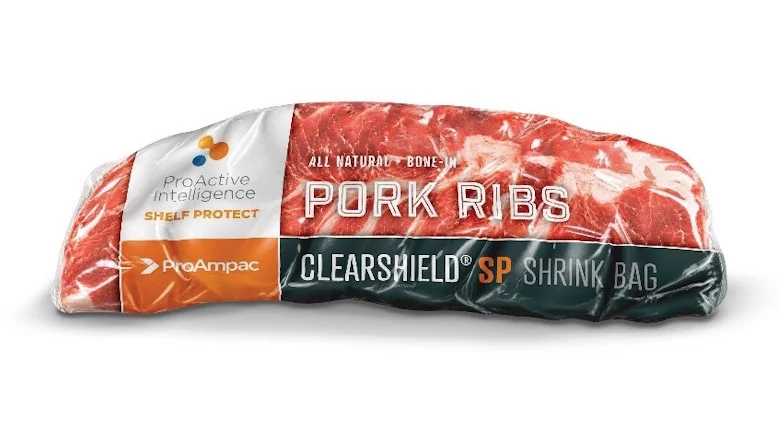
To ensure broad market applicability, ProAmpac is incorporating the Shelf Protect technology into three of its core packaging lines. The first is the TruTite-SP-1000, designed for boneless shrink bags and tubestock. This is ideal for large cuts of meat and deli blocks. The second is the ClearShield-SP-1000, which is engineered for bone-in applications. Bone-in meats require high puncture resistance to prevent leaks that would compromise the vacuum seal; ClearShield-SP-1000 combines this physical toughness with antimicrobial protection. Finally, the Envio-SP-1000 series covers forming and non-forming films, which are commonly used in thermoforming applications for products like sliced deli meats and cheeses.
The environmental implications of this technology are as significant as the economic ones. The sustainability of a packaging solution is often measured by its end-of-life (recyclability), but the "middle-of-life" impact is equally crucial. By extending the life of the food inside, ProAmpac is reducing the frequency of food waste, which in turn reduces the methane emissions produced by decomposing organic matter in landfills. Furthermore, by reducing the rate of spoilage, the technology allows for more efficient logistics, potentially enabling longer shipping distances or less frequent deliveries, which optimizes the carbon footprint of the distribution network.
Looking forward, the introduction of the ProActive Intelligence Shelf Protect Series signals a shift in the trajectory of the flexible packaging market. We are entering an era of "Intelligent Packaging," where the materials are functional, responsive, and integrated into the broader goals of food safety and waste reduction. As ProAmpac continues to expand its ProActive Sustainability suite, the integration of biotechnology like that provided by Copperprotek will likely become a standard expectation for premium food brands.
For food processors and retailers, the message is clear: the package is no longer just a container; it is a critical component of the product’s quality assurance strategy. With the launch of the Shelf Protect (SP) Series, ProAmpac is providing a scientifically validated, regulatory-compliant, and commercially viable path toward a more resilient and less wasteful food system. As the industry moves toward 2030 sustainability goals, innovations like these will be the bridge between current capabilities and a future where food waste is drastically minimized. For more information on these solutions, industry professionals are encouraged to engage with ProAmpac’s innovation teams to explore how active packaging can be tailored to their specific operational needs.