
The streets of New York City have long served as the unofficial runway for the world’s most formidable fashion icons, but few arrivals carry the weight of a returning legend. On a crisp Friday in the heart of Manhattan, Meryl Streep—the woman who breathed icy, impeccable life into the character of Miranda Priestly—demonstrated that her mastery of the visual narrative remains unparalleled. As the promotional cycle for the highly anticipated sequel, "The Devil Wears Prada 2," reaches a fever pitch, Streep navigated the city’s architectural canyons in two diametrically opposed ensembles, effectively charting a course from avant-garde relaxation to the high-gloss authority that has become synonymous with her most famous role.
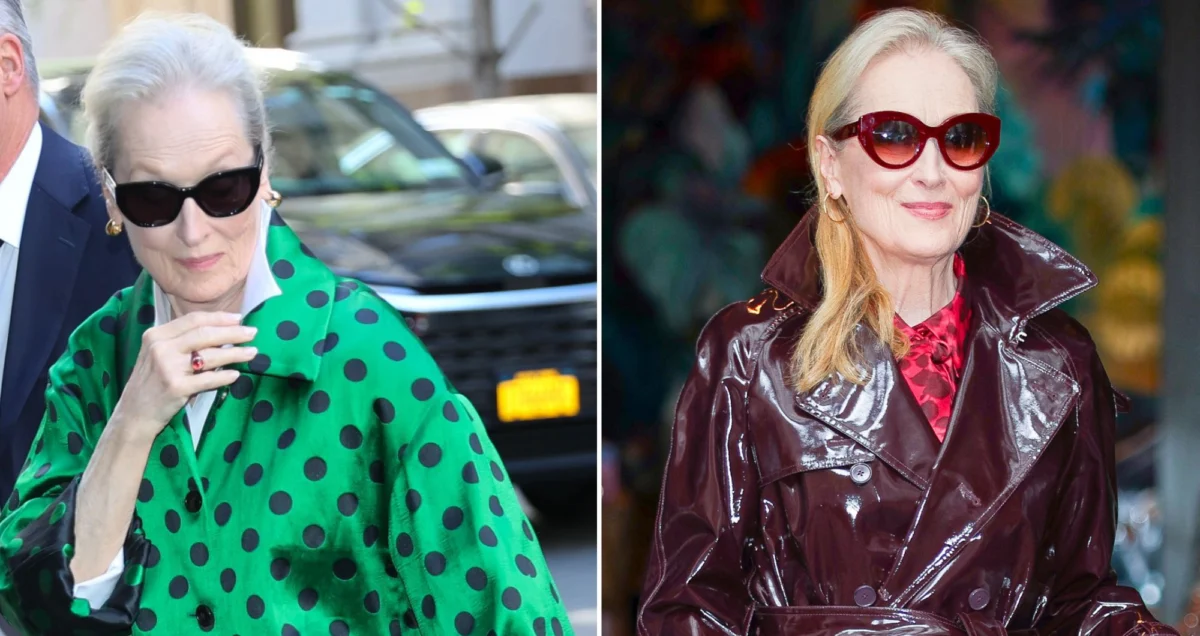
The day began with a masterclass in "intellectual chic," a stylistic lane Streep has occupied with grace for decades. Stepping out into the morning light, the Academy Award winner opted for a look that balanced volume with graphic precision. The centerpiece was an oversized, cocoon-shaped topper crafted from a luminous green satin. This was no ordinary coat; it was a canvas of playfulness and structure, featuring scattered, oversized black polka dots that offered a modern riff on a classic mid-century motif. The garment’s design—characterized by broad collars, dropped shoulders, and a generous silhouette—allowed Streep to move with an ease that felt both grounded and ethereal.
The details of the morning ensemble revealed a sophisticated approach to layering. Beneath the vibrant satin, Streep wore a crisp white collared shirt, the ultimate staple of the professional wardrobe, paired with medium-wash denim jeans. This juxtaposition of high-fashion evening fabric (satin) with the utilitarian grit of denim created a "street style" moment that felt authentic to New York’s eclectic spirit. Her accessories were curated with a "less is more" philosophy: dark, enigmatic sunglasses, subtle gold hoop earrings, and practical black slip-on shoes. A slate-blue top-handle bag provided a muted counterpoint to the verdant green of the coat, while turned-back cuffs revealed a clever sartorial secret—a reverse colorway of green spots on a black background, adding a touch of hidden complexity to the outfit.
However, as the sun climbed higher and the setting shifted to the Financial District for the film’s global press junket, the "off-duty" Streep vanished, replaced by a vision of uncompromising power. This transition was more than a mere change of clothes; it was a return to the "Miranda Priestly" persona that has haunted the fashion industry’s collective imagination since 2006.

For the afternoon’s high-stakes media appearances, Streep donned a long, double-breasted trench coat by Dolce & Gabbana. This was not the traditional beige gabardine of a rainy-day commute. Instead, the piece was rendered in a provocative, high-shine red patent leather that demanded total attention. The coat featured sharp, peaked lapels and a belted waist that cinched the silhouette, creating a hard, controlled line that stood in stark contrast to the morning’s fluid satin. The ankle-grazing hem and the glossy finish gave the garment an almost architectural quality, reflecting the glass and steel of the surrounding skyscrapers in the Financial District.
Underneath the commanding trench, a glimpse of a Gabriela Hearst dress was visible at the neckline. Hearst, a designer renowned for her commitment to "honest luxury" and sustainable craftsmanship, provided a layer of intellectual depth to the look. The dress featured a subtle red print that broke up the monochromatic intensity of the patent leather, offering a texture that was soft yet sophisticated.
The styling of the red ensemble was a study in monochromatic dedication. Streep and her long-time collaborator, celebrity stylist Micaela Erlanger, opted for a "total red" approach that felt both cinematic and aggressive. She wore pointed-toe Dolce & Gabbana pumps in a matching scarlet hue, and carried a structured top-handle bag by Manu Atelier—a brand known for its fusion of traditional leatherwork and contemporary shapes. The look was rounded out with Emmanuelle Khanh sunglasses and shimmering pieces from Effy Jewelry. Erlanger, who has gained fame for her ability to craft distinct "fashion eras" for her clients (most notably Lupita Nyong’o), clearly understood the assignment: this was not just a press tour; it was a coronation.
This New York outing is part of a broader, meticulously planned visual strategy for the "The Devil Wears Prada 2" tour. The campaign began in late March in Mexico City, where Streep set the tone in a monochrome red Dolce & Gabbana suit, paired with glossy Aldo slingbacks. The choice of Aldo—a more accessible brand—was a savvy nod to the "high-low" reality of modern fashion, even as she occupied the highest echelons of celebrity. From there, the tour moved to Tokyo, where the red theme continued, this time through the lens of Chanel’s Métiers d’Art 2026 collection, blending Parisian craftsmanship with the film’s bold color palette.
The significance of these fashion choices cannot be overstated. In the original 2006 film, the wardrobe—designed by the legendary Patricia Field—was a character in its own right. It defined the hierarchy of the fictional Runway magazine and served as the visual language of power and aspiration. By leaning into "method dressing" for the sequel’s promotion, Streep is bridging the twenty-year gap between the original film and its successor. She is signaling to the audience that while the industry has changed—moving from the era of print dominance to the digital-first, influencer-driven landscape of the 2020s—the fundamental nature of power and style remains unchanged.

The choice of the Financial District as a backdrop for the red patent look was particularly poignant. As the historic center of global commerce, the neighborhood’s "hard" aesthetic mirrored the "hard" texture of the Dolce & Gabbana trench. It suggested that Miranda Priestly (and by extension, Streep) is not just a figure of fashion, but a figure of industry. The red patent leather acted as a suit of armor, a high-gloss shield against the prying eyes of the press and the relentless pace of a global junket.
Furthermore, the involvement of Gabriela Hearst adds a layer of modern relevance to the wardrobe. In the years since the first film, the fashion industry has been forced to reckon with its environmental impact. Hearst is at the forefront of the movement toward sustainable luxury, and her inclusion in Streep’s wardrobe suggests a Miranda Priestly who has evolved with the times—perhaps a Miranda who now demands that her "Cerulean" sweaters be ethically sourced and carbon-neutral.
As the world waits to see how the sequel will handle the legacy of the original, Meryl Streep is providing a masterclass in how to manage a public image. Through the expert guidance of Micaela Erlanger, Streep is using her wardrobe to tell a story of duality. The green spotted satin of the morning represented the artist—creative, relaxed, and unafraid of bold, graphic patterns. The red patent leather of the afternoon represented the icon—disciplined, authoritative, and utterly in control.
In the end, Streep’s Friday in New York was a reminder of why she remains the preeminent actress of her generation. She understands that in the world of The Devil Wears Prada, fashion is never just about clothes. It is about the "stuff" that dreams—and nightmares—are made of. Whether she is draped in the soft folds of an oversized green coat or encased in the uncompromising shine of a red trench, she is always, undeniably, the woman in charge. And as the "The Devil Wears Prada 2" continues its march toward theaters, one thing is certain: everyone else is still just catching up.