
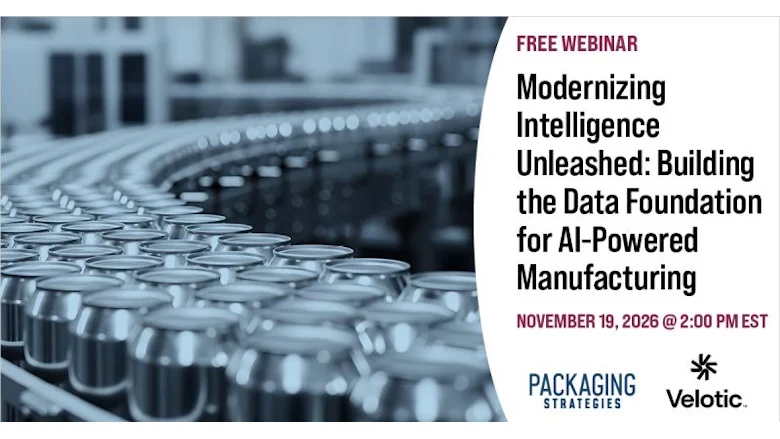
The global manufacturing landscape is currently navigating a pivotal transformation, moving away from the era of simple automation and toward a future defined by autonomous, self-optimizing systems. At the heart of this evolution is Artificial Intelligence (AI), a technology that promises to unlock unprecedented levels of efficiency, sustainability, and agility. However, as many Consumer Packaged Goods (CPG) leaders are discovering, the path to AI integration is often obstructed by a fundamental hurdle: the lack of a clean, contextualized, and scalable data foundation. Without a reliable stream of high-quality information, even the most sophisticated AI algorithms are rendered ineffective—a reality often summarized by the industry adage, "garbage in, garbage out." To address these critical challenges, industry experts are convening for a high-level thought leadership webinar on November 19 at 2 p.m. Eastern Time, titled "Building the Data Foundation for AI-Powered Manufacturing."
The upcoming session, featuring Joe Gerstl, Director of Manufacturing Execution Systems (MES) Software at Velotic, aims to provide a comprehensive roadmap for manufacturers looking to bridge the gap between raw shop floor data and high-level AI applications. In an industry where margins are razor-thin and supply chain volatility is the new normal, the ability to transform operational data into actionable intelligence is no longer a competitive advantage; it is a prerequisite for survival.
The Paradox of Modern Manufacturing Data
For decades, modern factories have been generating massive quantities of data. Every sensor on a conveyor belt, every PLC (Programmable Logic Controller) in a packaging line, and every temperature gauge in a processing unit emits a constant pulse of information. Yet, much of this remains "dark data"—information that is collected but never utilized. In many legacy environments, this data exists in silos, trapped within proprietary machine protocols or isolated software modules that do not communicate with one another.
The challenge for CPG manufacturers is not the quantity of data, but its lack of context. A temperature reading of 200 degrees Celsius is meaningless in isolation. To be useful for an AI model, that data point must be contextualized: What product was being run? Which operator was on shift? What was the ambient humidity in the plant? What was the specific batch of raw materials used? The webinar will delve into how leading manufacturers are using modern Manufacturing Execution Systems (MES) to weave these disparate threads into a "digital thread," providing the necessary metadata to make AI training successful.
The Role of MES as the Nervous System of the Factory
A central theme of the discussion will be the evolving role of the Manufacturing Execution System. Traditionally viewed as a tool for tracking and tracing or simple production scheduling, the modern MES has become the critical intermediary between the shop floor (Operational Technology) and the enterprise level (Information Technology). By acting as the "nervous system" of the factory, the MES captures real-time events and translates them into a standardized format that AI engines can digest.
Joe Gerstl of Velotic will explore how these systems enable real-time data collection that goes beyond mere observation. When an MES is properly integrated, it allows for "closed-loop" manufacturing. This means that AI can not only predict when a machine might fail—known as predictive maintenance—but can also trigger the MES to adjust production schedules or order replacement parts automatically. This level of synchronization reduces downtime and optimizes the lifecycle of expensive capital equipment.
Avoiding the "Rip and Replace" Trap
One of the most significant barriers to AI adoption is the fear of cost and complexity. Many executives believe that to become "AI-ready," they must undergo a massive, multi-million dollar "rip and replace" of their existing infrastructure. The November 19 webinar will specifically challenge this notion. The focus will be on establishing a scalable data foundation that supports future AI initiatives without requiring a complete technology overhaul.
The strategy involves leveraging "Edge-to-Cloud" architectures. By processing critical data at the "edge" (near the machine) and sending only the necessary, refined information to the cloud for deep learning, manufacturers can achieve significant results with incremental investments. This modular approach allows CPG companies to start small—perhaps focusing on a single packaging line or a specific quality control bottleneck—and then scale those successes across the entire enterprise.
From Predictive Insights to Operational Visibility
The webinar will also highlight the immediate benefits of a robust data foundation, even before full-scale AI is deployed. Enhanced operational visibility is the first "win" in the digital transformation journey. When managers have access to real-time dashboards that reflect the true state of the factory floor, they can make decisions based on facts rather than intuition.

In the CPG sector, where product variety (SKUs) is increasing and batch sizes are shrinking, this visibility is crucial. It allows for more agile changeovers and better management of "Overall Equipment Effectiveness" (OEE). During the session, experts will share case studies of how leading manufacturers have used analytics to identify hidden bottlenecks that were previously obscured by manual reporting and paper-based logs.
The Human Element: Empowering the Workforce
While the technical aspects of data architecture are vital, the "Building the Data Foundation" webinar will also address the human component of AI-powered manufacturing. There is a common misconception that AI is intended to replace human workers. In reality, the most successful implementations are those that empower the workforce.
By automating the collection and analysis of data, employees are freed from mundane administrative tasks and can focus on high-value problem-solving. AI-powered tools can provide shop floor operators with "augmented intelligence," offering real-time suggestions on how to optimize a machine’s performance or alerting them to subtle quality deviations that the human eye might miss. This shift not only improves productivity but also helps bridge the "skills gap" by providing less experienced workers with the insights of a seasoned veteran.
Why the CPG Industry Must Act Now
The timing of this webinar is particularly relevant given the current macroeconomic climate. CPG manufacturers are facing a "triple threat" of rising input costs, labor shortages, and increasing pressure to meet sustainability targets. AI offers a solution to all three. By optimizing energy consumption, reducing material waste through precision manufacturing, and maximizing the output of the existing workforce, AI-driven strategies provide a clear path to long-term profitability.
Furthermore, sustainability is no longer a corporate social responsibility (CSR) afterthought; it is a business imperative. Retailers and consumers alike are demanding transparency regarding the carbon footprint of the products they buy. A solid data foundation allows manufacturers to track energy and resource usage at the granular level, providing the data necessary for accurate ESG (Environmental, Social, and Governance) reporting and identifying opportunities for "green" optimizations.
Looking Ahead: The Future of AI in Packaging and Beyond
As the industry moves toward 2025 and beyond, the distinction between "manufacturing" and "tech" companies will continue to blur. The winners will be those who view their operational data as a strategic asset. The webinar hosted by Packaging Strategies and featuring Velotic is designed to be a catalyst for this shift, offering practical, actionable advice for professionals across the production spectrum—from plant managers and IT directors to C-suite executives.
The session will conclude with a deep dive into emerging AI technologies, such as Generative AI and Computer Vision, and how they will specifically impact the packaging industry. From automated visual inspection of seals and labels to the use of Large Language Models (LLMs) for troubleshooting complex machinery, the possibilities are vast—provided the foundation is strong.
Registration and Participation
The event, "Building the Data Foundation for AI-Powered Manufacturing," is scheduled for November 19, 2024, at 2 p.m. ET. Registration is currently open for industry professionals who wish to gain a deeper understanding of how to modernize their operations. Participants will have the opportunity to engage with Joe Gerstl during a dedicated Q&A session, ensuring that specific regional or sectoral challenges are addressed.
In a world where digital transformation is accelerating at a breakneck pace, staying informed is the only way to ensure that your facility is not left behind. By attending this webinar, manufacturers can take the first step toward turning their shop floor information into the actionable intelligence required for the AI era. This initiative represents a significant effort by the Packaging Strategies editorial team—including Brad Addington, Chloe Alverson, and Douglas J. Peckenpaugh—to bring high-value, technical education to the forefront of the packaging and manufacturing discourse.