
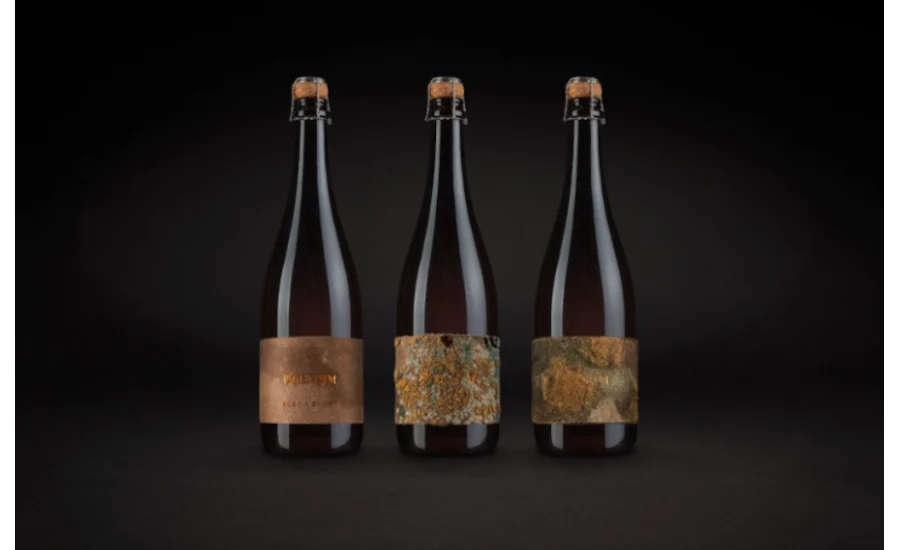
In the high-stakes arena of global packaging design, where glossy finishes and high-tech polymers often dominate the conversation, a radical shift toward raw, biological authenticity has just claimed the industry’s most prestigious crown. The Pentawards 2026, held as the definitive benchmark for packaging excellence, recently announced that the Diamond Award—the competition’s highest possible honor—has been bestowed upon Piquentum Brut Nature. This sparkling wine, born from the rugged terroir of Istria, Croatia, has captivated the international jury not through traditional luxury tropes, but through a breakthrough "living label" constructed entirely from the byproduct of its own fermentation.
Designed by the visionary Croatian agency Studio Sonda, the Piquentum Brut Nature packaging represents a seismic shift in how the wine industry approaches the circular economy. While the global wine market has long struggled with the environmental footprint of heavy glass, plastic foils, and non-recyclable adhesive labels, Piquentum has looked inward, literally using the "waste" from its own bottles to create a garment for the product. This recognition at the Pentawards marks a watershed moment, validating the idea that the future of premium packaging lies in the seamless integration of biology, craft, and sustainability.
The Genesis of a Biological Breakthrough
The story of the Piquentum label begins in the cellar of Dimitri Brečević, the winemaker behind Piquentum. Known for his minimal-intervention approach, Brečević operates out of a converted Mussolini-era water cistern in Buzet, Istria. His philosophy is rooted in the belief that wine should be a pure expression of the vintage, the soil, and the climate, without the interference of industrial additives. When it came time to package his Brut Nature—a sparkling wine made according to the traditional method but with a natural twist—the challenge was to create a visual identity that didn’t just talk about nature, but was a part of it.
Studio Sonda, led by Creative Director Jelena Fiškuš and Founder Sean Poropat, has a long history of collaborating with Piquentum to push the boundaries of narrative packaging. Their previous projects included labels that visualized annual rainfall through graphic punctures, allowing consumers to "see" the weather that shaped the wine. However, the 2026 Diamond Award-winning project took this conceptual depth into the realm of material science.
The team focused on the dégorgement process—a critical step in the production of traditional method sparkling wine. During the second fermentation inside the bottle, yeast consumes sugar to create carbonation, eventually dying and settling as a sediment known as "lees." In standard winemaking, this sediment is collected in the neck of the bottle and expelled (disgorged) as waste. While most producers simply discard this organic matter, Piquentum and Studio Sonda saw it as a raw resource.
Engineering the "Living Label"
Creating a functional label from wine sediment was an arduous task that required a departure from standard printing techniques. The sediment, a rich, organic sludge of spent yeast and grape particulates, was harvested and stabilized. To give it structural integrity, it was blended with a mere 10% paper pulp, which was itself sourced from the winery’s internal paper waste streams.
The result is the world’s first wine label made from the wine-making process itself. The texture is tactile and irregular, a far cry from the uniform smoothness of industrial paper. But the true innovation lies in the label’s "living" quality. Because the material remains fundamentally organic and porous, it continues to interact with its environment long after it leaves the winery. Over time, depending on the humidity and temperature of the cellar or storage area, the label can develop a fine patina of mold or change in hue.
Rather than viewing this as a defect, the designers embraced it as "proof of authenticity." Each bottle becomes a unique artifact, its label evolving in real-time. This "beautiful imperfection" serves as a biological timestamp, ensuring that no two bottles of Piquentum Brut Nature are ever exactly alike. It is a radical rejection of the sterilized, mass-produced aesthetic that has dominated the luxury wine sector for decades.
A New Definition of Premium
The Pentawards jury, a panel of the world’s leading design experts, was unanimous in its praise. Jury member Suzy Shelley, the sustainability and materials lead at the renowned agency Pearlfisher, highlighted the project’s dual success as both an aesthetic triumph and a technical marvel. "What I loved about this project is that it’s a beautiful piece of packaging," Shelley stated. "It’s something I’ve never seen before, and not only is it really gorgeous, but it’s also really innovative."
The Diamond Award is rarely given to projects that rely solely on visual appeal; it demands a fundamental rethinking of the packaging medium. In the case of Piquentum, the "premium" nature of the product is derived from its honesty. In a world of "greenwashing," where brands often use earthy tones and recycled logos to mask unsustainable practices, Piquentum’s label is a literal manifestation of its contents.
Creative Director Jelena Fiškuš reflected on the win, stating, "This recognition is the ultimate validation of our belief that today’s true premium lies in authenticity and a deep respect for the natural process. It proves that there is immense beauty in imperfection." This sentiment echoes a broader trend in the 2020s, where luxury consumers are increasingly moving away from "bling" and toward "provenance"—the story of where a product comes from and how it was made.
The Circular Economy in Practice
Beyond the artistry, the Piquentum label is a masterclass in circular design. The wine industry is under increasing pressure to reduce its environmental impact, with new regulations in the European Union and elsewhere targeting packaging waste. The traditional wine label is often a hidden environmental culprit; many are coated in plastic or metallic foils and use adhesives that make bottle recycling more energy-intensive.
By utilizing the sediment—a byproduct that would otherwise require disposal—and mixing it with internal paper waste, Piquentum has created a closed-loop system. This approach reduces the need for virgin raw materials and eliminates the carbon footprint associated with transporting label stock from distant manufacturers. Furthermore, because the label is composed of organic matter and minimal pulp, it is fully biodegradable, returning to the earth as easily as it emerged from it.
Impact on the Global Wine Industry
The success of Piquentum and Studio Sonda at the 2026 Pentawards is expected to send shockwaves through the viticulture world. For years, the "natural wine" movement has focused almost exclusively on what is inside the bottle. Piquentum has now bridged the gap, proving that the packaging can—and should—be as natural as the liquid it contains.
Industry analysts suggest that this "living label" concept could be adapted for other fermented products, from craft beer to artisanal vinegars, where sediment is a natural part of the lifecycle. It challenges other high-end winemakers to look at their own waste streams—grape skins (pomace), stems, and lees—not as trash, but as the building blocks of their brand identity.
Conclusion: The Future of Packaging is Organic
As the 2026 Pentawards concludes, the message from the Diamond Award is clear: innovation does not always mean more technology; sometimes, it means more nature. Piquentum Brut Nature has set a new benchmark for the industry, showing that sustainability and high-end design are not mutually exclusive but are, in fact, two sides of the same coin.
In the hills of Istria, Dimitri Brečević continues to produce wines that speak of the earth. Now, thanks to the creative intervention of Studio Sonda, the bottles themselves have found a voice. The "living label" is more than just a clever marketing tool; it is a testament to the power of circular thinking and a reminder that in the world of fine wine, the most sophisticated solutions are often found at the bottom of the barrel. As these bottles age in cellars around the world, their labels will continue to grow, breathe, and change—a constant, evolving celebration of the natural process that earned them the world’s highest design honor.