
The landscape of global commerce is increasingly defined by the efficiency of the "last mile" and the sustainability of the "first touch." This duality was on full display at the McCormick Place in Chicago during PACK EXPO International 2026. Produced by PMMI, the Association for Packaging and Processing Technologies, the event served as a massive industrial microcosm, drawing a staggering 72,000 professionals—comprising 43,000 attendees and 29,000 exhibitor personnel. Across 1.3 million net square feet of exhibition space, 2,700 companies showcased solutions designed to navigate the complexities of 40 distinct vertical markets. While the sheer scale of the event was breathtaking, the true narrative emerged from the specialized innovations tailored for unique market demands, ranging from high-speed robotics for flexible formats to revolutionary dry-molded fiber for foodservice.
The evolution of packaging is currently being driven by two main forces: the rise of flexible packaging and the urgent mandate for sustainable material science. As consumer preferences shift toward lightweight, portable, and shelf-stable products, the machinery that handles these items must become more intelligent and adaptable. This was perhaps most evident in the advancements seen in case packing and robotic integration, where the traditional rigidities of the assembly line are being replaced by dynamic, software-driven flexibility.

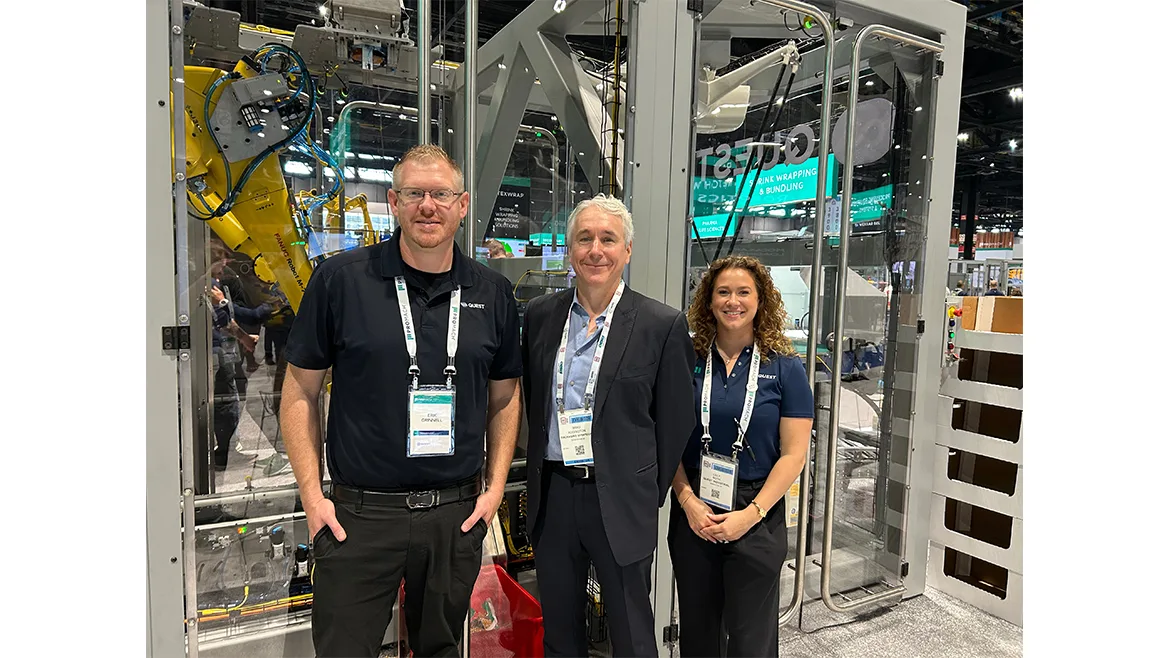
One of the most significant technical highlights of the expo was the QX250 Vertical & Horizontal Flexible Package Case Packer, a flagship offering from Quest Industrial, a ProMach brand. The rise of the "pouch revolution" has presented a unique set of challenges for manufacturers. Unlike rigid bottles or cans, pouches are inherently unstable, varying in shape and center of gravity. The QX250 addresses this by offering a versatile platform capable of handling a diverse array of flexible formats, including the popular Doy pouches and pillow bags.
What sets the QX250 apart in a crowded field of case packers is its multi-format capability. It can seamlessly transition between Regular Slotted Containers (RSC), Half Slotted Containers (HSC), Bliss boxes, and tray formats. In an era where SKU proliferation is the norm, the ability to switch between these formats in five minutes or less via an automated tool exchange is a game-changer for Operational Equipment Effectiveness (OEE). The integration of an intuitive Human-Machine Interface (HMI) with guided instructions further democratizes the technology, allowing operators with varying levels of experience to manage complex changeovers. Furthermore, the inclusion of sophisticated vision and line tracking allows the robots to "see" and adapt to the product as it arrives on the conveyor, ensuring that even the most irregularly shaped flexible packages are oriented and packed with surgical precision.
Beyond the mechanics of packing, the expo provided deep insights into the changing psychology of the consumer and the materials required to meet those expectations. This was particularly evident in the dairy and liquid food sectors. Tetra Pak, a global leader in food processing and packaging solutions, presented a vision of the future where convenience and shelf-stability coexist. Pedro Gonçalves, Tetra Pak’s Vice President of Marketing for the U.S. and Canada, highlighted a seemingly simple but profound innovation: the resizing of coffee creamer packaging.

Historically, the single-serve creamer market has relied on tiny, often difficult-to-open plastic cups. Tetra Pak’s research indicated a significant consumer pain point—the need to open multiple small containers to achieve the desired flavor profile. By introducing a larger, more ergonomic package, Tetra Pak has streamlined the user experience, allowing for a "one-and-done" convenience that appeals to the fast-paced lifestyle of modern coffee drinkers.
However, Tetra Pak’s most ambitious move in the North American market involves the broader rollout of shelf-stable (aseptic) milk. While common in Europe and Latin America—where refrigeration is often at a premium and sustainability is a top-tier driver—shelf-stable milk has faced a cultural barrier in the United States. In the U.S., consumers are conditioned to find milk in the "cold chain" refrigerated section. Gonçalves noted that while the technology allows milk to stay fresh for months without refrigeration, American consumers may still choose to refrigerate it out of habit. The environmental implications of this technology are massive; by removing the requirement for refrigerated transport and storage, the carbon footprint of the dairy supply chain can be drastically reduced. This shift toward aseptic packaging represents a pivot toward a more resilient food system, capable of weathering supply chain disruptions without the risk of mass spoilage.
While Tetra Pak focuses on liquid food systems, a Swedish company named Yangi is rewriting the rules for solid packaging in the foodservice and cosmetics sectors. Meeting with Yangi’s founder, Anna Altner, revealed that we are on the cusp of a new era in material science: dry-molded fiber. For decades, molded fiber—the material used for egg cartons and drink carriers—has relied on a "wet" process that requires immense amounts of water and energy for drying. Yangi’s Cellera technology bypasses the water-based forming step entirely.

This "dry-forming" process is a breakthrough in industrial sustainability. By eliminating the need for water, the Cellera technology reduces energy consumption, slashes greenhouse gas emissions, and offers production cycles as fast as four seconds. This speed and efficiency make it a viable competitor to traditional plastic trays used in foodservice. As global regulations tighten around single-use plastics, the ability to produce high-quality, fiber-based packaging at scale—without the environmental "tax" of heavy water usage—positions Yangi as a leader in the circular economy. Their technology proves that the transition from plastic to paper does not have to result in a loss of production speed or an increase in manufacturing costs.
The overarching theme of PACK EXPO 2026 was the move away from "one-size-fits-all" solutions. Whether it was Quest Industrial’s robots adapting to the "floppiness" of a pouch, Tetra Pak addressing the specific frustrations of a coffee drinker, or Yangi removing water from the fiber-forming equation, the industry is clearly moving toward hyper-specialization. This specialization is powered by data and driven by a need for greater environmental stewardship.
The 2,700 exhibitors at McCormick Place demonstrated that the packaging industry is no longer just about "the box." It is about the intersection of robotics, material science, and consumer behavior. The 72,000 professionals in attendance were not just looking for machines; they were looking for ways to future-proof their businesses against a rapidly changing climate and a volatile global economy.

As we look toward the future, the innovations debuted in Chicago suggest a few key trends will dominate the next decade. First, the "democratization of automation" will continue, with HMIs becoming so intuitive that the labor shortage in manufacturing will be mitigated by easier-to-operate machinery. Second, aseptic technology will likely expand beyond dairy into new categories of functional beverages and soups, further reducing our reliance on energy-intensive cold chains. Finally, the shift toward fiber-based materials will move from "niche" to "standard," as dry-molding technologies like Yangi’s make paper-based packaging more cost-competitive with plastic.
In conclusion, PACK EXPO International 2026 was more than a trade show; it was a testament to human ingenuity in the face of complex global challenges. By tailoring materials and machinery to unique vertical markets, the packaging industry is ensuring that it remains the backbone of the global supply chain—efficient, adaptable, and increasingly sustainable. The lessons learned and the partnerships formed over those four days in Chicago will undoubtedly shape the shelves of our supermarkets and the efficiency of our logistics for years to come.