
In an era where the boundary between elite European football and runway fashion has all but dissolved, contemporary French menswear label Drôle de Monsieur has officially entered the stadium. The independent brand, celebrated for its nostalgic silhouettes and self-assured outsider ethos, has signed on as the official formalwear partner for Real Betis Balompié, one of Spain’s most storied and culturally vibrant football clubs. Under the terms of the agreement, the Dijon-born fashion house will outfit the Seville-based squad off the pitch for the 2026–27 campaign, introducing a relaxed, retro-infused vision of athletic tailoring to the highest tier of international sport.
The collaboration represents a natural yet unexpected convergence. Founded in 2014 by lifelong friends Dany Dos Santos and Maxime Schwab, Drôle de Monsieur gained cult status largely without the backing of traditional Parisian institutions, immortalizing their independent upbringing with the famous slogan, “Not From Paris Madame.” In Real Betis, an Andalusian institution founded in 1907 that is renowned for its fiercely devoted supporters, romantic flair, and green-and-white identity, the French label has found a kindred spirit. Both parties operate slightly outside the conventional power centers of their respective industries, driven instead by authentic cultural pride and aesthetic self-determination.
The creative vision for the partnership runs far deeper than conventional corporate merchandising. For both Dos Santos and Schwab, the venture is anchored in genuine personal connections to Spain and the beautiful game. Schwab, who competed at the National 3 level within the competitive French football pyramid, understands firsthand the somatic reality of sport and the rituals that define life in the locker room. His connection to the game is visceral, born from years spent on the pitch rather than merely observing from the VIP terraces.
Dos Santos, meanwhile, brings a romantic and artistic fascination with Seville’s rich visual heritage. The city’s Moorish architecture, intricate tilework, sun-drenched plazas, and deeply preserved traditions of leathercraft and tailoring have long served as mood boards for the designer. Combined with Schwab’s personal Spanish lineage through his grandmother, the decision to forge ties with the Seville outfit carried an almost inevitable emotional resonance.
This emotional and geographical synergy is reflected directly in the collection’s construction. Recognizing that Seville boasts some of the warmest temperatures in continental Europe, Drôle de Monsieur discarded the stiff, suffocating conventions of traditional corporate matchday suiting. Instead, the team’s off-pitch wardrobe prioritizes breathable elegance, volume, and effortless movement.
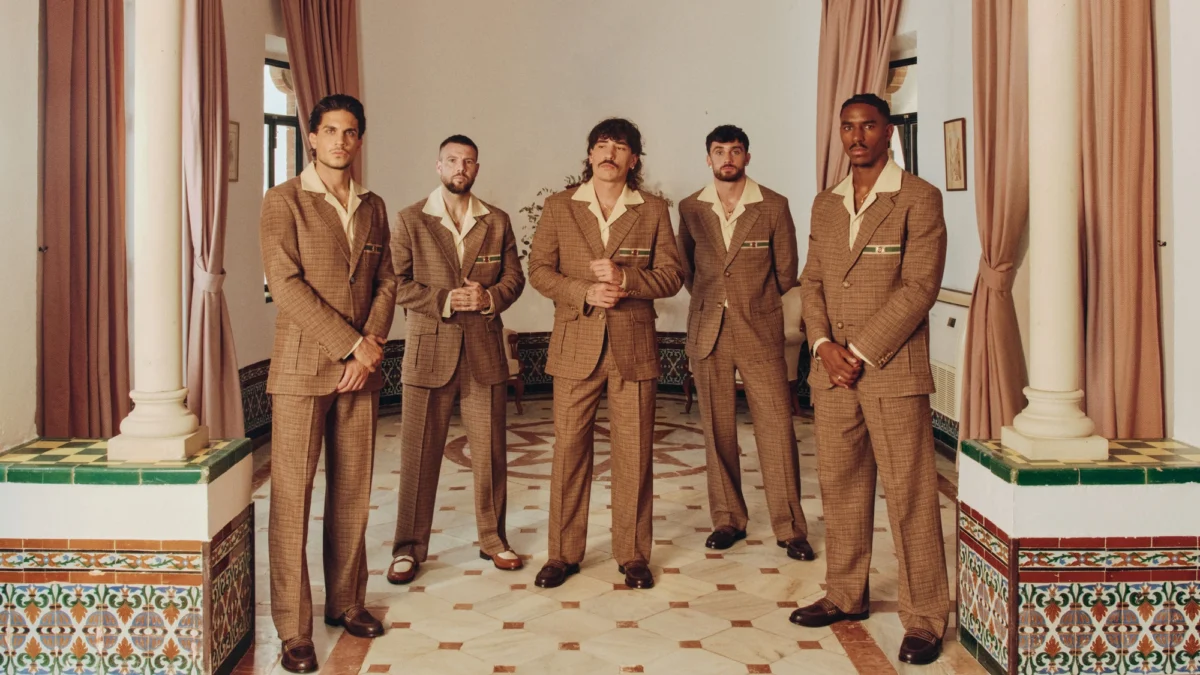
The centerpiece of the Real Betis collection is a series of generously proportioned, roomy suits cut in a nuanced, subtle check pattern. Blending classic European tailoring with mid-century utilitarian detailing, the jackets feature pronounced bellows pockets—a touch that nods to vintage hunting and travel garments while subverting the ultra-sleek, minimalist silhouettes that have dominated luxury football partnerships over the past decade. Paired with splayed Cuban-collar shirts worn open at the chest, the look captures an intrinsically Latin sense of leisure and swagger, transforming the ritual of arrival at the Estadio Benito Villamarín into an exercise in high-summer elegance.
This design language deliberately channels the spirit of football’s most stylish golden eras. Rather than following the ultra-clean, technical athleisure aesthetic that has swept contemporary sports culture, Dos Santos looked toward historic touchline icons whose personal style achieved legendary status. Figures like Diego Maradona—whose bold, maximalist presence and draped tailoring captured the raw charisma of the 1980s—alongside the immaculate Italian precision of Paolo Maldini and the cerebral, trench-coated elegance of Arsène Wenger, all informed the collection’s attitude. By blending these contrasting archetypes, Drôle de Monsieur has created a wardrobe that honors the sport’s theatrical, mythic past while remaining grounded in modern streetwear sensibilities.
The strategic timing of the announcement underscores Real Betis’s broader commercial transformation. The club has consistently outperformed expectations both on the pitch and across global marketing initiatives, leveraging Seville’s status as a global cultural destination to attract international lifestyle partnerships. The squad is scheduled to reveal the custom Drôle de Monsieur formalwear publicly on November 24, when they take the pitch for an international clash against Slovakian champions ŠK Slovan Bratislava.
According to Emilio García Duarte, business director of Real Betis Balompié, the partnership signals the club’s deliberate ambition to transcend traditional sports merchandising. The club’s contemporary growth is no longer measured solely in league points and European qualification; it is reflected in its capacity to align with innovative, tastemaking cultural entities. By entering into business with Drôle de Monsieur, Real Betis gains immediate credibility among modern fashion circles, youth subcultures, and design purists who prize independent craftsmanship over mass-market commercialization.
The partnership also reflects a broader structural evolution across the European sports landscape. Over the past five years, the intersection of football and luxury fashion—frequently referred to as “blokecore” and lifestyle crossover—has matured from brief capsule drops into multi-year formal appointments. Where football clubs once relied on heritage bespoke houses or commercial department store contracts for their official travel wear, teams are now treating off-pitch appearances as high-visibility runway moments. From Off-White dressing AC Milan to Dior outfitting Paris Saint-Germain and Thom Browne’s past collaborations with FC Barcelona, formalwear has become an essential pillar of a club’s international lifestyle brand.
Yet unlike mega-conglomerate alliances, the partnership between Drôle de Monsieur and Real Betis feels distinctly artisanal. It represents an emerging second wave of sports-fashion partnerships, where independent, cult-favorite fashion brands partner with historic regional powerhouses to produce garments that fans genuinely desire to wear off the pitch. Rather than looking like uniformed corporate executives, the Betis squad will step off the team bus looking like figures stepping straight out of a Mediterranean editorial.
For Drôle de Monsieur, dressing Real Betis offers a prominent European stage to display their expanding tailoring capabilities. The brand, which initially made waves through boxy graphic hoodies, retro track jackets, and elevated loungewear, has steadily pushed into tailored outerwear, structured shirting, and nuanced artisanal footwear. Tackling the wardrobe of an entire top-flight football team serves as an emphatic proof-of-concept, proving that their signature blend of 1970s warmth, modern proportion, and everyday comfort translates seamlessly to professional athletes with diverse body types and high standards for mobility.
As modern football continues to move further into the orbit of entertainment, art, and high fashion, players have become cultural influencers whose tunnel style is scrutinized as heavily as their on-ball metrics. In an era where matchday walk-ins are captured by high-fashion photographers and broadcast to millions across social platforms, the importance of a coherent, distinctive off-pitch visual identity cannot be overstated.
When the players step onto the tarmac and navigate the tunnel ahead of their encounter with Slovan Bratislava on November 24, they will not merely be representing a century-old football club; they will be embodying a tailored narrative where Sevillian romanticism meets French contemporary design. Through roomy cuts, tactile checks, and unbuttoned Cuban collars, Drôle de Monsieur and Real Betis Balompié have discarded the rigid corporate uniform, demonstrating that real elegance in modern sport comes from a relaxed attitude, historical reverence, and an unmistakable sense of place.