

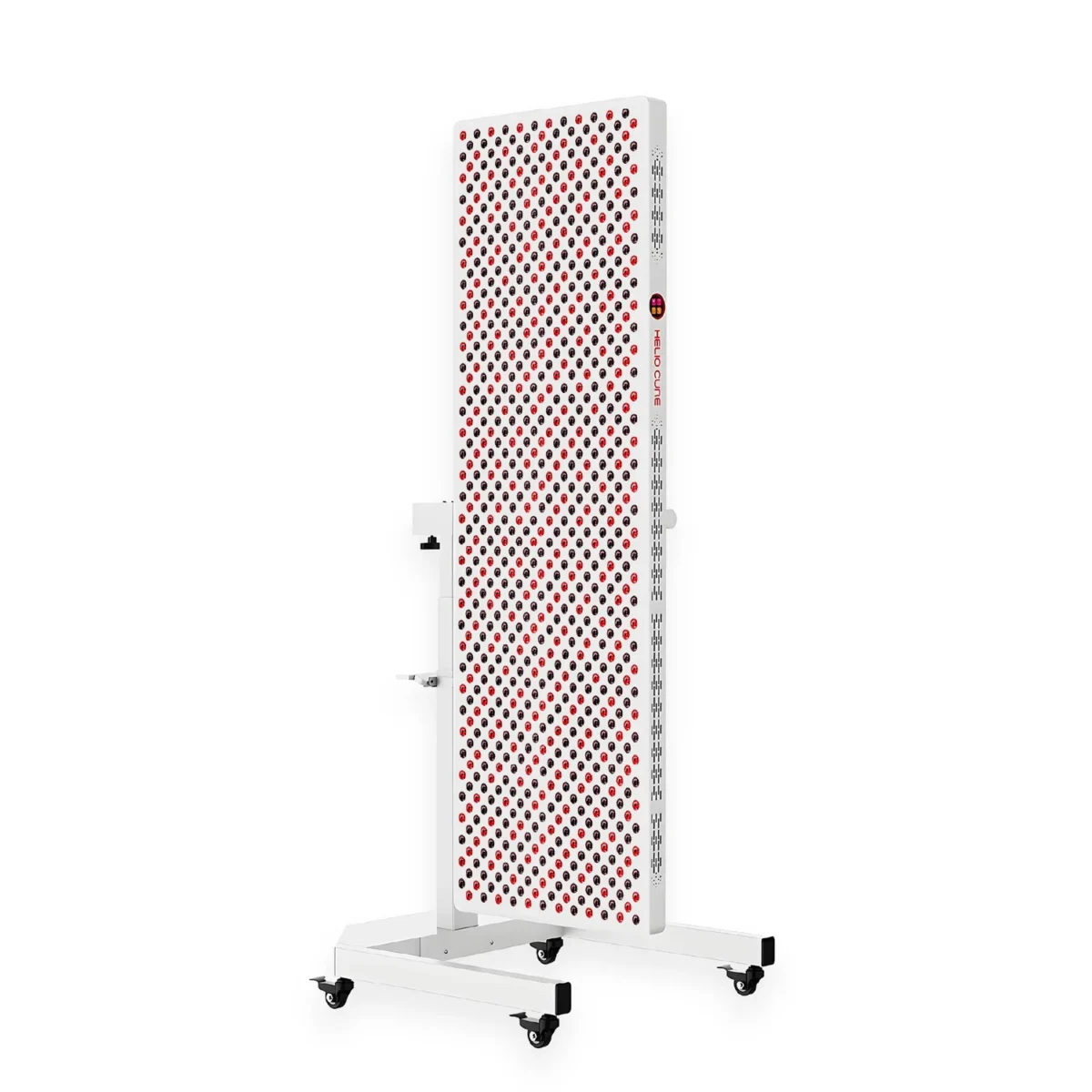
The landscape of at-home aesthetic technology has shifted radically over the past few years. Not long ago, consumer phototherapy was confined to flexible silicone face masks and handheld spot-treatment wands that promised to diminish blemishes and soften crow’s-feet from the comfort of the sofa. While those wearable devices democratized light therapy, serious skincare purists, biohackers, and wellness aficionados have increasingly looked past the boundaries of the jawline. The modern approach to longevity treats skin not as an isolated aesthetic canvas, but as the body’s largest organ, deserving of full-surface cellular activation. Consequently, clinical-grade red light therapy panels have transitioned from professional medispas and athletic training rooms straight into domestic living spaces.
These towering, high-output devices require a meaningful investment of both capital and square footage, shifting the paradigm of domestic self-care from a casual vanity accessory to dedicated domestic infrastructure. Expanding beyond the face to encompass the torso, back, and extremities, vertical and modular panels allow users to bathe their entire physique in restorative photons. To separate marketing hyperbole from genuine therapeutic efficacy, it is essential to examine the underlying mechanisms of photobiomodulation, evaluate the engineering specifications that truly matter, and rigorously analyze the standout panels shaping the industry today.
The Physiology of Photobiomodulation: How Cellular Energy Drives Results
At the core of red and near-infrared (NIR) light therapy lies photobiomodulation (PBM), a photochemical process directly analogous to plant photosynthesis. When tissue absorbs targeted wavelengths of natural light, it activates cellular respiration at a mitochondrial level. Specifically, light photons are absorbed by cytochrome c oxidase, an essential enzyme within the mitochondrial respiratory chain. This photo-activation encourages the production of adenosine triphosphate (ATP)—the fundamental energetic currency of human cells—while triggering a brief, beneficial surge in reactive oxygen species, which subsequently activates downstream anti-inflammatory and antioxidant defense systems.

The physiological dividends depend entirely on the spectral band utilized:
- Red Light (630 to 660 nm): These shorter wavelengths are predominantly absorbed within the superficial dermal layers. Red light stimulates fibroblast activity, synthesizing new collagen and elastin, accelerating epidermal healing, refining skin tone, and soothing cutaneous conditions such as rosacea, sun damage, and eczema.
- Near-Infrared Light (810 to 850 nm): Moving deeper into the optical window, near-infrared energy penetrates through subcutaneous fat into deep muscle fascia, tendons, joints, and even bone. Research shows NIR light is particularly adept at blunting systemic inflammation, fast-tracking neuromuscular recovery after strenuous exertion, and alleviating chronic joint discomfort.
- Extended Near-Infrared (1064 nm): Sitting at the cutting edge of modern photobiomodulation, light in the 1064 nm bracket bypasses surface melanin and water barriers to reach deeper neurological and structural tissues. Although scientific research into its full spectrum of applications remains ongoing, early evidence points to promising neurological, deep vascular, and soft-tissue therapeutic effects.
Beyond nominal wavelengths, the real-world performance of any panel hinges on irradiance—the radiant power density delivered per unit area, expressed in milliwatts per square centimeter (mW/cm²). Insufficient irradiance requires unrealistically long treatment sessions to achieve an effective biological dose, while excessive heat or unbalanced output can reduce cellular response. LED density, beam angle distribution, zero-flicker circuitry, and low electromagnetic field (EMF) emissions are the true hallmarks of a professional-grade device.
The Standout Panels: Tested, Evaluated, and Ranked
1. Editor’s Pick: Helio Cure Helio Nova
Taking the honors as the premier all-encompassing system on the market, the Helio Nova from Helio Cure reflects what happens when medical-grade industrial design aligns with the expectations of luxury skincare enthusiasts. Measuring a sweeping 65 inches in vertical height, this full-body titan features 864 heavy-duty LEDs engineered to deliver head-to-toe irradiation in a single consolidated treatment session.
What truly elevates the Helio Nova above standard commercial towers is its sophisticated six-wavelength array: 630 nm, 660 nm, 810 nm, 830 nm, 850 nm, and a specialized 1064 nm band. By intentionally excluding blue spectrum LEDs, the panel eliminates the risk of circadian rhythm disruption, ensuring that late-night recovery sessions support rather than sabotage sleep architecture. The unit is anchored by an automated, remote-controlled motorized stand capable of 360-degree rotation and smooth vertical articulation, enabling users to stand, sit, or recline underneath the beam array effortlessly. Five intelligent presets (Face & Skin, Pain & Inflammation, Weight Loss, Brain Health, and Hair Restoration) sit alongside fully customizable pulsing and intensity parameters. With FSA/HSA eligibility via Truemed, a 60-day home trial, and a comprehensive three-year warranty, the Helio Nova represents the gold standard of domestic photobiomodulation.

2. Best for High-Efficiency Simplicity: Mito Red Light MitoMEGA 2.0
For individuals who prioritize no-nonsense mechanical dependability and concentrated spectral power, the MitoMEGA 2.0 makes an exceptionally compelling case. Built with 300 high-potency LEDs, this panel eschews overly complex interfaces in favor of pure performance, utilizing a clinically validated dual-wavelength configuration that balances deep red with penetrating near-infrared light.
Designed to treat large surface areas—such as the full back, chest, or bilateral leg regions—the MitoMEGA 2.0 incorporates an integrated digital countdown timer configurable from one to 20 minutes, allowing users to effortlessly adhere to optimal energy dosing schedules without overexposure. Its cooling architecture is a masterclass in domestic engineering: internal whisper-quiet thermal fans dissipate heat seamlessly without breaking the tranquility of a home spa environment. It is a streamlined, reliable workhorse for those who want straightforward power and measurable dermal and musculoskeletal results.
3. Best for Tech-Forward Customization: Joovv Solo 3.0
Joovv remains one of the foundational pioneers in consumer light therapy, and the Solo 3.0 demonstrates why the brand maintains its dedicated following. With an emphasis on polished aesthetics and seamless home integration, the Solo 3.0 delivers red and near-infrared outputs through an impeccably manufactured, modular housing that can be interlocked with additional units over time to create a sprawling, multipanel architectural wall.
The technology within matches the exterior refinement. Joovv’s proprietary Recovery+ mode introduces pulsed near-infrared light designed to align with biological rhythms and assist cellular flush-out post-workout. Seamlessly operated via smartphone integration, the Solo 3.0 also doubles as a circadian ambient lighting installation, casting gentle sunrise and sunset tones throughout your living quarters to support natural melatonin production. It is a beautifully realized hybrid of wellness hardware and interior design.

4. Best Multi-Targeted Compact: Total Spectrum Compact by RLT Home
For homes with spatial constraints that still demand uncompromising flexibility, the Total Spectrum Compact provides remarkable spectral scope within an agile footprint. Housing 216 multi-chip LEDs, this panel distinguishes itself by packing seven distinct bands across the blue, red, and near-infrared spectra.
The tactical inclusion of blue light gives the Total Spectrum Compact a unique clinical edge against superficial acne breakouts and blemish-causing bacteria, while the complementary red and NIR bands handle tissue rebuilding and deep soothing. Supported by nine targeted program presets, an intuitive remote interface, dedicated eye shields, and an included heavy-duty wheeled stand, this device delivers high-mobility utility, wheeling effortlessly from the bedside to the home gym.
5. Best Clinical Versatility: PlatinumLED Biomax Pro Next Gen
Recognized across the clinical sphere for delivering blistering irradiance numbers, the Biomax Pro Next Gen is engineered for data-conscious users who want maximum photon density. Like the RLT Home, it employs a sophisticated seven-wavelength spectrum, but pairs it with an advanced patent-pending lens array that ensures superior beam penetration and minimal light scattering.
Featuring independent spectrum controls, the Biomax Pro allows users to turn specific spectral segments on or off, toggling between acne-clearing dermal sweeps and deep-tissue recovery sessions on command. Built-in digital linkage and app-enabled session tracking let you map out cumulative dosing across weeks of treatment, making it a favorite for quantified-self practitioners aiming for clinical precision.

Maximizing Your Panel Investment: Dosing, Distance, and Best Practices
Securing a high-end panel is merely step one; achieving visible aesthetic improvement and genuine systemic restoration demands technical discipline. Because photobiomodulation follows a biphasic dose-response curve—often termed the Arndt-Schulz rule—too little light yields no biological effect, while too much energy can oversaturate cells and temporarily blunt benefits.
To optimize your daily protocol:
- Mind Your Distance: Position yourself roughly 6 to 18 inches away from the panel face. Standing closer maximizes energy density for deep joint and structural pain relief, whereas stepping back widens the beam dispersion for balanced, full-body skin rejuvenation.
- Consistency Trumps Duration: A ten-to-fifteen-minute session completed four to five times weekly delivers vastly superior clinical outcomes compared to an irregular hour-long saturation once a week.
- Prioritize Eye Safety: While natural red light is generally safe, high-output near-infrared arrays produce substantial invisible energy. Always use the manufacturer-provided blackout goggles or protective eyewear, particularly during facial treatments.
- Bare Skin is Essential: Light cannot penetrate fabrics, and even lightweight sunscreens or heavy makeup can scatter or absorb specific wavelengths. Always treat clean, unclothed skin.
The Verdict on Modern Light Therapy
The migration of phototherapy from specialized medical clinics to the domestic sphere is more than an ephemeral beauty trend—it marks an evolution in how we view personal health maintenance. By targeting the foundational energy pathways that dictate skin elasticity, systemic inflammation, and muscle recovery, high-output red light panels offer a non-invasive, chemically independent path to elevated wellness. Whether your primary ambition is rebuilding structural dermal collagen, accelerating recovery from strenuous physical training, or simply bathing your body in therapeutic cellular wavelengths, the latest generation of engineered panels proves that dedicating personal space to light therapy pays profound, glowing dividends.