
The perennial debate regarding whether fashion can truly be classified as fine art has occupied the minds of critics, curators, and creators for centuries. From the revolutionary silhouettes of Cristóbal Balenciaga to the provocative runway performances of Alexander McQueen, the industry has long flirted with the hallowed halls of the museum. However, for Marine Serre, the Parisian designer who has built an empire on the pillars of "Eco-Futurism" and radical upcycling, the distinction between a garment and a masterpiece is no longer a point of contention—it is the very foundation of her Fall 2026 collection. In a season that eschews the frantic pace of the traditional runway in favor of "slow craft," Serre has deepened her relationship with the world’s most famous museum, the Louvre, to present a body of work that challenges our perceptions of value, history, and the lifecycle of an object.
The seeds of this collaboration were sown last year during the "Louvre Couture" exhibition in Paris, where Serre’s signature upcycled tapestry coats were displayed alongside the museum’s historical treasures. That moment marked a turning point for the designer, signaling a formal recognition of her work within the lineage of French artistic heritage. For Fall 2026, Serre returns to the Louvre not as a guest, but as a collaborator, launching a multi-faceted project that includes five one-of-a-kind couture pieces and a highly anticipated capsule collection set to debut in April. The genius of the capsule lies in its subversive use of the mundane: Serre has repurposed unsold T-shirts from the Louvre’s own gift shop, transforming mass-produced souvenirs into high-fashion artifacts. This gesture serves as a poignant commentary on the democratization of art and the staggering waste generated by the tourism industry.
The centerpiece of the collection—and perhaps the most literal interpretation of the "fashion as art" theme—is a gown dedicated to Leonardo da Vinci’s "Mona Lisa." While the world’s most famous portrait is often obscured by crowds of tourists and layers of bulletproof glass, Serre chose to deconstruct the icon entirely. The dress is a marvel of technical ingenuity and patience, composed of nearly 3,000 individual puzzle pieces. These pieces were meticulously sewn together, fitted onto a reinforced structural base, and finished with a protective varnish to mimic the aged texture of a Renaissance oil painting. The process required a staggering 420 hours of manual labor, a timeline that places the garment firmly within the realm of haute couture. By turning a literal puzzle of the Mona Lisa into a wearable silhouette, Serre invites the viewer to reconsider the "smile" not as a static image, but as a fluid, moving entity.
Serre’s decision to skip the traditional runway for the second consecutive season is a deliberate act of rebellion against the "hyper-speed" of the modern fashion cycle. In a preview held at her Paris headquarters, the designer was vocal about her desire to "frame" fashion in a way that demands stillness and contemplation. "My goal this year is to frame fashion and clothing as an art form, so that people stop looking at it like something that flies past," she explained. By removing the distraction of the catwalk, Serre forces the industry to look at the stitch, the seam, and the provenance of the material. This shift toward a slower, more intentional presentation style mirrors the experience of walking through a gallery, where the viewer is encouraged to linger on the details.
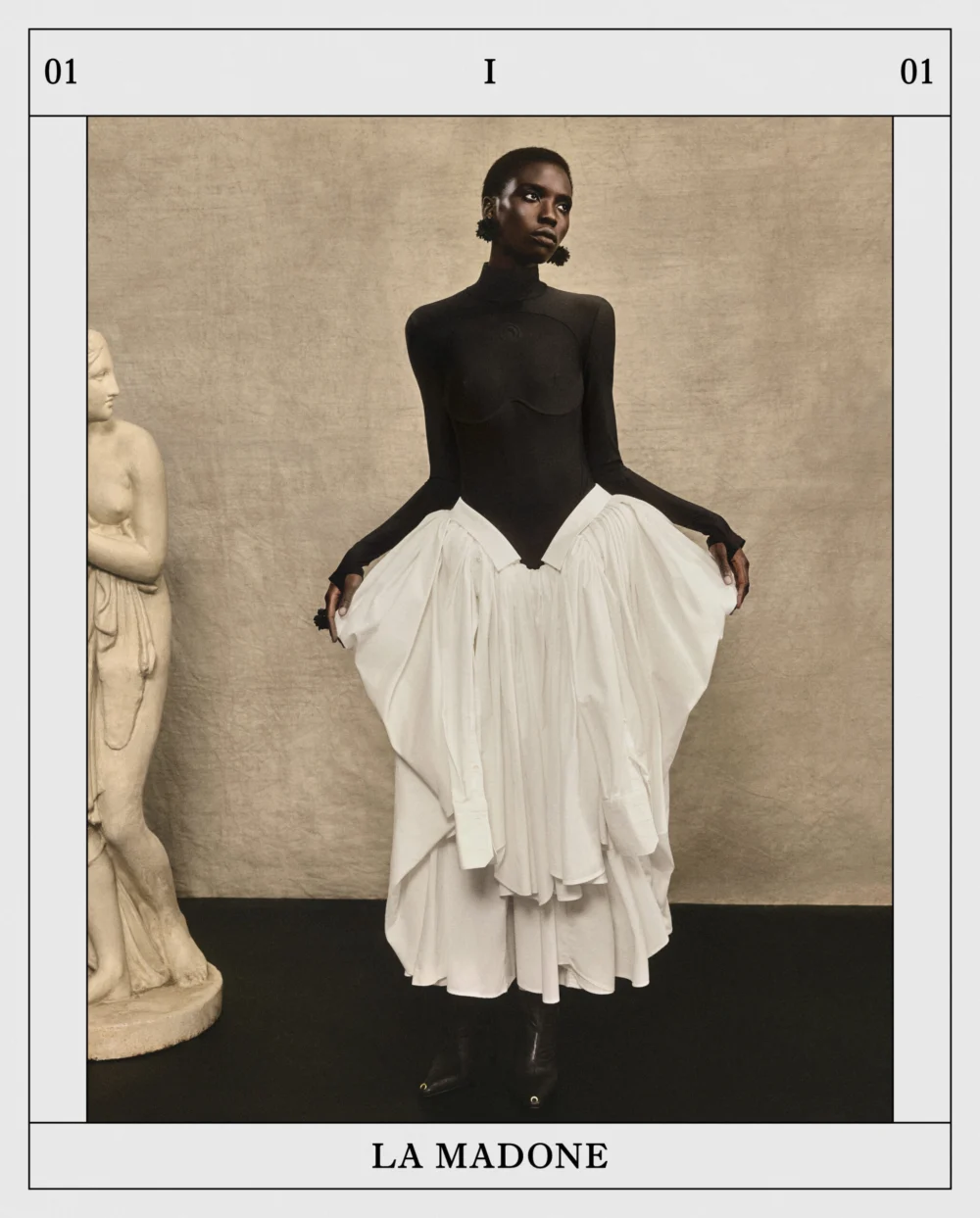
The Fall 2026 lookbook, captured through the lens of photographer Arash Khaksari, further blurs the lines between digital reality and classical art. The imagery is a sophisticated nod to the AI-generated videos of animated masterpieces currently saturating social media. In Khaksari’s frames, models appear to step out of gilded frames, their bodies draped in a fusion of Renaissance opulence and futuristic sportswear. The collection features poet blouses with dramatic puff sleeves, bustle gowns that recall the silhouette of the 19th century, and portrait necklines that frame the collarbone with the precision of a master painter. Yet, true to Serre’s DNA, these historical references are filtered through a contemporary, technical lens.
The juxtaposition of the old world and the new is most evident in the construction of the garments. Almost every look in the collection is spliced with high-performance technical fabrics, creating a "scuba-Renaissance" aesthetic that is uniquely Serre. A crisp white shirt is grounded by a black jersey bodice; a traditional T-shirt top is elevated by a Neoprene corset belt; and graphic trompe-l’oeil gowns, featuring faux fur trim, are modernized with transparent mesh panels. The designer’s take on the pannier skirt—a garment historically used to extend the hips—is reimagined here as a second skin. Serre attached black scuba tops to skirts assembled from upcycled white shirts, T-shirts, and vibrant silk scarves, using internal padding to create the exaggerated hip volume. The result is a silhouette that feels both ancient and bionic.
Beyond the "Mona Lisa" gown, the collection is punctuated by "technical feats" that push the boundaries of what materials can be used in garment construction. One standout piece is a column dress composed entirely of 850 discarded makeup brushes. This "readymade" approach to fashion—reminiscent of Marcel Duchamp’s Dadaist sculptures—transforms objects of low intrinsic value into a shimmering, tactile mosaic. It is a testament to Serre’s philosophy of "Regeneration," where the value of a piece is derived not from the cost of the raw materials, but from the human effort and time invested in its transformation. "It’s about taking things with little intrinsic value and showing how the time and human effort invested in each piece ultimately transforms it into a couture creation," Serre noted during the preview.
The timing of Serre’s artistic pivot is particularly serendipitous. As she prepared to attend the Louvre’s annual fundraising gala with guests dressed in her latest creations, the theme for the 2026 Met Gala was announced: "Fashion is Art." The alignment between Serre’s personal mission and the global fashion zeitgeist is undeniable. While the Met Gala will undoubtedly spark further debate on the subject, Serre has already provided her answer through her work. She is not merely making clothes; she is curating a wardrobe for a future where sustainability and artistry are inextricably linked.
The Fall 2026 collection also marks a maturation of Serre’s tailored offerings. A standout black jacket featured a Renaissance-inspired neckline so precise it looked as though it had been carved rather than sewn. This level of tailoring, combined with her experimental use of upcycled materials, positions Serre as a leader in the "New Luxury" movement—a movement that prioritizes ethical production and artistic integrity over mass-market appeal. By utilizing the Louvre’s unsold inventory, she also addresses the elephant in the room for the luxury industry: the problem of overproduction. Instead of destroying excess stock, Serre treats it as a precious resource, proving that the "waste" of today can become the "Louvre Couture" of tomorrow.
As the fashion world moves toward an increasingly digital and ephemeral future, Marine Serre’s Fall 2026 collection serves as a grounding force. It is a reminder that fashion, at its best, is a physical manifestation of human culture, history, and labor. By literalizing the "Mona Lisa Smile" and weaving it into the fabric of her garments, Serre has created a collection that doesn’t just reference art—it becomes it. Whether through a dress made of puzzles or a skirt made of discarded scarves, she continues to prove that the most radical thing a designer can do in 2026 is slow down, look back at the masters, and build something entirely new from the fragments of the past. In the hands of Marine Serre, the museum is no longer a graveyard for old ideas, but a living, breathing studio where the future of fashion is being painstakingly assembled, one puzzle piece at a time.