

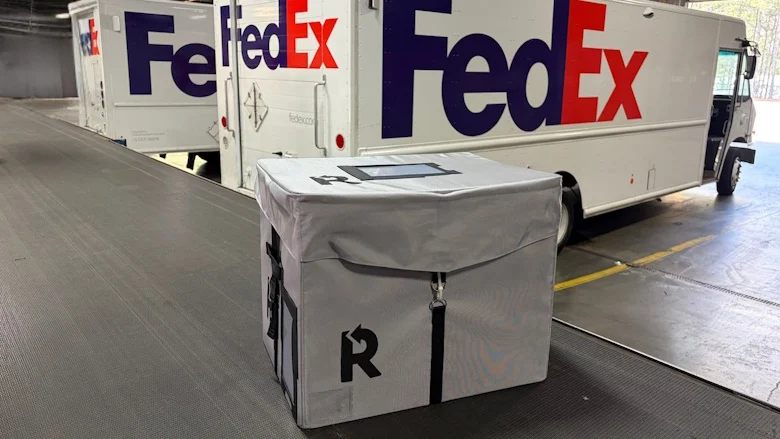
The landscape of global logistics is currently undergoing a radical transformation, driven by an urgent need for environmental stewardship and operational efficiency. At the forefront of this evolution, FedEx Corp. has officially announced a strategic partnership with Returnity, a leader in circular logistics and reusable packaging solutions, to launch a groundbreaking reusable packaging system specifically engineered for the business-to-business (B2B) sector. This initiative represents a significant departure from the traditional "ship-and-discard" model of corrugated cardboard, offering a durable, cost-effective alternative designed to thrive within the high-velocity environments of modern supply chains. By integrating Returnity’s specialized design with FedEx’s expansive global network, the two companies are providing a blueprint for how large-scale carriers can facilitate the transition toward a circular economy.
For decades, the logistics industry has relied almost exclusively on single-use corrugated containers. While cardboard is technically recyclable, the energy required to produce, transport, and reprocess it remains substantial. Furthermore, the sheer volume of cardboard waste generated by B2B transactions—where goods are frequently moved between fulfillment centers, retail storefronts, and field service hubs—presents a massive logistical and environmental burden. The new solution developed by FedEx and Returnity addresses these challenges head-on by introducing a FedEx-specific box design that is built for longevity and seamless integration into existing automated sorting systems. One of the most significant hurdles to the adoption of reusable packaging has historically been the "non-standard" nature of such containers, which often triggers additional handling fees from carriers. FedEx has eliminated this barrier by ensuring these new boxes are fully compatible with their current infrastructure, allowing B2B shippers to transition to reusables without the friction of surcharges or complex operational overhauls.
Neil Gibson, the Senior Vice President of Global Customer Experience at FedEx, emphasized that this collaboration is a milestone in the journey toward smarter, more sustainable supply chains. He noted that the solution is particularly transformative for shippers of "soft goods," such as apparel and textiles, where the volume of shipments is high but the physical requirements for packaging are often more flexible than for heavy industrial equipment. According to Gibson, the synergy between Returnity’s durable packaging and the FedEx network allows retailers to achieve significant cost savings while simultaneously meeting their ESG (Environmental, Social, and Governance) targets. The primary objective is to maintain the speed and reliability that FedEx customers expect while drastically reducing the carbon footprint of each individual shipment.
To understand why this launch is a watershed moment, one must look at the technical engineering of the box itself. Unlike standard shipping containers, these units are designed for "closed-loop" environments. In a B2B context, a closed loop refers to a system where the sender and the receiver are part of the same corporate ecosystem or have a structured relationship that ensures the packaging is returned to the point of origin or a central hub. This might include a distribution center sending inventory to a retail store, or a field service technician receiving parts and returning the empty container. Each box is engineered to withstand up to 50 shipment cycles, a remarkable feat of durability that translates to 49 fewer cardboard boxes entering the waste stream per unit. Furthermore, the boxes are rated to carry up to 50 pounds, making them robust enough for a wide variety of commercial applications.
The economic argument for the switch is equally compelling. FedEx reports that this reusable format can reduce packaging expenditures by as much as 30% per cycle. In an era where inflation and fluctuating raw material costs for paper and pulp have made traditional packaging prices volatile, the ability to amortize the cost of a single high-quality box over 50 uses provides a much-needed hedge for logistics managers. From an environmental perspective, the data is even more striking. Under typical conditions—and assuming a non-return rate of 40% or less—the system can reduce carbon emissions by between 64% and 88% compared to single-use corrugated packaging. These figures are vital for corporations striving to meet "Net Zero" commitments, as Scope 3 emissions (which include those from transportation and distribution) are often the most difficult to curb.
The successful rollout of this program follows an extensive pilot phase conducted across North America. During these trials, FedEx B2B shippers across various industries put the reusable boxes to the test in real-world retail and distribution workflows. The feedback from the pilots highlighted several unexpected benefits that go beyond simple cost and carbon savings. For instance, warehouse and retail staff reported that the reusable boxes were significantly faster to unpack and restock than traditional taped cardboard. Because the boxes are collapsible and designed for ease of use, they improved backroom organization and increased overall labor efficiency. Additionally, the structural integrity of the Returnity-designed boxes led to lower rates of product damage during transit, further protecting the bottom line for shippers.
The decision to focus on the B2B sector rather than the direct-to-consumer (D2C) market was a calculated strategic move. In the D2C world, the "reverse logistics" of getting a reusable bag or box back from a consumer’s home is notoriously difficult and expensive. Consumers may forget to return the packaging, or the cost of the individual return shipment may outweigh the value of the box. However, in B2B environments, the return path is predictable and controlled. Store employees can easily fold the boxes and place them on a returning FedEx truck during a scheduled pickup, or they can be consolidated at a distribution center. This predictability is what makes the solution "scalable," a word FedEx and Returnity use frequently to describe the system’s potential for widespread adoption.
While the program is currently available to FedEx customers within the United States, the vision for this initiative is global. FedEx has already signaled plans to expand the reusable box solution into international markets, with Australia and Europe cited as the next immediate targets. This expansion is particularly timely for the European market, where the European Union’s Packaging and Packaging Waste Regulation (PPWR) is placing increasing pressure on businesses to reduce waste and adopt circular models. By offering a ready-made, carrier-validated solution, FedEx is positioning itself as an essential partner for businesses navigating these new regulatory landscapes.
This launch is also a critical component of FedEx’s broader sustainability strategy. The company has set an ambitious goal to achieve carbon-neutral global operations by the year 2040. Reaching this target requires more than just electrifying their delivery fleet or investing in sustainable aviation fuel; it requires a fundamental rethinking of the materials that move through the network. By addressing the "packaging problem," FedEx is tackling a major source of indirect emissions and waste. The partnership with Returnity proves that sustainability and profitability are not mutually exclusive; rather, they are two sides of the same coin in a modernized logistics framework.
As the program moves out of the pilot phase and into general availability in the U.S., FedEx sales representatives are working directly with B2B customers to integrate the solution into their specific workflows. The shift toward reusables is not merely a trend but a structural change in how the world moves goods. In the coming years, the sight of a FedEx-branded, Returnity-designed reusable box on a loading dock may become as common as the traditional brown cardboard box. For businesses looking to optimize their supply chain for the 21st century, this new packaging system offers a rare "triple win": lower costs, higher operational efficiency, and a dramatically smaller environmental footprint. Through this collaboration, FedEx and Returnity are not just delivering packages; they are delivering a more sustainable future for global commerce.