
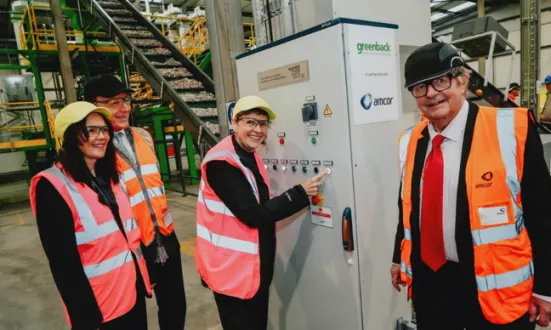
A significant leap forward in tackling plastic waste was officially inaugurated today as Mary Creagh formally commissioned the joint advanced recycling initiative between Greenback and Amcor at the Heanor facility. This state-of-the-art operation, bolstered by the strategic involvement of the Alliance to End Plastic Waste (AEPW), is pioneering a transformative process designed to convert challenging post-consumer flexible plastics—materials often destined for landfill or incineration—into high-quality, food-grade circular plastics feedstock. This development signals a critical juncture in the drive toward genuine material circularity within the packaging sector, particularly for hard-to-recycle materials.
The core of this innovation lies in Greenback’s Enval module, which has now been fully installed and brought online at Amcor’s established industrial site. This marks the first deployment of Greenback’s modular advanced recycling technology hosted by a major global packaging leader within the European landscape. The strategic co-location of this specialized recycling unit within existing, high-volume industrial infrastructure is a key element of the project’s scalability model, aiming to dramatically accelerate the realization of a fully functional circular economy for plastics.
The advanced recycling process employed is a sophisticated form of pyrolysis, breaking down complex polymer structures into their basic chemical components. Crucially, the integrity and traceability of this material flow are managed by the cutting-edge eco2Veritas traceability platform. This system leverages a combination of Artificial Intelligence (AI) and Internet of Things (IoT) devices to meticulously record every data point, beginning the moment baled waste arrives at the facility and tracking it all the way through to the final output of pyrolytic oil.
This rigorous digital tracking is essential for ensuring material compliance and enabling the crucial step of mass-balance allocation. The resulting pyrolytic oil, the intermediate product of the advanced recycling process, is accompanied by a certified digital certificate of provenance. This digital passport provides verifiable data that substantiates the recycled content claim as the oil is subsequently fed back into the production chain to create virgin-quality recycled plastics suitable for sensitive applications, such as food contact packaging.
The Heanor site already possesses an established reputation for excellence in plastics recycling, primarily handling post-consumer and industrial flexible plastic waste through conventional mechanical recycling methods. This existing capability allows the site to convert waste into high-quality recycled polymers that are already being integrated into Amcor’s diverse portfolio of flexible packaging solutions across numerous consumer markets. The integration of Greenback’s Enval advanced recycling process acts as a powerful complement, unlocking the viability of recycling mixed and contaminated flexible plastic streams that mechanical processes cannot effectively manage, thereby significantly expanding the scope of materials brought back into the loop.
Mary Creagh underscored the collaborative nature of this achievement, emphasizing its significance for national sustainability goals. "This commissioning is an electrifying illustration of how concerted action between governmental oversight and private sector innovation can effectively combat the global plastic waste challenge," she stated. "It is driven by smart investment in infrastructure and robust partnerships. This event clearly reflects the government’s wider commitment to fostering a resilient, circular economy by prioritizing the reuse and regeneration of existing plastic resources rather than relying solely on virgin materials."
Philippe G. von Stauffenberg, Founder and Chief Executive of Greenback, expressed pride in reaching this critical operational milestone. "This successful commissioning powerfully demonstrates that collaboration, paired with technological ingenuity, is the key to rapidly scaling up viable circular solutions," he commented. "We are deeply honored to partner with Amcor and key government stakeholders to deploy technologies capable of keeping valuable plastics within the economy and, critically, away from the natural environment. Our sincere appreciation also goes to the Alliance to End Plastic Waste (AEPW) for their instrumental support in navigating us to this significant operational benchmark."
Andrew Green, Vice President of Amcor Flexibles EMEA, highlighted the strategic importance of the trial at the UK facility. "The active piloting of this pioneering technology here at Heanor firmly reinforces Amcor’s unwavering dedication to enhancing circularity across all our flexible packaging offerings," he noted. "Furthermore, this endeavor directly supports the UK’s policy aspirations for cultivating a significantly more sustainable industrial and consumer future."
The synergy between Greenback’s novel modular technology, Amcor’s extensive industrial footprint, and the strategic oversight of industry bodies like the AEPW represents a blueprint for future circular economy development. By proving the efficacy and scalability of co-locating advanced recycling units within established industrial parks, the partners are overcoming traditional barriers related to logistics, infrastructure development, and material sourcing. If the ongoing trials prove successful across the full spectrum of operational parameters, this model holds immense potential for rapid deployment across Europe and globally, fundamentally reshaping how flexible packaging waste is managed and valued.
The flexibility inherent in Greenback’s modular design is a key differentiator. Unlike massive, centralized chemical recycling plants which require enormous upfront capital and dedicated, specialized sites, the Enval module can be integrated into existing facilities, allowing for quicker deployment and adaptation to local waste streams. This approach lowers the risk profile for adoption by incumbent industry players like Amcor, allowing them to incrementally build out their circular capabilities without entirely disrupting existing, successful operations like the mechanical recycling streams already running at Heanor.
The focus on food-grade output is particularly vital. For flexible packaging, which constitutes a significant portion of consumer plastic use, achieving food-grade circular content is often the highest hurdle due to stringent safety regulations. Success in this area validates the traceability system (eco2Veritas) and the purity of the pyrolytic oil, opening up the most valuable and challenging end-markets for recycled polymers. This shift moves flexible packaging away from being viewed as a single-use, linear product toward becoming a reliable, renewable feedstock source.
In essence, the inauguration at Heanor is more than just a facility opening; it is the commissioning of a highly traceable, scalable process designed to close the loop on materials previously considered unrecyclable by conventional means, setting a new standard for industry collaboration and technological integration in the pursuit of environmental sustainability.