
In the modern landscape of corporate social responsibility and high-stakes B2B marketing, the physical objects a brand chooses to represent itself carry immense weight. For an organization like Theirworld, a global children’s charity committed to ending the global education crisis, the stakes are even higher. Their brand is a beacon of hope, urgency, and sophistication. When it came time to develop a tangible asset for their stakeholders, they recognized that a standard, off-the-shelf promotional product would not suffice. A flimsy, generic tote bag would have been a missed opportunity to communicate quality and commitment. Instead, Theyworld sought a partner capable of complex textile engineering: The Bag Workshop. As a cornerstone of The Wurlin Group, The Bag Workshop moved beyond the role of a simple supplier to act as a premier UK OEM bag manufacturer, delivering a set of bespoke A4 bags that represent the pinnacle of custom-dyed perfection.
The challenge was not merely to print a logo on a canvas surface but to construct a high-performance, luxury textile product from the ground up. This required a deep dive into material science, structural design, and precision manufacturing. The goal was to create an A4 bag that was not only aesthetically striking but also structurally superior, capable of serving as a durable, daily-use tool for Theirworld’s audience. By leveraging a white-label manufacturing model, The Bag Workshop was able to manage every nuance of production, from the initial Pantone matching of raw fibers to the final reinforcement of high-stress seams.
The Philosophy of Bespoke Engineering vs. Commodity Supply
The primary friction point in the promotional merchandise industry is the "catalogue trap." Most businesses rely on stock inventory—pre-made bags sitting in warehouses waiting for a quick screen print. While this model offers speed, it severely limits brand expression. You are forced to accept the factory’s "standard" navy or "generic" red. For Theirworld, "close enough" was not an option. Their brand identity is built on specific, vibrant hues that demand exact replication.
The Bag Workshop’s approach is rooted in the "Original Equipment Manufacturer" (OEM) philosophy. This means every component of the bag—the fabric weight, the handle weave, the internal dimensions, and the thread color—is specified before a single stitch is made. This case study explores the four-phase methodology used to transform a conceptual vision into a physical reality.
Phase 1: Structural Integrity and the A4 Mandate
The most common failure of the traditional tote bag is its two-dimensional nature. A flat tote, composed of two panels sewn together, loses its shape the moment a three-dimensional object, such as a laptop or a thick journal, is placed inside. This distortion causes the fabric to pull at the seams and often leads to the "dog-earing" of important documents.
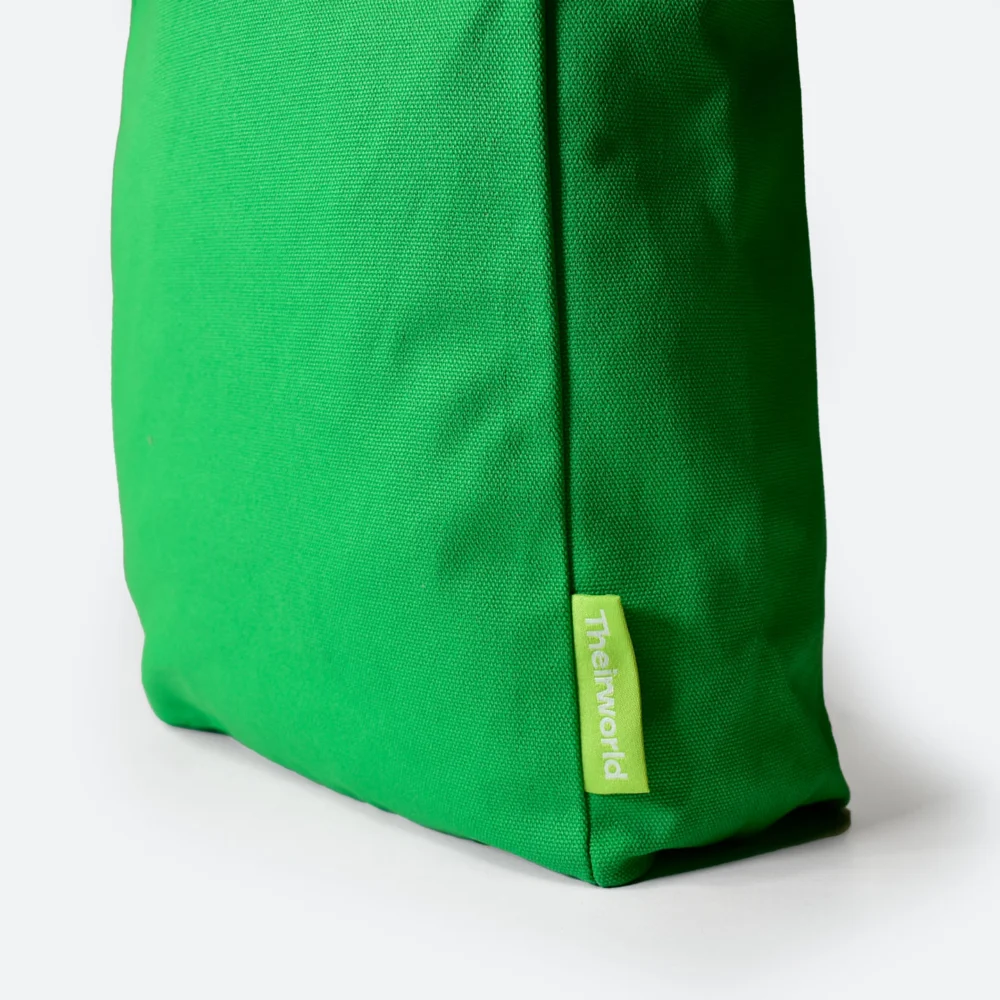
To solve this, The Bag Workshop’s design team moved away from 2D patterns to a 3D structural blueprint. The resulting A4 bag features integrated side panels and a full bottom gusset. This construction creates a rectangular footprint, allowing the bag to stand upright and maintain its silhouette regardless of its contents. The dimensions were meticulously calculated to provide ample clearance for A4 folders and digital devices, ensuring that the bag functions as a mobile office for the modern professional. By acting as a true OEM manufacturer, the team created a custom template that prioritized utility without sacrificing the sleek, professional aesthetic required by Theirworld.
Phase 2: The Science of Chromatic Fidelity through Custom Dyeing
Color is the most immediate communicator of brand value. In the world of textiles, achieving "Brand Pink" or "Brand Green" is a complex chemical process. Standard wholesale bags are often dyed in massive vats using low-cost pigments that can vary between batches.
The Bag Workshop utilized a precision custom-dyeing process for Theirworld’s cotton. Rather than printing a color onto the surface of a white bag—a method that often results in a stiff, "plastic" feel and ink that eventually cracks—the raw cotton fibers were dyed to specific Pantone references. This ensures that the color is fully saturated into the heart of the fabric. The result is a soft, breathable cotton that retains its vibrant hue even after heavy use and washing. This level of material engineering is what separates a luxury tote bag manufacturer from a high-volume commodity supplier.
Phase 3: Executing the Dual-Personality Colourways
The project required the production of two distinct colorways, each serving a different aesthetic purpose while maintaining a cohesive brand language.
Colourway A: The High-Contrast Pink
This design was intended to be bold and unapologetic. It utilized a vibrant pink base, but the technical mastery was found in the details. The Bag Workshop implemented high-contrast stitching in a secondary brand color, requiring a high degree of sewing precision. Every line of thread had to be perfectly straight, as the contrast would highlight any imperfection. The bag was finished with heavy-duty cotton webbing handles and a bespoke woven label, creating a tactile experience of luxury.
Colourway B: The Tonal Green
The second design focused on sophisticated harmony. This version used a monochromatic approach, where the stitching and handles complemented the primary green fabric. This tonal depth creates a more understated, "executive" feel, demonstrating the versatility of the A4 bag design. Both versions utilized the same structural DNA but delivered entirely different brand messages through color management.
Phase 4: Quality Assurance and the White Label Advantage
For agencies and high-end brands, the "White Label" model is essential. It allows the manufacturer to remain invisible, ensuring that the end-user’s focus remains entirely on the brand—in this case, Theirworld. However, white-label production requires a higher level of trust. The Bag Workshop leveraged its global network of specialist partner factories, selecting a facility known for its "incredible attention to detail" in gusset construction.
A common flaw in mass-produced bags is "bunched" stitching at the corners where the gusset meets the side panels. For Theirworld, a strict quality control gate was established to ensure sharp, clean corners. This technical refinement might seem minor, but it is the difference between a bag that looks like a "giveaway" and one that looks like a retail-ready fashion accessory.
The Result: A Sustainable Asset for Global Advocacy
The collaboration resulted in a product range that redefined the expectations for promotional textiles. By choosing to invest in bespoke manufacturing rather than stock inventory, Theirworld received more than just bags; they received a durable asset that stakeholders would keep and use for years.
Key Success Metrics:
- Total Brand Alignment: 100% Pantone accuracy across two distinct colorways.
- Structural Superiority: A 3D gusset design that protects documents and maintains shape.
- Ergonomic Comfort: Cotton webbing handles designed for heavy loads and shoulder comfort.
- Longevity: High-weight cotton and reinforced stitching that prevents the "disposable" cycle of cheap merchandise.
Understanding the Technical Specifications: A Deeper Dive
To appreciate the complexity of this project, one must understand the technical terminology of the bag manufacturing industry.
What is a Gusset?
A gusset is an additional section of fabric sewn into the sides or bottom of a bag. In the Theirworld project, a full gusset was used to transform a flat envelope shape into a three-dimensional box shape. This is critical for B2B applications where users are likely to carry laptops, tablets, and thick stacks of paper.
Why Cotton Webbing?
Most cheap bags use "self-fabric" handles, which are simply strips of the bag material folded over. These are prone to wrinkling and can cut into the shoulder when the bag is heavy. Cotton webbing is a specialized woven tape. It is incredibly strong, resists stretching, and provides a premium, textured feel that enhances the "luxury" perception of the product.
The Role of the OEM Manufacturer
An OEM (Original Equipment Manufacturer) provides a "blank slate" service. While a wholesaler sells you what they have, an OEM manufacturer builds what you need. For Theirworld, this meant they were not restricted by what was in a warehouse in London; they were only limited by their imagination.
Conclusion: Moving Beyond the Catalogue
In a world saturated with low-quality, disposable items, Theirworld made a strategic decision to prioritize quality. By partnering with The Bag Workshop and The Wurlin Group, they demonstrated that even a simple A4 bag can be a masterpiece of engineering when approached with precision and care.
Whether you are a creative agency looking for a reliable white-label partner or a brand manager seeking a bespoke solution that defies the limitations of stock products, the lesson from the Theirworld project is clear: do not settle for "close enough." From organic material sourcing to complex Pantone matching and international logistics, the path to brand excellence is paved with custom-dyed cotton, reinforced gussets, and an unwavering commitment to detail.