
The 98th Academy Awards will be remembered for many things—breathless wins, cinematic milestones, and a red carpet that redefined modern elegance—but as the curtains drew to a close on the main stage, the real fashion narrative was just beginning to unfold at the Los Angeles County Museum of Art (LACMA). It was here, amidst the 31st anniversary of the legendary Vanity Fair Oscar Party, that Teyana Taylor orchestrated one of the most sophisticated wardrobe transitions of the season. After appearing at the primary ceremony in a dramatic, voluminous feathered Chanel gown that commanded the room with its monochromatic gravity, the "One Battle After Another" star pivoted toward a philosophy of "less is more." Slips of white satin and the delicate glint of jewelry replaced the heavy textures of the evening, marking a triumphant finale to Taylor’s 2026 awards season run.
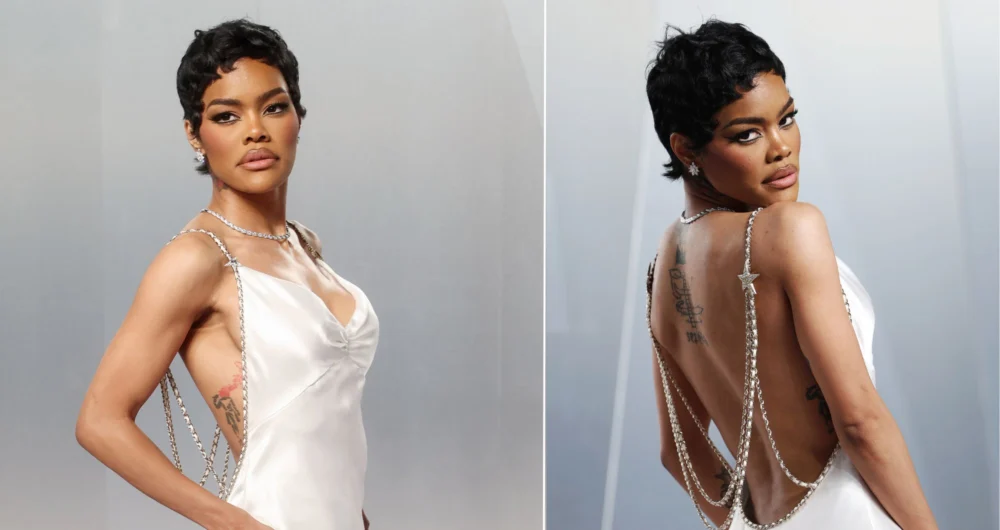
The 2026 Vanity Fair Oscar Party marked a historic shift for the publication, moving its celebrated festivities to the hallowed halls of LACMA for the first time. The change in venue provided a fittingly artistic backdrop for Taylor’s second Chanel ensemble of the night. If her first look was a nod to the house’s penchant for grandiosity and texture, her after-party attire was an exercise in pure silhouette and liquid movement. The gown, a column of pristine white satin, eschewed the traditional heavy embroidery or lace often associated with the French maison, opting instead to highlight the wearer’s form through masterful cutting and strategic proportion.
The architecture of the dress was deceptively simple. From the front, it presented a softly scooped neckline and a lightly gathered bust, echoing the effortless grace of a classic 1990s-inspired slip dress. However, as Taylor moved through the star-studded crowd, the garment’s true complexity was revealed. The sides and back of the gown were carved away, opening wide to expose a daringly low-cut back that was anchored by an intricate system of chain-trimmed straps. These were not mere utilitarian supports; they were pieces of high-fashion engineering. Replacing standard fabric straps were delicate, jeweled chains that caught the ambient light of the LACMA galleries. These chains extended into multiple draped tiers across the open back, creating a jewelry-like effect that blurred the line between clothing and ornament.

Perhaps the most poetic detail of the ensemble was the inclusion of star-shaped accents at the shoulder points. These celestial motifs served as a subtle homage to Gabrielle "Coco" Chanel’s 1932 "Bijoux de Diamants" collection, the designer’s first and only foray into high jewelry, which famously featured the "Comète" star. By incorporating these elements into the strap work, the current Chanel design team—and Taylor herself—bridged the gap between the house’s historical legacy and a modern, minimalist aesthetic. It was a look that felt deeply rooted in "Old Hollywood" slip dressing but was executed with a precision that felt entirely futuristic.
This appearance at the Vanity Fair party was not an isolated fashion success for Taylor; rather, it was the "cherry on top" of a meticulously curated season. The 2026 awards circuit has seen Taylor emerge as a formidable style chameleon, moving with ease between different design languages. Her journey began at the Golden Globes, where she took home a trophy while draped in a custom Schiaparelli gown that showcased Daniel Roseberry’s signature surrealism. She followed that performance with a turn at the Screen Actors Guild (SAG) Awards in a silver-and-white Thom Browne creation that played with avant-garde proportions and metallic textures. Just weeks prior to the Oscars, Taylor was seen front-row at Paris Fashion Week, attending the Chanel Fall 2026 show, signaling a deepening relationship with the brand that culminated in her dual-look Oscar night.
The shift toward a "sharper line" in Taylor’s wardrobe has been a point of fascination for fashion critics this year. While she has never been one to shy away from volume or theatricality, her 2026 choices have leaned into exposed construction and strong, clean silhouettes. The white satin Chanel gown at the after-party epitomized this trend. By stripping back the layers of tulle and feathers she wore earlier in the evening, Taylor allowed her natural charisma and athletic poise to take center stage. The dress did not wear her; she wore the dress, transforming a simple length of silk into a statement of ultimate confidence.
The Vanity Fair Oscar Party itself remains the most coveted invitation in Hollywood, and its move to LACMA only heightened the sense of prestige surrounding the 31st annual event. As the 98th Academy Awards drew nominees, presenters, and industry titans together, the after-party served as the ultimate intersection of cinema, art, and fashion. Against the museum’s curated collections, Taylor’s white Chanel gown acted as a living sculpture. The invitation-only event, which has hosted everyone from legacy actors to the new guard of digital creators, found its focal point in Taylor’s understated brilliance.

Beyond the aesthetics, Taylor’s choice of Chanel for both the ceremony and the after-party speaks to the brand’s enduring relevance in the cinematic world. Chanel has long maintained a symbiotic relationship with film, dating back to Coco Chanel’s own work with Hollywood studios in the 1930s. In 2026, that relationship remains as potent as ever. By choosing two vastly different Chanel looks, Taylor demonstrated the versatility of the house’s current direction—proving that it can cater to the high-drama needs of a red carpet walk as effectively as it can to the sleek, party-ready requirements of a late-night celebration.
As the night wore on and the champagne flowed within the walls of LACMA, Taylor’s look remained impeccable. The choice of satin was particularly brave; it is a fabric that demands perfection in both tailoring and posture, as every crease and shadow is visible. Yet, Taylor’s gown appeared liquid, moving with her as she greeted fellow actors and celebrated the night’s winners. It was a reminder that red carpet fashion is as much about the "after" as it is about the "before." While the ceremony gown is designed for the photograph and the seat in the theater, the after-party gown is designed for life, movement, and the intimacy of conversation.
In the broader context of Taylor’s career, 2026 has been a transformative year. Her work in "One Battle After Another" has solidified her status as a leading lady capable of carrying complex, emotionally resonant narratives. Her fashion choices have mirrored this professional growth, moving away from the street-style-inspired looks of her early career toward a more refined, "couture-adjacent" sensibility. The white Chanel gown was the perfect visual metaphor for this evolution: clean, bright, and undeniably sophisticated.
As the sun rose over Los Angeles the following morning, the images of Teyana Taylor in white satin were already being hailed as the "look of the night." In a year where many stars opted for maximalist colors and heavy embellishments, Taylor’s decision to go "stripped-back" was a masterstroke. It proved that in the high-stakes world of Oscar fashion, sometimes the quietest looks make the loudest impact. By closing out the 98th Academy Awards season in a gown that relied on cut, proportion, and the history of the House of Chanel, Teyana Taylor didn’t just attend the party—she defined it. Her journey through the 2026 awards season, from Schiaparelli to Thom Browne and finally to the dual-layered Chanel finale, stands as a testament to her status as a modern style icon, one who understands that fashion is not just about what you wear, but the story you tell as you change into something new.