
The global confectionery landscape is undergoing a profound transformation as consumer demand for environmental accountability converges with tightening international regulations on single-use plastics. At the forefront of this shift, Mondelēz International has unveiled a comprehensive sustainability roadmap for its Easter 2026 seasonal lineup, marking a significant escalation in its "Pack Light and Right" initiative. By integrating high concentrations of certified recycled plastic into its most iconic brands, including Cadbury Mini Eggs and seasonal chocolate tablets, the snacking giant is signaling a departure from traditional virgin-plastic reliance toward a circular economic model. This strategic pivot, executed in deep technical collaboration with packaging leader Amcor, represents one of the most ambitious applications of advanced recycling technology in the food industry to date.
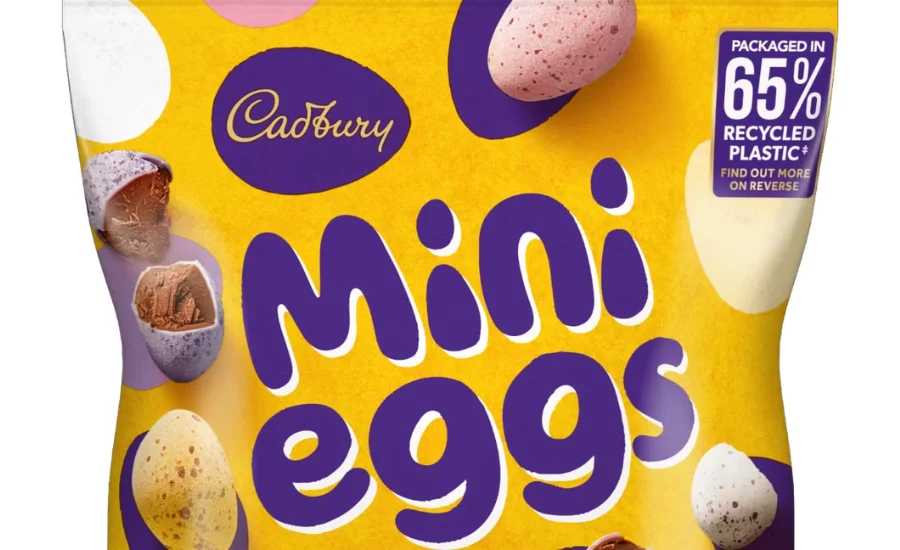
The centerpiece of the 2026 announcement involves a dramatic overhaul of the packaging for Cadbury Mini Eggs, a seasonal staple in the United Kingdom and Ireland. Mondelēz has confirmed that the 31.9g, 74g, and 256g formats of these chocolate treats will transition to packaging containing 65% certified recycled plastic. This move is complemented by an even more aggressive recycled-content target for the brand’s Easter tablets; both small and large seasonal Cadbury tablets will be wrapped in material featuring 80% certified recycled plastic. These figures are significantly higher than the industry average for flexible food-grade packaging, which has historically struggled with recycled content due to stringent safety and contamination standards.
To achieve these benchmarks, Mondelēz is utilizing a "mass balance approach." In the complex world of polymer production, mass balance is a chain-of-custody accounting system that allows recycled feedstocks to be tracked through the manufacturing process and mixed with virgin materials. Because it is often physically impossible to separate recycled molecules from virgin ones once they enter a refinery, mass balance ensures that the equivalent volume of recycled material is credited to the specific end-product. This methodology is increasingly recognized by global certification bodies as a credible way to scale up the circular economy, providing the necessary demand signals to chemical companies to invest in more recycling infrastructure.
The technical backbone of this transition is provided by Amcor, a long-term strategic partner for Mondelēz. The 2026 Easter range will utilize Amcor’s proprietary AmFiniti solution. Unlike traditional mechanical recycling—which involves grinding, washing, and melting plastic and often results in a degradation of material quality—AmFiniti relies on advanced, or chemical, recycling. This process breaks down post-consumer plastic waste to its molecular level, effectively "resetting" the material into a pristine resin that is indistinguishable from virgin plastic. This is critical for the food industry, as it ensures the packaging maintains the necessary barrier properties to keep chocolate fresh while meeting the highest food-safety standards.
The scale of this implementation is substantial. Mondelēz estimates that this initiative will divert approximately 134 tonnes of post-consumer plastic waste from landfills and incineration. To put this into a consumer perspective, the volume of recycled material sourced will be sufficient to produce packaging for roughly 16 million seasonal tablets and 70 million bags of Cadbury Mini Eggs annually. By moving these volumes into a circular loop, Mondelēz is not only reducing its carbon footprint but also insulating itself against the rising costs of virgin plastic, which is increasingly subject to environmental taxes in various jurisdictions.
Beyond the chemistry of the plastic bags, the 2026 Easter strategy addresses the secondary and tertiary elements of gift packaging. For years, the "Special Gesture" range of Easter eggs was characterized by ornate ribbon handles. While aesthetically pleasing, these mixed-material components often hindered the recyclability of the overall package. In the new iteration, these have been replaced with 100% recyclable cardboard handles. This follows a broader trend within the company to eliminate problematic materials; in previous years, Mondelēz successfully removed over 6.4 million plastic "windows" from its Easter egg boxes, replacing them with open-faced designs or fiber-based alternatives. Additionally, the company previously transitioned the Cadbury Easter Favourites Pouch to a paper-based outer wrap, demonstrating a willingness to experiment with diverse material substrates depending on the specific needs of the product.
This evolution is not happening in a vacuum. It is a critical component of Mondelēz’s broader "Snacking Made Right" ESG (Environmental, Social, and Governance) framework. The company has set a global target to ensure that 98% of its packaging is designed for recyclability by 2030. Currently, the company reports that 96% of its portfolio meets this criteria, but the final 2% represents the most difficult challenge: flexible films and multi-layer laminates. Furthermore, Mondelēz aims to achieve a 25% reduction in the use of virgin plastic across its rigid plastic packaging by 2030. By proving the viability of recycled content in flexible seasonal packaging, the company is creating a blueprint that can eventually be applied to its year-round "power brands" like Oreo, Milka, and Toblerone.
Transparency is another pillar of the 2026 rollout. Each of the new Cadbury Mini Egg bags will feature a scannable QR code on the reverse side. This digital bridge allows consumers to access detailed information regarding the recycled content of the specific bag they are holding, as well as broader education on Mondelēz’s sustainability goals. In an era where "greenwashing" allegations are common, providing verifiable, third-party certified data (often through ISCC+ certification for mass balance) is essential for maintaining brand trust.
The industry implications of this move are significant. Seasonal confectionery is notorious for "over-packaging," where the ratio of packaging weight to product weight is often higher than in standard retail. By tackling the Easter portfolio, Mondelēz is addressing a high-visibility waste stream. Joanna Dias, the Sustainability Lead for Mondelēz UK & Ireland, noted that the iconic status of the Mini Eggs brand makes it the perfect vehicle for this milestone. She emphasized that the goal is to make the "joy of Easter" more sustainable without compromising the consumer experience or product quality.
From a manufacturing standpoint, Janice Narainsamy, a Senior Product Development Engineer at Amcor, highlighted that the collaboration proves circular packaging solutions can be integrated at an industrial scale. The challenge for engineers is to ensure that the recycled-content film performs identically to virgin film on high-speed packaging lines. Any loss in "machinability" or seal integrity would lead to food waste, which would negate the environmental benefits of using recycled plastic. The success of the AmFiniti integration suggests that these technical hurdles are being overcome.
The regulatory environment in Europe and the UK is also a driving factor. The EU’s Packaging and Packaging Waste Regulation (PPWR) is setting increasingly strict mandates for recycled content in plastic packaging, with targets escalating toward 2030 and 2040. Similarly, the UK Plastic Packaging Tax applies to plastic packaging produced in or imported into the UK that does not contain at least 30% recycled plastic. By hitting 65% and 80% recycled content, Mondelēz is not just complying with current laws but "future-proofing" its operations against even more stringent future requirements.
As the industry looks toward 2026, the Mondelēz-Amcor partnership serves as a case study in the power of the value chain. No single company can solve the plastic waste crisis alone; it requires chemical recyclers to provide the feedstock, packaging converters like Amcor to create the films, and brand owners like Mondelēz to create the market demand. The 134 tonnes of plastic being diverted through this Easter range is a fraction of the millions of tonnes produced globally, but it represents a scalable proof of concept. If 70 million bags of Mini Eggs can be produced with majority-recycled content, it sets a new expectation for the entire confectionery category.
Ultimately, the 2026 Easter season will serve as a high-profile test of consumer reception to sustainable packaging innovation. By combining high-tech molecular recycling with traditional material substitutions like cardboard handles, Mondelēz is attempting to balance the nostalgia of a traditional holiday with the modern necessity of environmental stewardship. The message is clear: the future of snacking is not just about taste, but about the circularity of the materials that bring those snacks to the world’s tables. As the company continues toward its 2030 goals, this "milestone in the sustainable packaging journey" is likely only the beginning of a much larger transformation in how global brands approach the lifecycle of their products.