
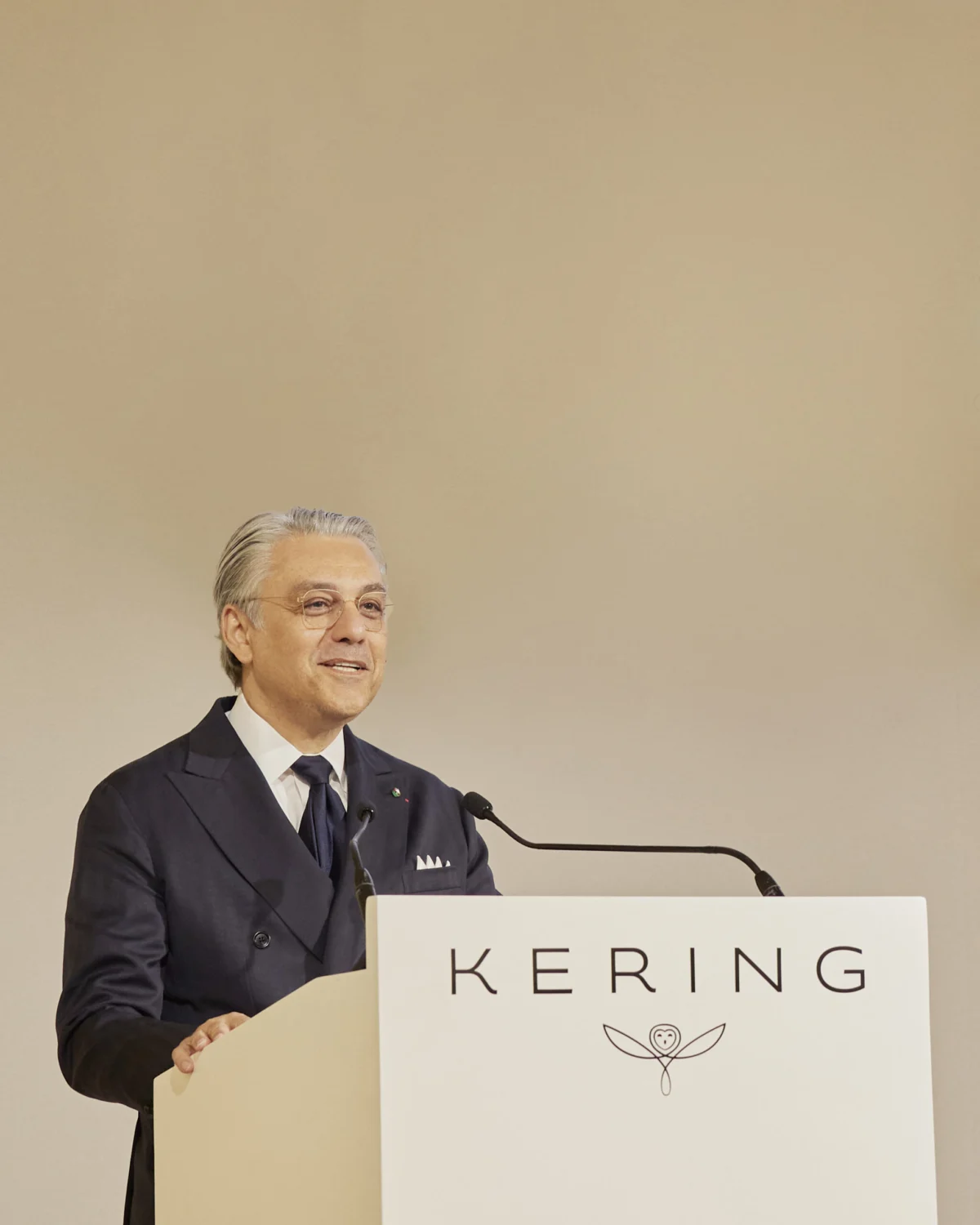
In the historic heart of Florence, a city synonymous with the birth of the Renaissance, Kering’s chief executive officer Luca de Meo stood before an audience of wary investors, sharp-eyed equity analysts, and the fashion elite to deliver a message of radical transformation. The "ReconKering" strategy, unveiled during the group’s high-profile Capital Markets Day, represents more than just a fiscal recovery plan; it is a fundamental reimagining of how a luxury conglomerate must operate in an increasingly volatile global economy. With a headline goal to more than double the group’s recurring operating margin by the "mid-term," de Meo is betting his reputation—and the future of icons like Gucci, Saint Laurent, and Balenciaga—on a philosophy that favors "operational rigor" over mere brand desirability.
The backdrop for this announcement was one of stark financial reality. Kering’s 2025 fiscal year was defined by turbulence, resulting in a net loss of 29 million euros—a jarring contrast to the 1.02 billion euro profit recorded just twelve months prior. This downturn was largely the result of aggressive, nonrecurring costs associated with a sweeping restructuring effort. Recurring operating profit plummeted 33 percent to 1.63 billion euros, and the crucial recurring operating margin contracted from 14.5 percent to a lean 11.1 percent. For a group that relies on Gucci for 59 percent of its operating profit, the stagnation of its star brand has become an existential challenge. De Meo, the former Renault chief who transitioned to the luxury sector in September, is now tasked with steering this ship through a "structural reset" designed to return Kering to its status as an industry pacesetter.
The "ReconKering" roadmap is articulated through a meticulously timed three-phase execution plan. The first phase, slated for completion by the end of 2026, focuses on a total structural reset, stripping away inefficiencies and stabilizing the group’s foundations. The second phase, extending through 2028, is characterized as a "rebuild" period where the group expects to achieve sustainable, profitable growth. The final horizon, set for 2030, aims to see Kering reclaim its position as the "reference player in Next Luxury"—a term de Meo uses to describe a future where agility, digital integration, and extreme craftsmanship converge. "True Luxury is our mission, and Next Luxury is our horizon," de Meo remarked, emphasizing that the group must adopt the "agility of a challenger" while maintaining the prestige of a heritage house.
Central to this turnaround is the revitalization of Gucci. In a move that has sent ripples through the industry, the brand is now under the creative stewardship of Demna, the visionary formerly of Balenciaga. The strategy for Gucci is nothing short of Herculean: de Meo aims to add 1 billion euros to its leather goods business and another 600 million euros from ready-to-wear and footwear by 2030. Furthermore, the brand’s watches and jewelry segment is targeted to leap from 200 million euros to 700 million euros. To achieve this, Kering plans to double the sales density within Gucci’s boutiques, focusing on "icon products" that transcend seasonal trends. De Meo was firm in his conviction, stating that Gucci’s recovery would be "structural" rather than a temporary marketing lift.
However, the "ReconKering" plan extends far beyond its flagship brand. De Meo’s vision for the entire portfolio involves a series of aggressive "doubling" targets by 2030. This includes doubling the group’s overall jewelry business, Saint Laurent’s menswear and Asian market presence, Bottega Veneta’s non-leather categories, and Balenciaga’s leather goods and U.S. operations. To support these lofty goals, the group is implementing a new operational architecture, including two "centers of excellence" dedicated to industrial production and client relations. The appointment of a chief digital, AI, and IT officer underscores a commitment to technological supremacy, while a dedicated unit for high jewelry aims to capture the ultra-high-net-worth segment that has remained resilient amid broader economic cooling.
The retail strategy is undergoing an equally radical overhaul. Kering intends to shutter at least 100 underperforming stores this year as part of a rationalization effort to "resize and strengthen" its global footprint. By 2030, the group plans to have renovated two-thirds of its entire retail network, which currently stands at 1,719 locations. This shift suggests a pivot away from sheer volume toward high-impact, high-margin flagship experiences. De Meo’s focus on "top-tier clients"—the Very Important Clients (VICs) who already represent a quarter of luxury consumption—is a calculated move to insulate the group from the fluctuations of the aspirational consumer market, which has been hit hard by inflation and shifting spending habits.
Financially, the "mid-term" objectives are designed to appease a skeptical market. Kering is targeting a Return on Capital Employed (ROCE) of above 20 percent and plans to maintain a capital expenditure envelope of 5 to 6 percent of revenue. The group’s dividend policy remains ambitious, with a payout ratio targeting approximately 50 percent of recurring net profit. These targets come at a time of immense pressure; Kering’s first-quarter 2026 results showed a 6.4 percent revenue decline, leading to a nearly 10 percent drop in share price. When compared to the relatively minor 1.4 percent dip at Hermès or the 9 percent decline in LVMH’s fashion division, Kering’s struggle to find its footing is evident.
The skepticism of market analysts remains a significant hurdle. TD Cowen’s Oliver Chen noted that the "uplift from the new creative direction is taking longer to materialize than investors initially expected," citing a particular need for momentum in the Chinese market. China, once the primary engine of luxury growth, has become a complex landscape of cautious spending and shifting brand loyalties. Gucci’s 14 percent slide in the Asia-Pacific region stands in stark contrast to its 8 percent growth in North America, highlighting a geographical divergence that de Meo must bridge. Bernstein’s Luca Solca was even more pointed, suggesting that without a "rabbit out of the hat," the reality of a difficult brand turnaround would likely weigh on the stock, leaving Kering at risk of a "turnaround yo-yo."
The Florence presentation was as much about optics as it was about balance sheets. By bringing creative directors like Anthony Vaccarello (Saint Laurent), Pierpaolo Piccioli (Balenciaga), and Louise Trotter (Bottega Veneta) onto the stage alongside brand CEOs and Chairman François-Henri Pinault, de Meo sought to project a united front. He emphasized that "excellence is a discipline," a mantra intended to shift the corporate culture from a collection of siloed houses to a synchronized powerhouse. The presence of Demna, now tasked with the Gucci revival, served as a reminder of Kering’s willingness to take bold, often controversial, creative risks to break out of stagnation.
As the luxury industry watches, Kering is essentially attempting to perform open-heart surgery on itself while running a marathon. The "ReconKering" plan is a high-stakes gamble that luxury can be systematized through operational "rigor" and "clarity" without losing the ephemeral magic that drives desirability. Whether de Meo can successfully navigate the structural reset of 2026 to reach the "Next Luxury" leadership of 2030 remains the industry’s most pressing question. For now, the group is betting that by trimming the fat, doubling down on high-margin categories, and centralizing its technological and industrial expertise, it can transform from an ailing giant back into the "reference player" of the global luxury stage. The roadmap is clear; the execution, as de Meo himself noted, will be the ultimate measure of success.