

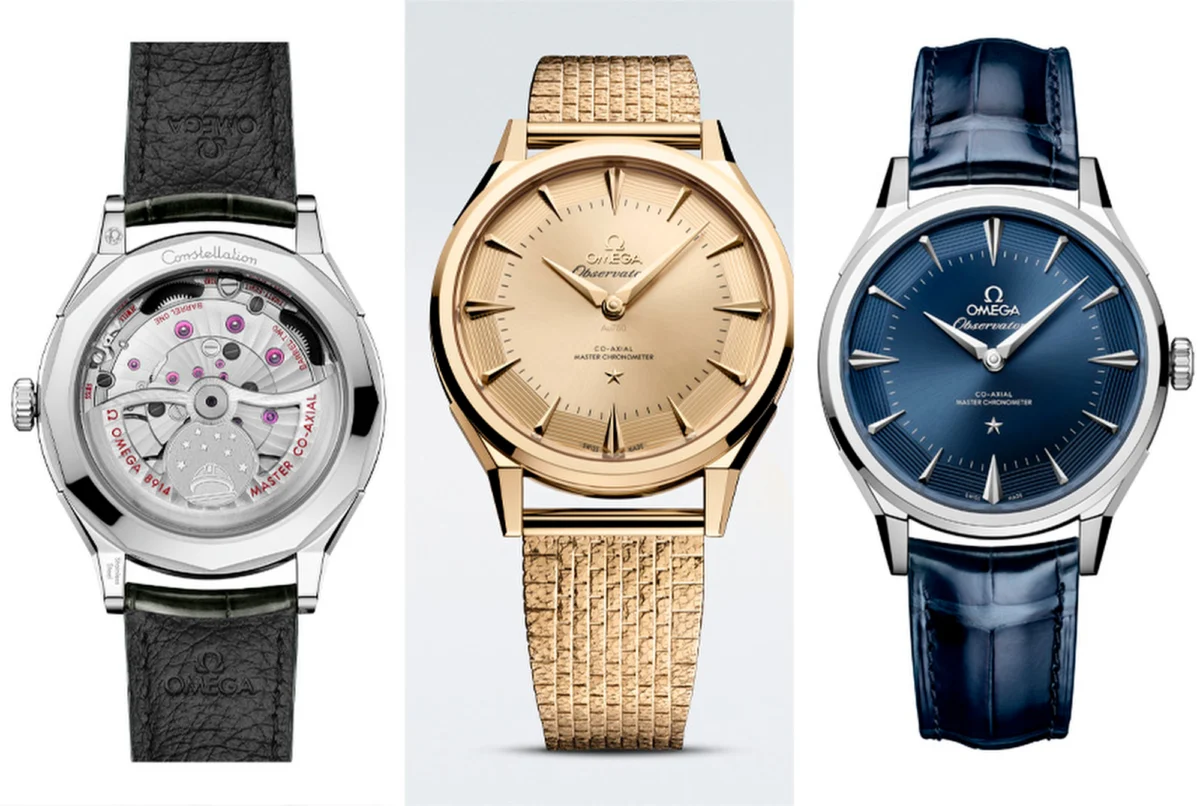
In the high-stakes world of Swiss horology, where seconds are often the primary currency of excellence, Omega has performed a masterstroke by looking backward to leap forward. The brand has officially unveiled the Constellation Observatory Collection, a suite of nine exquisite references that represent a landmark achievement in technical watchmaking: the first-ever two-hand timepieces to earn the prestigious Master Chronometer certification. This launch is not merely an aesthetic nod to the mid-century golden era of design; it is a profound technological disruption that renders the traditional requirements for precision testing obsolete through the implementation of cutting-edge acoustic methodology.
For decades, the path to Chronometer and Master Chronometer status was paved with the visual movement of a seconds hand. The seconds hand served as the vital sign of a mechanical movement, allowing testing bodies like the Contrôle Officiel Suisse des Chronomètres (COSC) and the Federal Institute of Metrology (METAS) to measure the daily deviations in rate across various positions and temperatures. Without a seconds hand, verifying a watch’s accuracy to the exacting standards of -0/+5 seconds per day was considered impossible. Omega’s breakthrough lies in the development of a new acoustic testing system that "listens" to the heartbeat of the movement—the oscillation of the balance wheel—to determine its precision without the need for visual confirmation from a ticking hand. As Raynald Aeschlimann, President and CEO of Omega, noted, this development has effectively made the requirement for a seconds hand a thing of the past, allowing the brand to strip the dial down to its most elegant essentials while maintaining a level of performance that exceeds almost everything else on the market.
The Constellation Observatory Collection serves as a bridge between the avant-garde future of the Laboratoire de Précision and the storied heritage of the Constellation line, which debuted in 1952. To understand the significance of this collection, one must look back to 1948, the year Omega released the "Centenary" to celebrate its 100th anniversary. The Centenary was Omega’s first chronometer-certified automatic wristwatch, and its success paved the way for the official birth of the Constellation four years later. The new Observatory models lean heavily into this "Pre-Manhattan" design language—referring to the era before the famous "claws" or griffes were introduced in 1982—focusing instead on the architectural purity of the "Pie-Pan" dial.
The Pie-Pan dial is perhaps the most beloved feature among vintage Omega collectors. Its dodecagonal (twelve-sided) shape creates a series of facets that catch the light from different angles, giving the watch a three-dimensional depth that a flat dial cannot replicate. In the new collection, Omega has reinterpreted this classic feature with a level of finishing that speaks to modern luxury. Several references feature a meticulous guilloché finish on the facets of the pie-pan, a decorative technique that first appeared on Constellation models in 1953. This intricate pattern creates a shimmering effect that contrasts beautifully with the sun-brushed central portions of the dial.
Complementing the dial are the faceted "kite-form" indexes and "dauphine" hands. These elements are not just stylistic choices; they are historical echoes of the original 1952 Constellation. The kite-shaped markers provide a sharp, geometric counterpoint to the circular case, while the dauphine hands—characterized by their tapered, triangular shape—offer a sense of mid-century sophistication. Each index is diamond-polished to a mirror sheen, ensuring that the watch remains legible even in low-light conditions, despite the absence of a seconds hand or luminescent material on some of the more formal references.
Beneath the dial lies the true engine of this revolution: two new movements that have been engineered specifically for this collection. These calibres represent the pinnacle of Omega’s movement manufacture, featuring the brand’s signature Co-Axial escapement and silicon balance springs. Because they are Master Chronometer certified, they are virtually immune to the effects of magnetism, capable of withstanding fields of up to 15,000 gauss. This is a critical feature in the modern world, where smartphones, tablets, and magnetic clasps on handbags can easily magnetize a traditional mechanical watch, causing it to run fast or stop altogether.
The certification process for these watches is handled by the Laboratoire de Précision, an authorized chronometer testing facility that Omega announced two years ago. While founded by Omega, the laboratory operates as a completely independent body, certified by METAS and accredited by the Swiss Accreditation Service (SAS). It is a "neutral" ground in the Swiss watchmaking landscape, open to any brand that wishes to subject its movements to the most rigorous testing standards in the world. By integrating the Laboratoire de Précision into the Master Chronometer workflow, Omega has created a feedback loop of data that allows for unprecedented levels of quality control. The acoustic testing technology used here is the secret sauce that allows the Constellation Observatory to prove its mettle without a seconds hand, marking a "first" in watchmaking history that will likely be studied by horological historians for years to come.
The collection itself is expansive, consisting of nine distinct references that cater to a wide range of tastes and budgets. At the entry level, stainless steel models offer a crisp, monochromatic look that highlights the architectural lines of the case and the pie-pan dial. These pieces, retailing from $10,900, provide a gateway into the world of high-precision horology. Moving up the range, Omega utilizes its proprietary 18K gold alloys, including the warm hues of Sedna Gold and the brilliant, white luster of Canopus Gold. The most exclusive references in the collection, priced at up to $59,100, feature stunning combinations of precious metals and possibly diamond-set markers, though the focus remains firmly on the purity of the two-hand design.
The caseback of each watch features a final, poetic nod to the collection’s namesake: the Constellation Observatory medallion. This iconic emblem depicts the Geneva Observatory under a sky of eight stars. In the world of horology, these stars are not merely decorative; they represent the eight precision records Omega set at the world’s major observatories during the mid-20th century. Today, those eight stars have taken on a dual meaning, also symbolizing the eight rigorous METAS tests that every Master Chronometer must pass. The medallion serves as a permanent reminder that while the technology inside the watch has changed, the brand’s obsession with being the most accurate timekeeper in the world remains unwavering.
The launch of the Constellation Observatory Collection at Omega boutiques signals a shift in the luxury watch market. For several years, the industry has been dominated by "sports-chic" steel watches with integrated bracelets. With this release, Omega is making a strong case for the return of the "chronometer-grade" dress watch—a timepiece that prioritizes elegance and technical perfection over rugged utility. It is a watch for the connoisseur who understands that true precision doesn’t always need to be shouted through a ticking seconds hand; sometimes, it is best expressed through the quiet, confident hum of a perfectly tuned movement.
As collectors and enthusiasts flock to see these pieces in person, the conversation will undoubtedly center on the acoustic testing breakthrough. It is a rare moment in watchmaking when a brand solves a problem that many didn’t even realize existed. By removing the seconds hand, Omega hasn’t just simplified the dial; they have challenged the very definition of how we measure the passage of time. The Constellation Observatory is a masterclass in restraint, proving that in the pursuit of perfection, sometimes less is infinitely more. With nine references that span the gap from modern steel to opulent gold, Omega has ensured that its next chapter in precision is not just a technical footnote, but a beautiful, wearable reality.