

The global packaging industry stands at a critical crossroads, caught between the soaring demands of a hyper-connected consumer economy and the urgent necessity of environmental stewardship. For decades, the narrative of "sustainable packaging" has been dominated by the visible and the tangible: the recyclability of a plastic bottle, the thickness of a corrugated box, or the percentage of post-consumer resin in a pouch. While these factors are undeniably important in the context of a circular economy, they represent only the final chapter of a much longer and more resource-intensive story. As manufacturing complexities grow and global regulations tighten, the industry is beginning to realize that true sustainability is not merely found in the product itself, but in the invisible engineering processes that bring that product to life.
According to data cited by the United Nations Environment Programme (UNEP), the packaging sector is the single largest consumer of virgin plastics, accounting for approximately 36% of all plastics produced globally. Furthermore, the sector is responsible for roughly 40% of global plastic waste. These figures have historically placed the industry under intense public and regulatory scrutiny, leading to a surge in Environmental, Social, and Governance (ESG) reporting. Today, it is nearly impossible to find a major packaging manufacturer or consumer packaged goods (CPG) brand that does not boast ambitious carbon-neutral targets or waste-reduction goals. However, as the "green" marketplace becomes increasingly crowded, a fundamental question has emerged among engineers, environmentalists, and policymakers: Are the metrics we use to measure success actually driving environmental progress, or are they simply serving as "report-friendly" marketing tools?
The inherent problem with many current sustainability metrics is their focus on end-of-life outcomes rather than the environmental performance of the manufacturing facility. For instance, a company might successfully transition to a mono-material laminate that is technically recyclable, yet if the production of that laminate involves inefficient drying ovens, high-solvent printing processes, and unmitigated volatile organic compound (VOC) emissions, the net environmental gain may be negligible—or even negative. This disconnect is highlighted by the Organisation for Economic Co-operation and Development (OECD), which notes that the global plastics lifecycle is responsible for 3.4% of all greenhouse gas emissions. A significant portion of this impact occurs during the conversion and printing stages, where energy consumption and chemical emissions are at their peak.
To move toward a more authentic model of sustainability, the packaging industry must shift its gaze toward the production floor. In the realms of flexible packaging, converting, and flexographic printing, the manufacturing process is often a high-stakes balancing act of chemistry and thermodynamics. Solvent-based inks, coatings, and adhesives are essential for achieving the barrier properties and aesthetic quality consumers expect, but they are also primary sources of VOCs. When these compounds are released into the atmosphere, they react with nitrogen oxides in the presence of sunlight to form ground-level ozone—a major component of smog and a significant respiratory hazard.
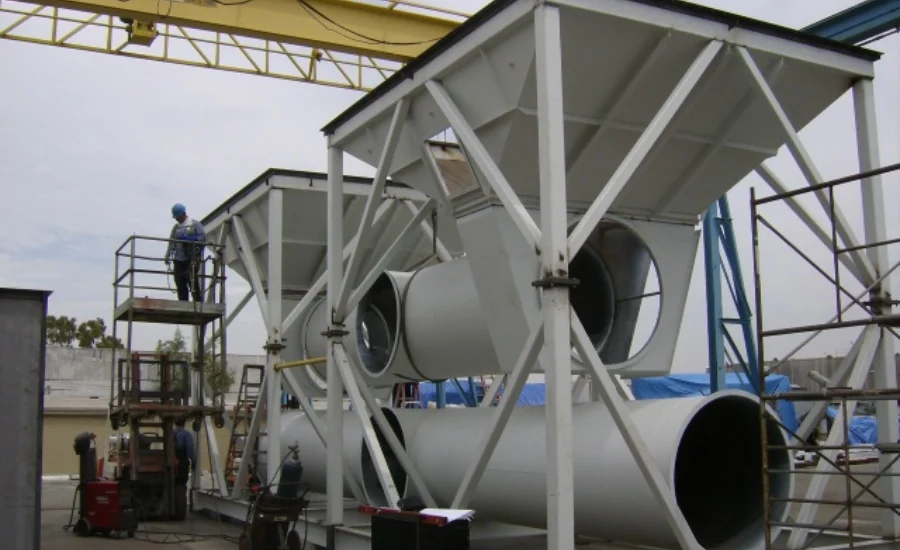
In this context, pollution abatement is no longer just a "pipe-end" compliance cost; it is a strategic pillar of operational sustainability. Advanced technologies, such as those developed by firms like Ship & Shore Environmental, are transforming how manufacturers manage their environmental footprint. The Regenerative Thermal Oxidizer (RTO) has become the gold standard for this transition. Unlike older, less efficient incineration methods, modern RTOs are designed to destroy VOCs at temperatures exceeding 1,500°F with a destruction efficiency that often tops 99%. More importantly, these systems are marvels of energy recovery. High-efficiency RTOs can capture up to 97% of the thermal energy generated during the combustion process, redirecting that heat back into the plant’s drying ovens or facility heating systems. This "closed-loop" approach to thermal energy significantly reduces a plant’s reliance on natural gas, thereby lowering Scope 1 carbon emissions in a way that material reduction alone never could.
The transition from marketing-led metrics to engineering-led metrics requires a new set of Key Performance Indicators (KPIs). For the forward-thinking plant manager, the following metrics provide a far more accurate picture of environmental health than traditional ESG disclosures:
- Destruction Removal Efficiency (DRE): This measures the exact percentage of pollutants neutralized by abatement systems. While 95% was once acceptable, the industry leaders are now pushing for 99.5% or higher to future-proof against tightening air quality standards.
- Capture Efficiency: It is not enough to destroy the VOCs that reach the oxidizer; one must also ensure that 100% of the emissions generated at the printing press or coating head are actually captured and routed to the control device. This requires precision in "permanent total enclosure" (PTE) design.
- Specific Energy Consumption (SEC): This tracks the amount of energy required to produce a single unit of packaging. By monitoring SEC, manufacturers can identify inefficiencies in their drying and curing lines that might otherwise go unnoticed.
- Thermal Energy Recovery (TER) Ratio: This metric quantifies the effectiveness of heat exchangers within the abatement system. High TER ratios directly correlate to lower utility costs and reduced carbon intensity.
- Solvent Recovery Rates: In some high-volume operations, the ability to capture, condense, and reuse solvents creates a circularity within the factory walls that drastically reduces the need for virgin chemical inputs.
The shift toward these rigorous, data-driven metrics is being accelerated by a changing regulatory landscape. In the United States, the Environmental Protection Agency (EPA) and various state-level agencies are moving away from "design-based" compliance—where a company is assumed to be in compliance if they installed the right equipment—toward "performance-based" compliance. This involves continuous emissions monitoring systems (CEMS) and regular, rigorous stack testing. In Europe, the Green Deal and the Industrial Emissions Directive are imposing similar pressures, demanding that manufacturers prove their environmental claims with verifiable, real-time data.
For packaging manufacturers in sectors like food safety, medical devices, and pharmaceutical labeling, the stakes are even higher. These industries require high-performance coatings and specialized barrier layers that often necessitate the use of complex solvent systems. In these environments, sustainability cannot be achieved through material substitution alone without compromising product integrity. Therefore, the only path to a sustainable future is through the optimization of the manufacturing infrastructure itself. By integrating advanced pollution control directly into the production line, these companies can maintain their high quality standards while drastically reducing their environmental impact.
Furthermore, this engineering-centric approach offers a significant competitive advantage in a volatile global economy. As energy prices fluctuate and carbon taxes become a reality in many jurisdictions, the ability to recover heat and reduce fuel consumption is a powerful hedge against rising operational costs. A packaging facility that operates with 97% thermal efficiency is inherently more resilient than one that vents its waste heat into the atmosphere. Investors and B2B customers are beginning to recognize this; they are increasingly looking past the glossy sustainability brochures to examine the "operational DNA" of their suppliers.
The growth of the packaging market—fueled by the explosion of e-commerce and the necessity of sterile medical packaging—shows no signs of slowing down. However, the industry’s "license to operate" will increasingly depend on its ability to prove that this growth is not coming at the expense of the planet’s air and climate. This requires a cultural shift within packaging companies, where sustainability is no longer siloed in the marketing or legal departments but is instead a core responsibility of the engineering and operations teams.
Ultimately, rethinking sustainability measurement in packaging means acknowledging that what happens inside the factory is just as important as what happens to the package after it is discarded. Real progress is found in the precision of a capture hood, the efficiency of a heat exchanger, and the total destruction of harmful pollutants before they ever leave the stack. By embracing these engineering realities, the packaging industry can move beyond the surface-level metrics of the past and build a foundation for a truly sustainable future—one measured by the data that actually matters.