

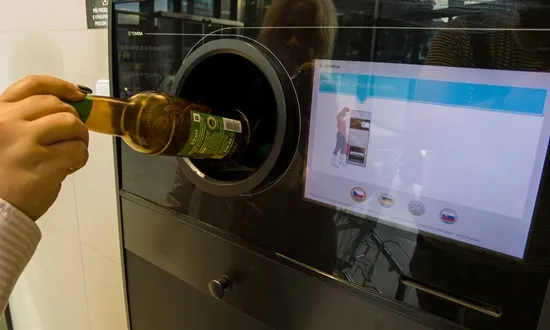
A significant industry alliance, spearheaded by British Glass and encompassing Welsh businesses, packaging suppliers, and trade associations, has issued a grave warning regarding the Welsh Government’s proposed Deposit Return Scheme (DRS) for drinks containers, specifically targeting the inclusion of glass beverage packaging. This divergence from the established approach in the rest of the United Kingdom is predicted to generate substantial market fragmentation, impose undue financial burdens on Welsh consumers, and potentially jeopardize established, high-efficiency glass recycling infrastructure across the nation. The concerns are formally articulated in a detailed letter directed to policymakers ahead of the anticipated implementation of the Deposit Scheme for Drinks Containers (Wales) Regulations 2026.
The core of the apprehension lies in the prospect of Wales becoming an isolated jurisdiction within the UK by mandating the inclusion of glass beverage containers within its DRS framework, while England, Scotland, and Northern Ireland opt to exclude glass from their respective schemes. This unilateral decision threatens to cleave the integrated supply chains that currently service the entire British Isles, forcing businesses to navigate a complex, two-tiered regulatory landscape that is inherently inefficient and costly.
Nick Kirk, Federation Director of British Glass, emphasized the severity of this impending operational schism. “Wales stands on the precipice of adopting a wholly distinct methodology for beverage container collection compared to its UK counterparts, solely through the inclusion of glass in its DRS,” Kirk stated. “This deviation guarantees significant upheaval for producers who distribute beverages across the entire United Kingdom. Practically speaking, manufacturers may face the untenable requirement of developing Wales-specific packaging SKUs or applying unique labeling to comply with regional mandates. This dramatically escalates both the expense and the administrative overhead across the entirety of the production and distribution network.”
The ramifications of this increased complexity are inevitably passed down the chain, ultimately impacting the end-user. Kirk cautioned against the illusion that these increased operational costs can be absorbed by the industry. “The inescapable consequence is that Welsh residents will either confront higher retail prices for everyday drinks packaged in glass, or, more worryingly, certain products may become entirely unavailable on Welsh shelves as producers deem the market too prohibitive to serve,” he elaborated. Furthermore, the industry director pointed to a potentially devastating environmental consequence: the risk that producers, seeking to circumvent the labyrinthine complexity of a bespoke Welsh system, might actively pivot away from glass toward alternative packaging formats. “Such a shift would represent a substantial environmental regression, undermining years of progress in promoting sustainable, infinitely recyclable glass,” Kirk added.
Beyond the immediate logistical and financial pressures, the industry coalition highlighted critical ambiguities within the draft regulations that remain unaddressed, creating an environment of paralyzing uncertainty just as companies must commit to substantial, long-term capital investments. Key unanswered questions pertain to the financial mechanisms supporting glass collection infrastructure during the crucial transition phase. Specifically, stakeholders are unclear on how the funding burden for glass collection will be distributed, particularly whether glass producers will continue to be liable for existing Packaging Extended Producer Responsibility (pEPR) levies while producers of materials included in the DRS might receive exemptions. Furthermore, the seamless integration—or potential conflict—between the proposed deposit-managed system and the established, functioning kerbside recycling collections presents a major operational hurdle that lacks concrete regulatory guidance.
Perhaps the most poignant concern articulated by British Glass relates to the potential erosion of Wales’s existing, proven glass recycling successes. Wales currently benefits from a robust, effective, and largely closed-loop system designed for remelting collected glass, which underpins high-quality material recovery. The introduction of a DRS encompassing glass risks dismantling the very economic incentives that currently sustain this high-performance recycling stream. By altering the flow of material and introducing competing collection methodologies, the new scheme could inadvertently starve existing, efficient infrastructure of the necessary feedstock, leading to a decline in the overall quality and quantity of recycled glass available for domestic remanufacturing.
The industry body was careful to reaffirm its commitment to wider environmental goals, confirming robust support for the introduction of a DRS covering plastic, steel, and aluminum beverage containers slated for 2027. “We unequivocally support the implementation of a unified deposit return scheme for plastic, steel, and aluminum drinks containers from 2027,” Kirk asserted. “However, imposing a uniquely Welsh framework specifically for glass beverage packaging introduces needless complication, generates extraneous costs, and carries the significant risk of causing severe, unintended damage to established business operations and placing Welsh consumers at a measurable economic disadvantage.”
The coalition concluded its appeal by stressing a desire for collaborative resolution. “Our objective is to partner constructively with the Welsh Government,” Kirk summarized. “We seek to realize the environmental aspirations embodied in a deposit return scheme without inadvertently fracturing critical supply chains, distorting packaging material choices across the UK, or penalizing the Welsh consumer through higher costs or reduced product availability. A unified approach across the UK remains the most logical and environmentally sound pathway forward.” The implications of the Welsh divergence are therefore seen not merely as a local regulatory hiccup, but as a significant threat to the operational cohesion of the entire UK packaging sector.