

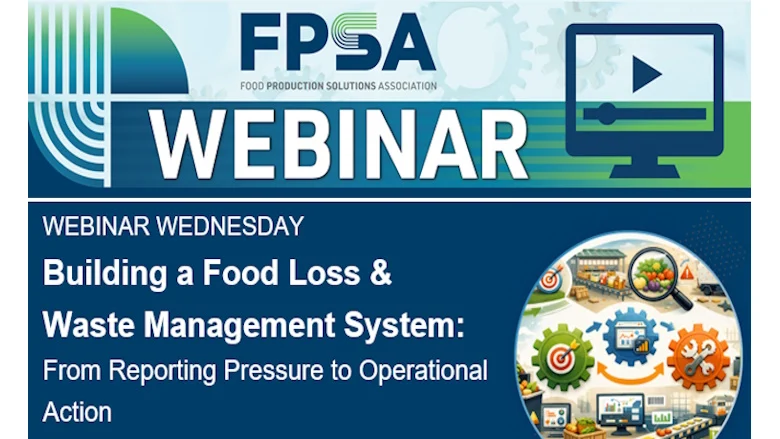
The global food supply chain is currently standing at a critical crossroads where environmental necessity, regulatory mandates, and economic survival converge. For decades, the issue of food loss and waste (FLW) was treated as an unfortunate but inevitable byproduct of industrial-scale production. However, as the world grapples with the dual pressures of a growing population and a shrinking ecological footprint, the "business as usual" approach to waste is no longer tenable. In this high-stakes environment, the Food Production Solutions Association (FPSA) has announced a pivotal webinar titled “Building a Food Loss & Waste Management System: From Reporting Pressure to Operational Action,” scheduled for April 8. This session aims to bridge the gap between the theoretical desire to be sustainable and the practical, day-to-day operational shifts required to eliminate waste at the source.
The scale of the challenge is staggering. According to data from the United Nations Food and Agriculture Organization (FAO), approximately one-third of all food produced for human consumption—roughly 1.3 billion tons—is lost or wasted globally each year. In the United States alone, the non-profit ReFED estimates that 38% of the food supply goes unsold or uneaten, representing a financial loss of $428 billion annually. For food manufacturers and processors, these numbers are not just environmental statistics; they represent lost margins, wasted energy, and inefficient labor. While many organizations have begun the journey of measuring their waste to satisfy stakeholders and regulatory bodies, the FPSA argues that measurement is merely the first step. The real challenge—and the focus of their upcoming webinar—is moving beyond the "what" of waste reporting to the "why" and "how" of operational mitigation.
The shift from passive reporting to active management is being driven by a perfect storm of external pressures. Regulatory bodies across the globe are tightening the noose on corporate transparency. In the European Union, the Corporate Sustainability Reporting Directive (CSRD) is setting a high bar for how companies disclose their environmental impact, including waste. In the United States, the Securities and Exchange Commission (SEC) and various state-level mandates, such as California’s landmark climate disclosure laws, are forcing companies to look deeper into their supply chains. Simultaneously, consumers are becoming increasingly sophisticated, demanding that the brands they support demonstrate tangible progress toward sustainability rather than just "greenwashed" marketing claims.
The FPSA webinar, designed to address these complexities, will move past the abstract theory of sustainability. Instead, it will focus on the mechanics of change. The central premise of the discussion is that waste is often a symptom of deeper operational inefficiencies—be it poor traceability, lack of data visibility, or a disconnect between cross-functional teams. When a batch of product is discarded, it is rarely due to a single isolated event; it is usually the result of a chain of failures in forecasting, procurement, processing, or logistics. By applying root cause analysis to waste, organizations can transform their "waste data" into "operational intelligence."
To lead this high-level discussion, the FPSA has assembled a panel of industry veterans who sit at the intersection of data, standards, and industry engagement.
Kristen Lee, the Director of Business Initiatives at ReFED, brings a wealth of data-driven expertise to the table. ReFED is widely considered the leading authority on food waste data in the United States, and Lee oversees the U.S. Food Waste Pact. This pact represents a pre-competitive collaboration where major food companies share data and best practices to accelerate progress toward the national goal of halving food waste by 2030. Lee’s background in corporate foodservice operations with giants like Aramark (on the Nike account) and Compass Group (on the Google Food Program) provides her with a unique "on-the-ground" perspective. She understands that while the data at the corporate level is important, the real battle against waste is won or lost in the kitchens, warehouses, and production lines.
Joining Lee is Ryan Lynch, the Practice Director for Sustainability at The British Standards Institute (BSI). Lynch represents the "standards" side of the equation. As companies face increasing pressure to report on Greenhouse Gas (GHG) emissions and conduct Life Cycle Assessments (LCAs), Lynch and his team provide the framework for doing so accurately and ethically. His work focuses on driving collective action to advance decarbonization and sustainable supply chains. In the context of the webinar, Lynch will likely address how a robust food waste management system serves as a cornerstone for broader climate risk adaptation and carbon reduction programs. For BSI, waste management isn’t just about the trash bin; it’s about the carbon footprint of every resource that went into producing that wasted food—water, fertilizer, fuel, and labor.
The discussion will be moderated by Bob Garrison, the Director of Industry Engagement for the Food & Beverage Manufacturing and Innovation Sector at BNP Media. Garrison is a titan of food industry journalism, having served as the Editor-in-Chief of Prepared Foods for over a decade. His deep institutional knowledge of the manufacturing sector allows him to bridge the gap between the sustainability experts and the plant managers who must implement these changes. Garrison’s perspective is grounded in the reality of the food and beverage industry, where margins are thin and operational uptime is king.
One of the key themes the webinar will explore is the role of traceability and technology in waste reduction. In the modern food plant, "dark data"—information that is collected but never analyzed—is a missed opportunity. Advanced traceability systems, powered by IoT sensors and AI-driven analytics, can now track a product’s journey through the facility with surgical precision. If a specific production line is consistently producing more scrap than others, or if a certain raw material supplier’s goods have a shorter shelf life, the data will reveal it. The webinar will delve into how organizations are using these insights to improve coordination between procurement, production, and sales teams, ensuring that what is produced matches what can be sold and delivered while still fresh.
Furthermore, the session will tackle the cultural shift required within an organization to manage waste effectively. Historically, waste was often seen as "someone else’s problem"—the sustainability officer’s concern or the facility manager’s headache. The FPSA panel will discuss how to foster cross-functional alignment, where every department from R&D to logistics understands their role in the waste management ecosystem. When the product development team designs packaging that extends shelf life, or when the logistics team optimizes cold chain routes to prevent spoilage, they are participating in a holistic food waste management system.
The financial incentive for this shift cannot be overstated. Beyond the moral and environmental imperatives, reducing food waste is one of the most effective ways to improve the bottom line. ReFED’s research indicates that for every dollar a company invests in food waste reduction, they realize a median return of $14 in cost savings. These savings come from reduced purchasing costs, lower waste disposal fees, and increased product yield. In an era of volatile commodity prices and rising labor costs, an efficient waste management system is a powerful competitive advantage.
The FPSA webinar on April 8 is positioned as an essential resource for industry professionals who are tired of the "reporting treadmill" and are looking for actionable strategies to drive real change. By focusing on root causes and operational integration, the session promises to provide a roadmap for transforming waste from a liability into an opportunity for innovation.
For those unable to attend the live session, the FPSA has confirmed that a recording will be made available to all registrants. This ensures that the insights from Lee, Lynch, and Garrison can reach a wide audience of stakeholders across the food supply chain. Registration is currently open through the FPSA event calendar, offering access to this and other educational resources designed to propel the food production industry into a more sustainable and efficient future. As the industry looks toward 2026 and beyond, the message is clear: the time for simple measurement has passed; the era of operational action has arrived.