

The global packaging industry is currently navigating a pivotal transition, moving away from the traditional "take-make-waste" linear model toward a sophisticated circular economy. At the heart of this transformation is the challenge of secondary packaging—the materials that bundle products together for transit and retail. As the industry prepares for interpack 2026, one of the world’s most influential trade fairs for processing and packaging, the spotlight is intensifying on solutions that bridge the gap between environmental responsibility and industrial performance. PakTech, a veteran in the design and manufacture of sustainable secondary packaging, has announced its return to the event, where it will showcase a portfolio centered on recycled High-Density Polyethylene (rHDPE) and the high-speed automation required to bring these materials to the global mass market.
Located at Hall 7A, Booth B02, PakTech’s showcase at interpack 2026 represents a strategic response to the dual pressures of regulatory compliance and operational efficiency. For brands operating in the beverage, food, health, and personal care sectors, the choice of secondary packaging is no longer just a logistical footnote; it is a critical component of their sustainability credentials and brand reputation. PakTech’s approach centers on the utilization of 100% post-consumer recycled (PCR) HDPE, a material that offers a compelling alternative to both virgin plastics and traditional paperboard carriers.
The argument for rHDPE is increasingly driven by hard data rather than aesthetic preference. In an era where "greenwashing" is a significant legal and reputational risk, PakTech is advocating for a data-driven approach to material selection. The company’s multipack handles are engineered to maintain structural integrity under the rigorous conditions of the modern supply chain. This is particularly relevant in the European market, where products often encounter high humidity and fluctuating temperatures during transit and storage. Unlike paperboard, which can lose its tensile strength when damp, rHDPE remains resilient. This durability directly translates to a reduction in product failure rates. When a multipack handle fails, the resulting damage—unsellable stock and wasted primary packaging—creates a significant environmental and financial burden. By ensuring that products reach the consumer in pristine condition, PakTech’s solutions safeguard the entire value chain.
Furthermore, the design philosophy behind these handles is one of "functional minimalism." By utilizing a low-profile, customizable design, PakTech allows the primary branding on cans and bottles to remain visible, ensuring that the consumer’s focus stays on the product itself. This design choice also minimizes the total volume of material used, aligning with the "reduce" pillar of the circular economy while simultaneously lowering shipping weights and associated fuel costs.
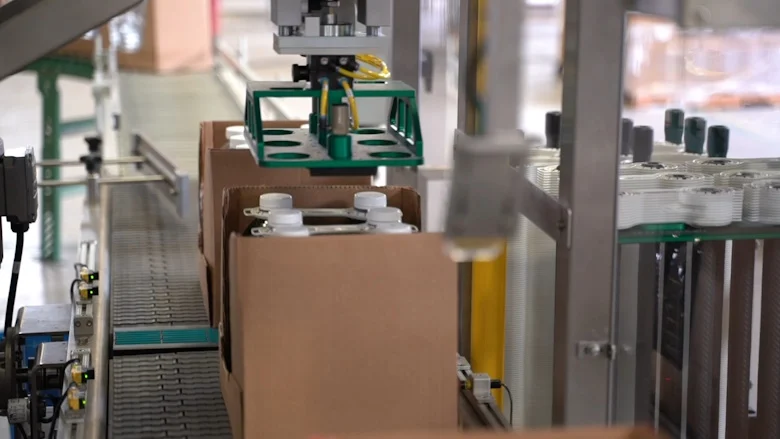
The transition to sustainable materials is only viable for large-scale manufacturers if it can be integrated seamlessly into existing production lines. To address this, PakTech’s presence at interpack will highlight its advanced application machinery, including the CCA 120/180 and the MicroPak can-carrier applicators. These systems are designed to handle the high-speed requirements of modern bottling and canning facilities. The CCA 120/180, for instance, is a CE-certified powerhouse capable of processing up to 120 6Pak or 180 QuadPak units per minute. This level of automation ensures that the switch to recycled materials does not result in a production bottleneck. These machines are also highly adaptable, allowing co-packers and brand owners to customize the setup to meet specific facility footprints and output goals.
The environmental impact of PakTech’s circular model is supported by staggering metrics. Since 2020, the company has successfully repurposed over one billion gallon-sized milk jugs into high-performance packaging handles. This represents more than 160 million pounds (approximately 72.5 million kilograms) of plastic that has been diverted from landfills and prevented from entering marine ecosystems. The lifecycle of these products is a closed loop: the handles are made from 100% recycled content and are themselves 100% recyclable, allowing the plastic to remain in the economy and out of the environment indefinitely.
Crucially, PakTech leverages Life Cycle Assessment (LCA) data to prove the superiority of rHDPE over alternative materials. While paperboard is often perceived by consumers as the more "natural" choice, LCA data reveals that rHDPE can have a carbon footprint two to five times lower than that of paperboard carriers and cartons. This is due to the energy-intensive nature of paper production, which requires significant water usage and chemical processing, as well as the heavier weight of some cardboard solutions which increases transport emissions. By providing a material that is both recycled and low-impact, PakTech offers a strategic pathway for brands to meet their Scope 3 emissions targets.
The timing of these innovations is critical as the European regulatory landscape shifts. The EU’s Packaging and Packaging Waste Regulation (PPWR) is setting the stage for a new era of accountability. The regulation mandates ambitious recycled content targets for 2030, effectively making the use of PCR materials a legal requirement for doing business in the European Union. Keenan Hoar-Perez, PakTech’s International Sales Manager, emphasizes that the company’s mission at interpack 2026 is to demonstrate how brands can meet these mandates without sacrificing speed or reliability. The goal is to show that circularity and operational excellence are not mutually exclusive, but rather two sides of the same coin.
PakTech’s influence extends far beyond its headquarters in Eugene, Oregon. With over 30 years of experience, the company has established a robust global infrastructure to support its international clientele. This includes manufacturing and warehouse operations in Australia and a strategic distribution hub in the Netherlands, which serves as the gateway for its European operations. Currently, PakTech services customers across 13 European countries, providing localized support and a reliable supply chain that mirrors the durability of the products themselves.
As the industry looks toward the 2026 exhibition in Dusseldorf, the conversation is moving beyond simple recyclability toward "total circularity." This involves looking at the entire life of the package—from the post-consumer waste used as raw material to the energy used in the application process and the eventual recovery of the material for a new life. PakTech’s integrated approach, combining material science with high-speed engineering, positions it as a key architect of this future.
Visitors to the PakTech booth at interpack will not only see the hardware and the handles but will also have access to the company’s technical experts who can provide tailored advice on transitioning to rHDPE. Whether a craft brewery looking for its first automated applicator or a global CPG giant seeking to overhaul its secondary packaging across multiple continents, the solutions on display are designed to be scalable and impactful.
In conclusion, the path to a sustainable future in packaging is paved with innovation, data, and a commitment to durability. By reclaiming plastic waste and transforming it into a high-performance tool for the modern supply chain, PakTech is proving that plastic, when managed correctly within a circular system, remains one of the most efficient and environmentally sound materials available. As interpack 2026 approaches, the message from PakTech is clear: the technology exists to protect both the product and the planet simultaneously, and the time to implement these solutions is now. Through the combination of 100% rHDPE handles and precision-engineered application systems, the packaging industry can finally close the loop on plastic waste while maintaining the high-speed efficiency that the global economy demands.