
The global beverage industry, long beholden to the heavy, energy-intensive legacy of glass, is facing a seismic shift in manufacturing capabilities. Frugalpac, the British sustainable packaging pioneer, has officially launched the Frugal Bottle Assembly Machine 2 (FBAM-2), a high-speed technological powerhouse designed to transition the world away from traditional viticulture and spirits packaging. This launch represents more than just a new piece of machinery; it is an infrastructure-grade solution intended to decentralize the production of paper-based bottles, making the transition to eco-friendly packaging economically viable for global enterprises.
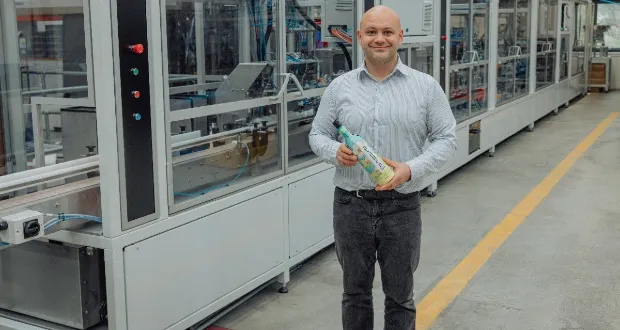
At the heart of this innovation is the FBAM-2’s sheer industrial capacity. Capable of churning out an impressive 14 million units annually, the machine is engineered to be installed directly within bottling plants and existing packaging facilities. By placing the manufacturing capability at the point of filling, Frugalpac is effectively dismantling the inefficiencies of the traditional supply chain. Currently, beverage manufacturers often face the high costs and significant carbon footprint associated with shipping empty glass bottles from distant manufacturers to filling lines. The FBAM-2 solves this by enabling “distributed manufacturing,” where the bottle is born exactly where it is destined to be filled.
The economic and environmental implications are substantial. The Frugal Bottle—composed of 94% recycled paperboard with a food-grade pouch—is now 30% more affordable than previous iterations of the paper bottle design. From a climate perspective, the math is compelling: each Frugal Bottle saves 348g of CO2e compared to a standard glass alternative. In an era where corporate sustainability mandates are becoming as critical as profit margins, this reduction is a powerful tool for brands aiming to reach net-zero targets.
The modular design of the FBAM-2 is one of its most critical technical achievements. Recognizing that the needs of a boutique distillery differ vastly from those of a multinational wine conglomerate, Frugalpac has developed multi-lane configurations. This flexibility allows facilities to scale production up or down based on seasonal demand or specific product runs. Whether the liquid inside is a premium spirit, a vintage wine, an artisanal oil, or a ready-to-drink (RTD) cocktail, the FBAM-2 is built to accommodate diverse liquid profiles with maximum uptime and minimal changeover friction.
Early adopters have already begun integrating this technology into their operations, signaling a growing appetite for alternatives to glass. Notable partners, including the Monterey Wine Company in the United States and KinsBrae Packaging in Canada, are currently leveraging the FBAM-2 to bring bottle assembly in-house. These partnerships are critical, as they serve as proof-of-concept for the broader industry, demonstrating that high-speed paper bottle manufacturing is not just a laboratory experiment, but a reliable, plug-and-play reality for large-scale operations.
J.P. Grogan, the Product Director at Frugalpac, views the FBAM-2 as the catalyst for a mass-market evolution. “The FBAM-2 is the industrial rollout the mass market has been waiting for,” Grogan stated. “We have engineered it for maximum uptime and modular flexibility, allowing it to handle everything from spirits and wine to oils and ready-to-drink cocktails. The technology is ready; the era of heavy glass is over.” His sentiment underscores a growing impatience with the status quo. For decades, glass has been the default vessel for alcohol, prized for its aesthetics and tradition. However, its environmental cost—high transport weight, massive energy consumption during the melting process, and a complex recycling landscape—has made it an increasingly difficult asset to justify in a modern, climate-conscious economy.
Malcolm Waugh, CEO of Frugalpac, echoed these sentiments, framing the shift in packaging as a fundamental shift in business ethics. “For decades, glass has been the default for wine and spirits. But it’s heavy, energy-intensive and increasingly expensive to use and recycle,” Waugh explained. “What’s changed is that packaging is no longer just a design choice; it’s a climate decision. Glass is no longer neutral.”
Waugh’s assertion that “glass is no longer neutral” strikes at the core of the sustainability debate. Every ton of glass produced requires significant fossil fuel usage, and every mile a glass bottle travels adds exponentially to its carbon footprint due to its weight. By contrast, the Frugal Bottle is significantly lighter, which drastically lowers fuel consumption during shipping. Furthermore, because the inner pouch is easily separated from the paper outer shell, the components are designed to be easily recycled, creating a circular economy that traditional glass bottles struggle to match in terms of ease and efficiency.
The FBAM-2 launch is designed to lower the barrier to entry for beverage brands that have been hesitant to switch materials. Historically, companies were wary of paper-based packaging, fearing potential leaks, shelf-life issues, or high implementation costs. The FBAM-2 mitigates these concerns by providing a standardized, robust, and repeatable manufacturing process that ensures consistent quality control. By decentralizing production, Frugalpac is also helping companies reduce their supply chain risk. If a global shipping route is disrupted or energy prices spike in a particular region, a localized bottling facility can continue to operate with a steady supply of local paperboard, rather than waiting for imported glass containers.
As the industry moves forward, the focus is shifting from simple recycling to source reduction. The FBAM-2 is a tool for source reduction on a grand scale. By minimizing the weight of the packaging and eliminating the need for long-distance transport of empty containers, Frugalpac is providing the infrastructure for a more resilient beverage industry. The company is positioning itself as the leader of a “lighter, lower-cost” future, where the packaging is as innovative as the drink inside.
The implications for retailers and consumers are equally profound. On a retail shelf, a lighter bottle translates to easier handling and potentially lower shipping costs passed down the chain. For the consumer, the Frugal Bottle offers a tactile, lightweight experience that maintains the integrity of the beverage while aligning with personal values regarding sustainability.
In conclusion, Frugalpac’s FBAM-2 is a definitive move toward the industrialization of sustainable packaging. By combining high-speed output, modular flexibility, and a drastically reduced carbon footprint, the company is challenging the beverage industry to move away from the heavy, energy-intensive reliance on glass. With partners in North America already scaling production, the trajectory is clear: the industry is being equipped with the tools necessary to make a permanent transition. The technology has matured, the costs have been optimized, and the environmental urgency has never been higher. As Malcolm Waugh summarized, “The opportunity is clear. The technology is ready. The future of packaging is lighter and of a lower cost and the industry now has the tools to get there.” The era of the heavy glass bottle is not just being challenged; it is being systematically dismantled in favor of a future that is leaner, cleaner, and built for the realities of a changing world.