

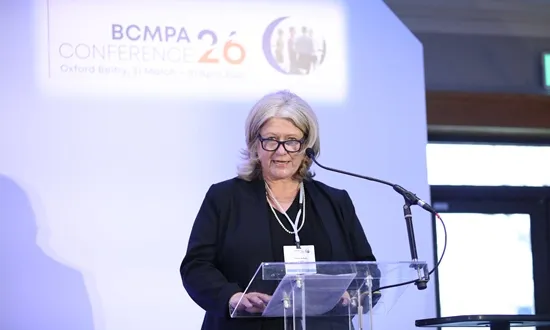
The recent BCMPA (British Contract Manufacturers and Packers Association) conference, hosted at the Oxford Belfry, served as a critical nexus for the contract manufacturing, packing, fulfilment, and logistics sectors. As the industry grapples with a volatile global economy and rapid legislative shifts, the event provided a comprehensive forum for delegates to explore how digital transformation, robust cybersecurity, and circular economy mandates can be leveraged to ensure long-term resilience and growth.
The Economic Horizon: Caution and Opportunity
The keynote session set a sober but strategic tone, featuring Professor Trevor Williams, former Chief Economist for Lloyds Bank. Williams provided a deep dive into the current geopolitical climate, specifically focusing on how the ongoing conflict in the Middle East has disrupted global supply chains and forced a hasty revision of growth forecasts. He emphasized that the volatility witnessed today is not a transitory blip but a long-term structural reality that UK firms must prepare for.
However, Williams challenged the narrative of decline, arguing that the antidote to economic stagnation is aggressive digitalisation. He debunked the common misconception that automation and digital integration lead to job losses, asserting instead that these technologies act as multipliers for national wealth and individual income. This sentiment was bolstered by Professor Mike Wilson, Chief Automation Officer at the MTC (Manufacturing Technology Centre). Wilson provided a practical roadmap for manufacturers, explaining that robotic automation should not be viewed as a replacement for human labour, but as a sophisticated toolset that empowers staff to work more efficiently, safely, and creatively.
The Cyber Frontier
In an era where data is the lifeblood of logistics and supply chain management, the threat landscape has expanded exponentially. Victoria Speight, Founder of Cyberfit, delivered a stark warning to delegates: the digital perimeter is under constant assault. With approximately 23,506 malicious cyber-attacks targeting UK organisations every single day, businesses can no longer afford to treat cybersecurity as an "IT issue." Speight urged leadership teams to integrate robust, proactive cyber-defence procedures into their operational DNA to protect their intellectual property and client data from increasingly sophisticated bad actors.
The EPR Revolution: Sustainability as a Legislative Mandate
A significant portion of the conference was dedicated to the seismic shifts in environmental legislation, specifically the Extended Producer Responsibility (EPR) scheme. Esther Carter, Chief Strategy Officer at PackUK, outlined the fiscal magnitude of these changes, noting that initial payments across the UK’s four nations have reached a staggering £1.4 billion.
The objective of the EPR is clear: to incentivise the removal of unrecyclable packaging from the supply chain through a system of modulated fees. If successful, these reforms have the potential to drive national recycling rates from their current levels to between 64% and 84%. Louisa Goodfellow, a policy manager at Ecosurety, addressed the anxiety surrounding these changes, advising that while market confusion is understandable, the key to compliance lies in mastering the technical nuances of the scheme.
The conversation regarding packaging extended to the consumer experience, with Jude Allan, managing director of OPRL, discussing the vital role of on-pack labelling. While the industry is eager for clarity, Allan noted that the UK government’s plans for mandatory, standardised labelling are currently in a state of flux as the UK considers aligning its standards with emerging EU proposals. This ongoing regulatory dialogue highlights the necessity for contract packers to remain agile as they navigate the intersection of environmental policy and international trade.
Operational Excellence and Talent Retention
While the macro-economic and legislative sessions provided the "big picture," the afternoon breakout sessions were designed to offer tactical, ground-level solutions for operational success.
Stefan Casey, Commercial & Innovation Director at Celeritas Solutions, provided a compelling case for the essential role of co-packers in the modern supply chain. He argued that by absorbing risk and providing flexible, scalable infrastructure, co-packers enable brand owners to focus on market growth rather than operational bottlenecks.
A recurring theme throughout the day was the human element of business. Jamie Tinsley, CEO of Touchstone, delivered a high-energy presentation on the psychology of transformation, focusing on how leaders can engage their teams during periods of structural change. This was complemented by a collaborative session between James Coull of Wallace Hind and Vicki Fitzpatrick of The Wellbeing Focus. Together, they explored the intersection of employee retention and talent inspiration, arguing that in a tight labour market, the companies that thrive will be those that foster environments prioritising professional development and mental wellbeing.
Technological implementation was further examined through a panel discussion moderated by Josephine Coombe, Chief Commercial Officer at Nulogy, and a practical guide by Wayne Kedward, managing director of Autopack. Kedward offered an honest assessment of machinery procurement, outlining the common pitfalls businesses face when upgrading their facilities—most notably the failure to properly map software integration with physical hardware before investment.
Energy management rounded out the operational sessions, with Paul Gregory, Group Commercial Director at HSEnergy Group, providing a timely masterclass on investing in renewables. As energy prices remain a significant variable in manufacturing costs, Gregory’s insights into navigating the energy market provided delegates with a clear strategy for reducing long-term carbon footprints and energy overheads simultaneously.
A Call for Collective Resilience
Reflecting on the event, Emma Verkaik, Chief Executive of the BCMPA, expressed her optimism regarding the industry’s trajectory. "While our conference highlighted the complex array of challenges that lie ahead—from the macroeconomic environment to the intricacies of EPR compliance—it also reaffirmed that our members possess the innovative thinking and the practical solutions required to navigate these hurdles," she stated.
Verkaik emphasised that the strength of the BCMPA lies in its collaborative culture. "The more dialogue we facilitate within our industry, the stronger and more resilient we become," she noted. "It was deeply encouraging to see so many delegates actively engaging with our speakers and each other. By flagging these critical subjects, we are ensuring that our members are not just spectators to the future of the contract manufacturing and packing industry, but active participants in shaping it."
As the event drew to a close, the consensus among attendees was clear: while the external landscape is becoming increasingly difficult to navigate, the combination of technological adoption, strategic investment in people, and proactive engagement with sustainability mandates provides a clear path forward. The BCMPA conference served as a vital reminder that in a rapidly changing world, industry collaboration is the most effective tool for transforming uncertainty into a competitive advantage.