
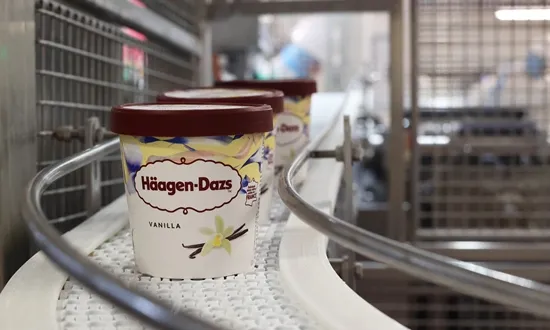
Häagen-Dazs is fundamentally reshaping its operational strategy to align with the ambitious sustainability targets of its parent company, General Mills, as it pushes toward a net-zero future. Since its inception in 1960, the premium ice cream brand has become a global household name, anchored by its massive production hub in Arras, France. Operating in the Hauts-de-France region since 1992, this facility serves as the nerve center for the brand’s global footprint, employing over 500 staff and churning out 75 million liters of ice cream annually for distribution across more than 90 countries. As the brand scales its production capacity, it is simultaneously embarking on a comprehensive transformation of its packaging and supply chain, proving that mass production and environmental stewardship can be mutually inclusive.
Engineering Sustainability: The "Recyclability by Design" Mandate
At the heart of the brand’s environmental strategy is a commitment to "recyclability by design." By 2030, General Mills aims for 100% of its global packaging to be fully recyclable or reusable. Achieving this requires more than just swapping out materials; it necessitates a deep-dive engineering approach that considers the entire lifecycle of a product, from the moment it leaves the Arras facility to its eventual arrival at a regional sorting center.
Frederic Chapuis, the global packaging sustainability leader at General Mills, emphasizes that the brand’s strategy is informed by rigorous design guidelines and the reality of local recycling infrastructures. "When designing for recyclability, we leverage existing design-for-recycling guidelines and consider the local collection and recycling capabilities," Chapuis explains. A prime example of this technical evolution is the brand’s shift away from black pigments in its lids. Because standard automatic optical sorting machines struggle to detect black plastic, this simple color change significantly improves the likelihood that the lids will be captured and recycled rather than discarded as waste.
Furthermore, the brand has successfully addressed the complex challenge of lidding membranes. Traditionally, these thin, protective seals were composed of multi-material laminates that are nearly impossible to separate during the recycling process. By transitioning to a PE-based (polyethylene) structure, the brand has ensured that these essential components are now fully compatible with modern recycling streams.
Decoupling Convenience from Plastic Waste
A significant portion of the brand’s sustainability progress is visible to the consumer. For years, the convenience of the mini-cup multipack was tethered to the inclusion of single-use plastic spoons. Recognizing that this created an unnecessary burden of non-recyclable waste, Häagen-Dazs took the decisive step of removing these spoons from all multipack configurations.
This move alone is expected to eliminate 126 tons of plastic waste annually. For those who still require a utensil, the brand has replaced the plastic spoons in individual mini-cups with sustainable wooden alternatives. "Removing spoons from every multipack will save 126 tons of plastic every year," Chapuis notes. "This is an ongoing process, and we’re working hard to reduce the environmental impact of our ice cream even further. With 100% of our packaging designed to be recyclable or reusable, this means 1,700 tons less going to the environment annually on a global scale."
The brand is also moving toward mono-material films, which simplify the recycling process by ensuring that packaging does not consist of layers of disparate materials that must be chemically or mechanically separated. While Chapuis acknowledges that recycling capabilities remain inconsistent across different UK local authorities, the brand’s design philosophy ensures that their packaging is theoretically capable of being processed in any modern recycling facility.
Regenerative Agriculture and Localized Sourcing
Packaging is only one piece of the puzzle. Häagen-Dazs is also addressing the carbon-intensive nature of dairy production, which historically represents the largest share of the brand’s environmental footprint. To mitigate this, the company has prioritized hyper-local sourcing, procuring dairy from farmers situated near the Arras production facility to drastically reduce the emissions associated with logistics and transportation.
Beyond logistics, the brand is actively investing in the health of the land itself. Through a strategic pilot program with the dairy cooperative Prospérité Fermière Ingredia, Häagen-Dazs is providing the resources and support necessary for dairy farmers to transition toward regenerative agriculture. This farming model focuses on restoring soil health, increasing biodiversity, and sequestering carbon—a critical departure from traditional, extractive farming methods.
Currently, 58 dairy farms are integrated into this decarbonization initiative. The goal is ambitious: to achieve a 30% reduction in carbon emissions by 2030. To further enhance ecosystem resilience, the program includes agroforestry efforts, such as the planting of 5,000 trees, which help to balance the local carbon cycle and improve water retention in the soil. Furthermore, the Arras plant is working toward a "zero waste to landfill" status, ensuring that every facet of the manufacturing process is optimized for efficiency.
Innovation as a Cultural Staple
The brand’s commitment to sustainability is bolstered by a culture of internal innovation. While the production designs are often outsourced, Häagen-Dazs maintains a dedicated in-house design team tasked with continuous experimentation. This team bridges the gap between aesthetic appeal and technical feasibility, conducting exhaustive consumer research on everything from "ease of opening" to the overall usability of new, more sustainable formats.
"We constantly have new projects in the pipeline to improve the design, convenience, and environmental impact of our packaging," says Chapuis. By balancing consumer expectations for the premium "Häagen-Dazs experience" with the urgent need for radical environmental change, the company is demonstrating that brand identity need not be sacrificed for sustainability.
Ultimately, the transition toward a net-zero future is an iterative process. It requires a marriage of high-tech material science, such as the development of mono-material films, and old-fashioned agricultural wisdom, such as regenerative soil management. As the company continues to refine its packaging and production, it sets a benchmark for how global FMCG (fast-moving consumer goods) brands can reconcile large-scale manufacturing with the realities of a planet under pressure. The next time a consumer peels back the lid of a mini-cup, they are participating in a global supply chain transformation—one that is lighter on the earth, yet remains true to the premium heritage that has defined the brand for over six decades. Through these deliberate steps, Häagen-Dazs is proving that the future of indulgence lies in the responsible stewardship of the resources that make it possible.