
In the contemporary landscape of high-stakes B2B marketing, the era of the generic, "one-size-fits-all" promotional item is rapidly drawing to a close. For global organizations whose missions carry significant weight, a flimsy, off-the-shelf tote bag is more than just a missed opportunity—it is a brand misalignment. When Theirworld, a prominent global children’s charity committed to ending the global education crisis, required a physical touchpoint for their stakeholders, they did not seek a simple logo-printed shopper. Instead, they required a sophisticated, highly engineered textile solution that mirrored the precision and professionalism of their advocacy work. To bring this vision to life, they partnered with The Bag Workshop, a premier UK-based OEM (Original Equipment Manufacturer) and a core division of The Wurlin Group, to develop a set of specification-heavy, custom-dyed A4 bags that redefined the standards of bespoke merchandise.
The challenge presented by Theirworld was multifaceted. They required a product that was structurally sound enough to house heavy documents and digital devices, aesthetically vibrant enough to match their unique brand palette, and durable enough to serve as a long-term asset rather than a disposable giveaway. This case study delves into the technical journey of moving beyond the limitations of wholesale stock to create a high-performance textile product through meticulous material engineering and design.
The Shift from Procurement to Engineering
The philosophy at The Bag Workshop is built on the premise that a bag is not just a carrier but an engineered tool for brand communication. Most promotional suppliers operate on a "print-on-stock" model, where a pre-made bag is pulled from a warehouse and a logo is applied via screen printing. This model is fraught with limitations: the colors are restricted to factory standards, the dimensions are unalterable, and the structural integrity is often sacrificed for cost-efficiency.
For the Theirworld project, The Bag Workshop bypassed these constraints by adopting a true OEM approach. This meant starting at the fiber level. Every element—from the Pantone-matched cotton to the specific weave of the handles—was specified before a single stitch was sewn. The goal was to produce an A4 bag that could comfortably accommodate journals, laptops, and reports without the distortion of shape that plagues standard flat totes.
Phase 1: Architectural Integrity and the 3D Footprint
The primary functional requirement was the "A4" designation. In the world of textiles, "A4" often simply refers to the surface area of the bag. However, a flat, two-dimensional bag becomes functionally useless once you insert a three-dimensional object like a laptop or a thick stack of documents; the fabric stretches, the corners dog-ear the papers, and the bag loses its professional silhouette.
To solve this, The Bag Workshop’s design team moved away from the traditional 2D "pillowcase" construction. Instead, they engineered a structured bag featuring integrated side panels and a full-bottom gusset. This three-dimensional architecture creates a rectangular footprint, allowing the bag to stand upright when filled and ensuring that the internal volume is optimized for its contents. By creating a custom template rather than utilizing a stock mold, the team ensured the bag’s dimensions provided ample clearance for A4 materials, maintaining the crispness of the documents housed within.
Phase 2: The Science of Custom Dyeing and Color Fidelity
Color is the most immediate communicator of brand identity. For an organization like Theirworld, their specific shades of pink and green are non-negotiable assets. Standard wholesale bags typically come in a limited "Big Six" color range: navy, black, red, royal blue, white, and natural. Attempting to force a vibrant, modern brand into these antiquated options results in a diluted brand presence.
The Bag Workshop utilized a sophisticated custom-dyeing process to achieve 100% color fidelity. Unlike digital printing, where ink sits on top of the fabric and can crack or peel, vat dyeing involves immersing the raw cotton fibers into a custom-mixed pigment solution. This process ensures that the color is "locked" into the core of the fiber. This not only results in a more vibrant, saturated hue but also maintains the soft, premium "hand-feel" of the cotton. Every yard of fabric used in the Theirworld project was matched against specific Pantone references, ensuring that the final product was an exact extension of their digital and print branding.
Phase 3: Executing the Dual Personality Colorways
The project was split into two distinct aesthetic directions, each requiring its own unique set of technical specifications and quality control protocols.
Colorway A: The High-Contrast Statement
The first design was a masterclass in bold, high-contrast aesthetics. Utilizing a vibrant pink base, the bag featured contrasting stitching that highlighted the architectural lines of the gussets. The most striking feature was the heavy-duty cotton webbing handles in a contrasting shade. This was not merely an aesthetic choice; the contrast served to draw the eye to the bag’s structure, signaling that this was a bespoke, high-end item rather than a mass-produced giveaway.
Colorway B: The Tonal Sophisticate
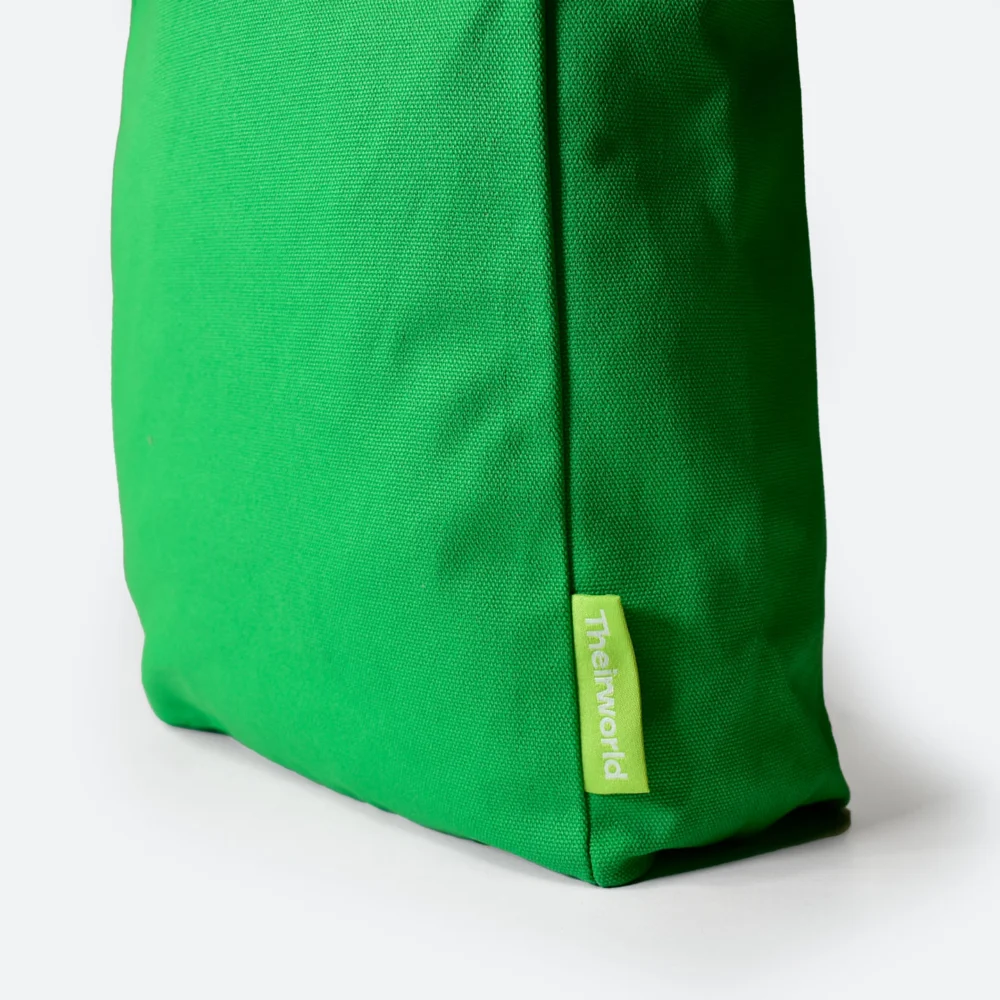
The second design focused on a "tonal" or monochromatic approach using Theirworld’s signature green. Here, the goal was harmony and depth. By using varying textures of the same color—the smooth cotton of the bag body against the ribbed texture of the webbing handles—the team created a product that felt professional, understated, and sophisticated.
In both colorways, the branding was further elevated through the use of bespoke woven labels. Unlike printed labels that can fade, woven labels are created on a loom, weaving the logo directly into the fabric of the tag. This detail is a hallmark of luxury manufacturing, providing a tactile reminder of the bag’s quality every time the user reaches for it.
Phase 4: Component Engineering—Handles and Reinforcements
A bag is only as strong as its weakest point, which is almost always the handle attachment. For the Theirworld project, "self-fabric" handles—made from the same thin cotton as the bag—were rejected as being too flimsy. Instead, the team specified heavy-duty cotton webbing.
Cotton webbing is a specialized woven tape that offers superior tensile strength and ergonomic comfort. Because it is thicker and has a slight "give," it does not cut into the wearer’s shoulder even when the bag is loaded with heavy documents. Furthermore, these handles were "X-stitched" into the reinforced headers of the bag, a technical sewing pattern that distributes weight across a larger surface area, preventing the fabric from tearing under stress.
The Role of White Label Expertise and Global Sourcing
As a premier white label bag supplier, The Bag Workshop provides a critical service to creative agencies and high-level consultants. "White label" manufacturing means the goods are produced to the highest standards without the manufacturer’s own branding, allowing the client’s brand to take center stage.
To achieve the "incredible attention to detail" required for the Theirworld gussets, The Bag Workshop leveraged its audited global supply chain. Standard manufacturing often results in "bunched" or messy stitching at the corners of a 3D bag. By implementing a rigorous quality control gate at their partner facility, The Bag Workshop ensured that every corner was sharp and every seam was straight. This level of precision is what differentiates a "luxury" manufacturer from a "merchandise" supplier.
Conclusion: The Value of Longevity
The collaboration between Theirworld and The Bag Workshop resulted in a product range that serves as a benchmark for what promotional textiles can achieve. By investing in custom-dyed cotton, 3D structural design, and high-performance components, Theirworld moved away from the "disposable" culture of marketing.
The success metrics for this project were not just about delivery dates, but about brand resonance. The bags have become a coveted item for stakeholders, serving as a functional, daily-use tool that keeps the Theirworld mission visible in professional environments worldwide.
In a market saturated with cheap, short-lived items, the decision to engineer a bespoke solution is a statement of intent. It suggests that the organization values quality, precision, and sustainability. For The Wurlin Group and The Bag Workshop, the Theirworld project was an opportunity to demonstrate that when you move beyond the catalog and into the world of bespoke manufacturing, the only limit is the vision of the brand. Whether it is through complex Pantone matching, organic material sourcing, or intricate structural engineering, the path to a premium brand touchpoint begins with a partner who understands that a bag is never "just a bag."