
In the contemporary landscape of high-stakes B2B marketing and non-profit advocacy, the physical artifacts a brand leaves behind are more than mere souvenirs; they are tangible representations of an organization’s values, attention to detail, and commitment to quality. For Theirworld—a global children’s charity committed to ending the global education crisis and ensuring every child has the best start in life—a standard, off-the-shelf promotional product was never going to suffice. To reflect their mission of unlocking big change, they required a physical touchpoint that felt substantial, professional, and meticulously crafted. They sought a partnership with The Bag Workshop, a specialized arm of The Wurlin Group, to move beyond the limitations of generic merchandise and into the realm of high-specification, luxury OEM (Original Equipment Manufacturer) textile engineering.
The challenge was to create a set of bespoke A4 bags that could function as durable, daily-use tools for stakeholders, donors, and activists. This project was not merely about printing a logo on a pre-existing canvas; it was an exercise in ground-up manufacturing, involving precise Pantone color matching, complex structural design, and the integration of high-end hardware and labeling. As a premier UK-based manufacturer, The Bag Workshop leveraged its deep technical expertise to manage a project that prioritized longevity over disposability.
The Philosophy of Bespoke OEM Manufacturing vs. Stock Procurement
The primary distinction in this project lies in the choice of the OEM route over the traditional wholesale "stock" route. Most promotional bags found at conferences are "stock" items—pre-made in massive quantities in a handful of basic colors like navy, black, or natural. Branding on these items is restricted to a small "print area" on the center of the bag.
For Theirworld, this "one size fits all" approach was rejected in favor of a bespoke solution. Being an OEM manufacturer means The Bag Workshop controls the entire supply chain, starting with the raw, undyed cotton. This allows for total creative freedom: the dimensions can be altered to the millimeter, the fabric weight can be specified for durability, and every seam can be reinforced according to the anticipated load. By choosing a bespoke path, Theirworld ensured that their merchandise was an exact extension of their visual identity, rather than a compromised version of it.
Phase 1: The Engineering of Structural Integrity
The "A4" designation of these bags was a functional mandate, not just a size suggestion. In the world of NGOs and corporate advocacy, the ability to carry journals, policy reports, and tablets without damaging the contents is paramount. A standard "flat" tote bag—essentially two sheets of fabric sewn together—fails when tasked with carrying three-dimensional objects. When a flat bag is filled, the fabric pulls tight across the center, distorting the shape and often "dog-earing" the corners of important documents.
To solve this, The Bag Workshop’s design team implemented a three-dimensional architecture featuring side panels and a full gusset. This construction creates a rectangular footprint, allowing the bag to stand upright when placed on a surface and providing a consistent internal volume. By moving away from 2D patterns, the team engineered a bag that maintains its aesthetic silhouette even when fully loaded with heavy reports or electronic devices. This structural choice elevated the item from a "shopper" to a "professional carrier."
Phase 2: Material Science and the Precision of Custom Dyeing
The most visually striking aspect of the Theirworld project was the color fidelity. Theirworld’s branding utilizes a vibrant, specific palette that communicates energy and urgency. Standard factory colors in the wholesale market are often muted or generic, which can dilute a brand’s impact.
The Bag Workshop utilized a sophisticated custom-dyeing process to achieve the exact Pantone references required. Unlike surface printing, where ink is layered onto a finished bag, custom dyeing involves treating the raw cotton fabric in a dye bath before the bag is even cut. This ensures the pigment penetrates deep into the fibers, resulting in a rich, saturated color that will not fade, crack, or peel over time. This process also maintains the soft, organic "hand-feel" of the high-grade cotton, ensuring the bag feels like a luxury textile rather than a plasticized promotional item.
Phase 3: A Tale of Two Colourways
The project was divided into two distinct aesthetic directions, each requiring its own set of technical specifications and quality control protocols.
The High-Contrast Pink Colourway
The first design was a bold exercise in maximalist branding. Utilizing a vibrant pink base, the design team opted for high-contrast elements to make the bag pop in a crowded professional environment. This version featured heavy-duty cotton webbing handles in a contrasting hue, providing both visual interest and exceptional tensile strength. The inclusion of contrast stitching along the gusset seams served a dual purpose: it highlighted the precision of the construction while reinforcing the bag’s structural "skeleton."
The Tonal Green Colourway
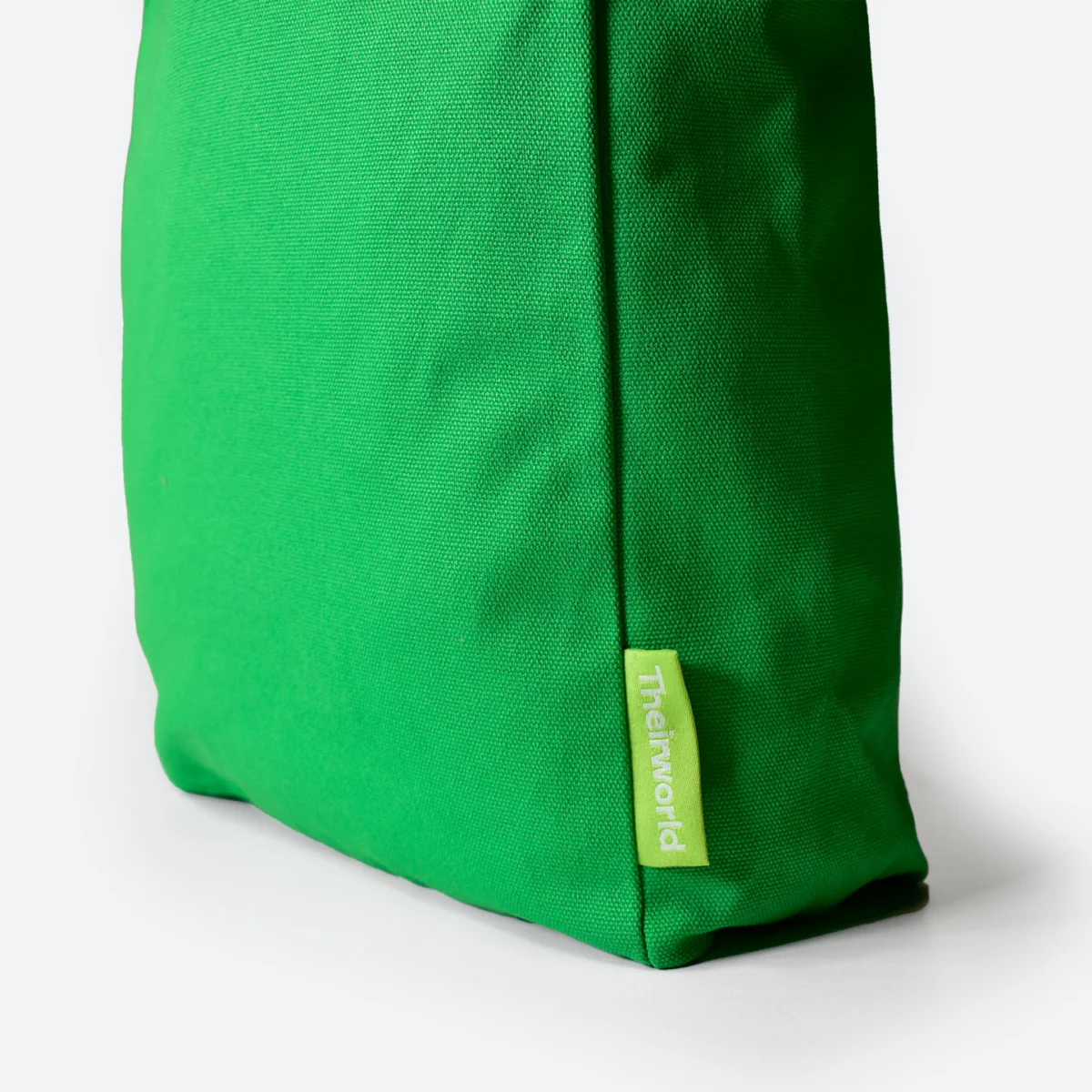
The second design focused on a more sophisticated, monochromatic depth. By using varying shades of green for the body, handles, and stitching, the team created a product that felt harmonious and understated yet clearly premium. This tonal approach is often more difficult to execute than high-contrast designs, as it requires perfect synchronization between the dye lots of the cotton body and the woven webbing of the handles.
Phase 4: The Art of the Finish – Labels and Webbing
In luxury manufacturing, the "finish" is what separates a product from a commodity. For the Theirworld bags, The Bag Workshop integrated bespoke woven labels rather than simple printed tags. These labels were sewn into the side seams, providing a "white label" professional finish that mimics high-end retail fashion.
Furthermore, the choice of handle material was critical. While many manufacturers use "self-fabric" handles (strips of the same bag material folded over), The Bag Workshop utilized heavy-duty cotton webbing. Webbing is a specialized woven tape that offers significantly higher durability and comfort. It does not "rope" or dig into the shoulder when the bag is heavy, and it retains its flat, crisp appearance over hundreds of uses. This choice directly contributes to the "longevity metric"—ensuring the bag remains in use for years rather than being discarded after a single event.
White Label Excellence and Global Coordination
As a trusted partner for agencies, The Bag Workshop operates with a "White Label" philosophy. This means that while the technical heavy lifting and manufacturing are handled by The Wurlin Group, the final product belongs entirely to the client’s brand ecosystem. For agencies representing major organizations like Theirworld, this seamless integration is vital.
The production management phase involved rigorous quality assurance. Standard mass-produced bags often suffer from "bunched" stitching at the corners of the gussets, where multiple layers of fabric meet. The Bag Workshop implemented specific QC gates to ensure that every corner was sharp and every line of stitching was straight. By leveraging a global network of partner factories that specialize in high-detail textile work, the project moved from concept to international distribution with clinical precision.
The Result: A Tangible Asset for Global Change
The collaboration between Theirworld and The Bag Workshop resulted in more than just a promotional item; it produced a brand asset. The final A4 bags serve as a masterclass in how bespoke manufacturing can solve the "disposability crisis" in the marketing industry. By investing in custom-dyed fabrics, reinforced structural designs, and premium hardware, Theirworld received a product that their audience values and retains.
The success of the project is measured not just in the aesthetic beauty of the bags, but in their utility. Stakeholders now have a dedicated, branded vessel for their work that reflects the high standards of the organization they support. This project cements The Bag Workshop’s reputation as the premier OEM bag manufacturer for UK partners who refuse to settle for "close enough."
Technical Q&A: Deepening the Understanding of Custom Manufacture
How does the OEM process differ from traditional bag printing?
In traditional printing, you are limited by the physical constraints of a pre-made bag. You cannot print over seams, and you cannot change the bag’s shape. In the OEM process, we are the architects. We start with a roll of fabric. This allows for "full-bleed" edge-to-edge designs, custom interior pockets, unique handle lengths, and specific structural reinforcements that are simply impossible with stock inventory.
What are the specific advantages of cotton webbing handles?
Cotton webbing is superior to self-fabric handles for three reasons: durability, comfort, and aesthetics. Because it is a separate, densely woven component, it has a much higher break strength. It also provides a tactile, premium feel that signifies a "luxury" product, helping to elevate the brand’s perceived value in the eyes of the recipient.
Why is a gusset essential for an A4-sized bag?
An A4 bag is designed for a specific purpose: carrying documents and technology. Without a gusset (the side and bottom panels), the bag is a 2D envelope. As soon as you put a laptop or a stack of papers inside, the 2D shape is forced to expand, which creates tension at the seams and curls the corners of the contents. A gusseted bag provides a 3D "box" space, ensuring the contents remain flat and protected.
How does Pantone matching work on natural fibers?
Pantone matching on cotton is a chemical process. Because cotton is a natural fiber, it absorbs dye differently than synthetic materials. Our technicians use a lab-dip process to create small samples of dyed fabric, which are then compared under calibrated light sources to the Pantone Solid Coated or Uncoated formula. Once the "recipe" is perfected, the entire batch of fabric is dyed to ensure total consistency across thousands of units.
By choosing to engineer a bespoke solution, Theirworld has demonstrated that even a simple item like a tote bag can be a powerful tool for brand storytelling when executed with technical mastery and creative vision.